
Books
Story of the Setts and Sethnas
"Lady Navajbai Tata had a profound influence on me and was the moving force in my life. She taught me to be dignified, benevolent, and instilled in me exemplary values and ethics, the virtue of giving and of always doing the right thing,” stated Ratan Tata while launching the four-volume tome The Genealogy of The Sett and Sethna Family at the K. R. Cama Oriental Institute (KRCOI) on January 14, 2015. A member of the Sett family, Navajbai was a grandmother to young Tata who recalled his embarrassment when she would send a very old chauffeur driven Rolls Royce with a footman to pick him up from school. He preferred to walk home to avoid the laughter of his fellow students. Though he shies from accepting invitations to preside or to speak at functions, Tata made an exception for Navajbai to whom he was close.
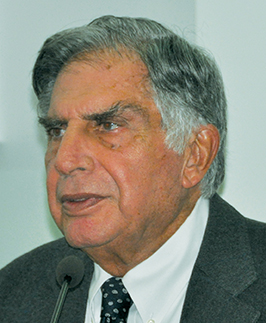
Ratan Tata
KRCOI president Muncherji Cama informed the audience that Jamsetji N. Tata purchased the plot on which the Cama Institute was constructed for Rs 50,000. Though the Sir Dorabji Tata Trust was offered Rs 5,00,000 for the land a few years later, the Trust sold the property to the Cama family for the same amount at which it had been purchased. While praising the contribution made by the Sett and Sethna family, Cama said: "Parsis tend to live in the past. The entire point of the volumes being released is not to look back on the past with nostalgia but to learn from it, to pull up your socks and do something.”
The history of the Sethna family was recorded in two volumes in Gujarati. These have now been translated into English and brought up-to-date courtesy Rustam Vakil, managing trustee of the F. H. B. Sethna Legacy Trust and the painstaking efforts of Dr Louiza Rodrigues and her team of researchers. Vakil mentioned that in addition to it being a record of the genealogy of the Sethna family it is also a historical account of public charity in the country.
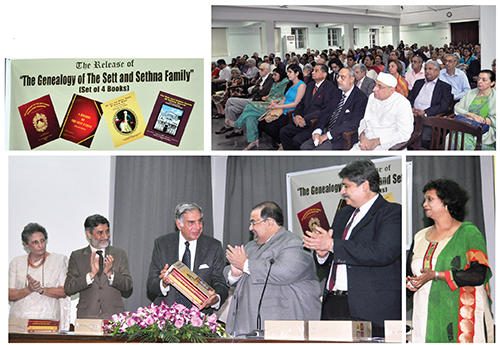
The books; audience; (above, l-r): Dr Nawaz Mody, Rustam Vakil, Tata,
Muncherji Cama, Noshir Dadrawala; Dr Louiza Rodrigues
"Philanthropy is linked to wealth and Zoroastrianism is one of the few religions where the creation of wealth is not looked down on as long as it is put to good use,” stated Noshir Dadrawala, chief executive officer of the Centre for Advancement of Philanthropy who spoke on "Institutional Philanthropy of the Sett and Sethna family of Rustom Maneck.”
When the armies of Shivaji ransacked Surat and took Parsis, Hindus and Muslims prisoners it was Rustomji Maneckji Sett who paid the ransom. When poor Parsi weavers could not pay a tax imposed on them, Maneckji paid on their behalf. When the Sett wadi was acquired by the government for the creation of the Sir Pherozeshah Mehta Road and Rs 11,00,000 was paid as compensation, the family used the amount to set up the Sett Polytechnic and to promote healthcare and education. Maneckji went to Aurangzeb to take up the case of the British ships which were not permitted to land in Surat, stated Dadrawala. When two of his sons were imprisoned, his youngest son, Naoroji, went to Britain to fight a suit against the British for unfairly maligning his brothers. The fact that he got a verdict in favor of his brothers reflects the impartial character of the British legal system where an individual could take on the mighty East India Company.
"The five virtues of Zoroastrianism are truthfulness, charity, skill, endeavor and encouragement to others to do good deeds,” said Dadrawala. "The best charity is to give without being asked, to give on time and to give it, if promised. Happiness comes to him who makes others happy.”
Rodrigues spoke warmly about the exhilarating and educative time she and her colleagues had researching this work. "What helped us most in our research was the Parsi virtue of not discarding anything.” She spoke about the contribution made by women like Navajbai and the evolving nature of philanthropy which moved from the religious to the secular over a period of time.
KRCOI joint honorary secretary Dr Nawaz Mody gave a vote of thanks while Cama voiced his appreciation for the dedicated and selfless work she has been performing over the years for the Institute.
◆ ◆ ◆
From the archive