
Cover Story
"Chronicles of achivement"
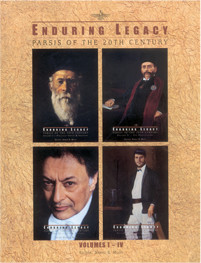
The four volumes of Enduring Legacy depict the preoccupation with excellence and understatement that marked the life of Parsi achievers of the 20th century
"I can say with all emphasis that it gives me great pride to belong to a community that’s so very small, which came as refugees and established itself so admirably in commerce, politics, science and medicine, without fan-fare, in so quiet a way.”
As he launched the four-volume Enduring Legacy edited and published by Dr Na-waz Mody, the proverbially quiet Ratan Tata, chairman of Tata Sons and head of House of Tatas, zoomed in on that aspect of the Parsi achievers of the 20th century which reflects his own preoccupation with excellence and understatement. They achieved all the great things documented by the book, he said, "very selflessly, in pursuit of excellence, in pursuit of beliefs they had, with no fanfare except what the world has given them.” He was happy that their achievements "have been chronicled in these beautiful books. This is a great contribution to the creation of archives of what Parsis have done.
"Many are not with us; many are here, in this room,” Tata continued, surveying the closely seated audience of achievers, all invited guests, gathered in the Rendezvous of the Taj Mahal Palace and Tower Hotel on January 17, 2006. He referred to them as "citizens of the world, citizens of India and members of this community…people who have done very very great things with no desire to be visible” in contrast to the "great visibility sought by (the generality of) people today.”
The four volumes totaling 1,168 pages divides the prolific achievements of the community in the 20th century under the heads of politics, trade and industry (in volume I), the professions including lawyers, doctors, administrators, police and the armed forces, scientists, journalists, educators, economists and social workers (volume II), the arts and culture including dramatists and cinematographers (volume III) and sports including cricket plus 180 pages of bibliography and index (volume IV).
The massive project which took nearly six years to complete was sparked by Dr P. C. Alexander, then governor of Maharashtra, as he launched Mody’s publication The Parsis of Western India: 1818 to 1920 on February 9, 1999. A set of 13 research papers presented at the seminar organized by the Sir Pherozeshah Mehta 150th Birth Anniversary Celebrations Committee and the Bombay University, The Parsis…won Alexander’s praise and the simultaneous injunction to Mody to proceed with a supplementary volume analyzing the community’s contribution from 1920 to 2000: "It is absolutely necessary that Tata, Godrej and other great champions of democracy” be documented. He wanted to see included the contributions of the great Parsi lawyers — "top names in the world of law (who) will not be forgotten while the rule of law exists” — surgeons and physicians. "Immediately start on this new project,” he directed Mody in his capacity as chancellor of the University.
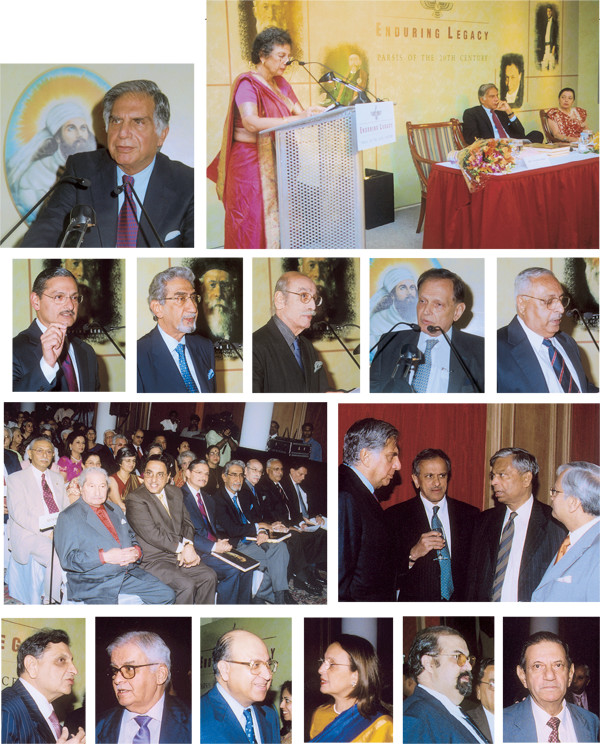
L to R (Top row) Ratan Tata; Nawaz Mody (speaking), Tata and Homai Modi; (2nd row) Cyrus Guzder, Iqbal Chagla, Jehangir Sabavala, Farokh Udwadia and Farokh Khodaiji; (3rd row) Burjor Poonawalla (ext L, 2nd row), Jamshed Guzder and Bahadur Mody (1st and 2nd from left, front row); Tata in conversation with Krishna Kumar and Syamal Gupta, directors, Tata Sons and Ravi Kant of Tata Motors; (4th row) Cyrus Poonawalla, Jamshed Irani, Farrokh Kavarana, Pheroza Godrej, Muncherji Cama and Jamsheed Kanga Photographs by Hoshi Patel
Accordingly a national seminar on "The contributions made by the Parsi community to India between 1920-2000” was held under the Committee and the University’s auspices where 28 papers were presented. However, these grew into 66 as Mody toiled on their publication, the project acquiring, as she said, "a life of its own.”
Narrating this story to the gathering, master of ceremonies Homai Modi spoke of the immense effort of the editor-publisher to authenticate details and seek illustrations (there are over 1,200 in toto), the enthusiasm and commitment that resulted in the coffee table presentability of these "monumental chronicles of achievement” in contrast to the modest 288-page earlier work. Mody’s sleepless nights of research were leavened by the joy of unearthing unexpected details, noted Modi.
All India Congress Committee president Sonia Gandhi’s message congratulated all those involved (in recording) "the many-splendored achievements of the Parsis…in inverse proportion to their numbers in national life.” Honoring their promise to be "the proverbial spoon of sugar in India’s cup of milk,” she noted that they have "shone in every field. Adding lustre to their achievements is their strong spirit of philanthropy and social activism.”
The message from maestro Zubin Mehta noted how enthralled he was to be included among the likes of Dadabhai Naoroji, the Tata dynasty and Homi Bhabha, "incredible pioneers like my father and families like the Jejeebhoys and the Wadias... I am most proud to be Indian, I never forget my Zoroastrian roots or its cuisine... its learning and magnanimous charity.”
Five members of the audience, outstanding achievers themselves, had agreed to read out chosen excerpts from the four volumes. To each of them Mody had allotted a five-minute time-limit. "To select from 100 and odd pages and read in five minutes was one of the more challenging things that I’ve had to face in my business career,” laughed AFL (Airfreight) chairman and managing director Cyrus Guzder. Noted counsel Iqbal Chagla said he "shared Cyrus’ dilemma” and spent half the afternoon with a stopwatch! The other readers were doyen of the medical fraternity Dr Farokh Udwadia, artist Jehangir Sabavala and former table tennis champion Farokh Khodaiji. We reproduce brief samples from their offerings.
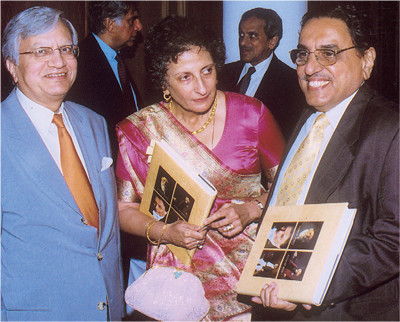
Ravi Kant (ext left), managing director of Tata Motors, with the Modys
Guzder chose excerpts from Arvind Mambro’s piece on Dadabhai Naoroji – the founding of the Rast Goftar with Kharshedji Nusserwanji Cama and Jamsheed Kanga’s contribution on Sir Dhanjishah B. Cooper who started the Satara Industrial Works to make agricultural implements for the farmers of the area and grew to make diesel engines but whose interest in the life of people around him led him into politics. He observed the harsh treatment meted out to dalits and arranged to save the future author of India’s constitution Babasaheb Ambedkar, for better things:
"When he realized that this promising young lad was unable to study owing to bad living conditions, Dhanjishah gave a small house which he owned in Sadarbazar, opposite the Parsi agiary, to Ambedkar’s father on a nominal rent. He also assisted him financially to enable Babasaheb to pursue his studies. This was truly an unusual gesture as dalits were not then considered capable of succeeding in higher education. Perhaps the initial confidence Dhanjishah showed in Babasaheb Ambedkar and the support he gave his family helped him achieve the eminence he got later on. Ambedkar reciprocated this gesture when later on Dhanjishah’s ministry was facing difficulty.” [Dhanjishah was asked by the governor of Bombay to form the government — known as the Interim Ministry — and became the first Prime Minister (chief minister) of Bombay Province on April 1, 1937. It lasted only three and a half months.]
Kali Mody and Alice Pastakia’s piece on Sir Homi Mody: "Mody’s style in the (Central Legislative) Assembly was summed up by Commerce in these words: ‘A well reasoned speech spiced with humor, which is his way of seasoning the unpalatable truth for the ignorant.’ Sir Homi Mody’s style, however, soon brought into currency new terms and phrases: ‘Homicide,’ Modyfication,’ Modyisms,’ ‘bon Homi’ and so on.” Post Independence, Jawaharlal Nehru asked Sir Homi to join the Lok Sabha explaining that "there would be a lot of frustration, irritation and anger and Sir Homi’s wit and humor would be required to diffuse the ugly situation.” Mody declined, offering the services of any of his three sons. "Panditji said, ‘But Sir Homi do they have your wit?’ Sir Homi replied, ‘Yes they do! One is a half wit, another is a dim wit and the third is a nitwit.’”
Sir Ardeshir Dalal, the first Indian municipal commissioner of Bombay, was fighting a war against malaria and it was recommended that the wells of Bombay be closed. "Many of Ardeshir’s critics advocated that well water was purer than the water from the lakes which was supplied by the municipality. Ardeshir countered this argument by simply submitting the results of chemical analyses of the samples of water drawn from the two most popular and important wells in Bombay – the High Court well and the Bhikha Behram well – which proved that the water was contaminated. Out of 110 wells analyzed, only 24 contained water that could be drunk with safety. The water of 67 was absolutely unfit for drinking. He concluded, ‘The water of the majority of wells of Bombay is impure and that of the best is not as pure as the Tansa water supplied by the municipality.’…He commissioned a survey to examine the feasibility of developing the Vaitarna River as a source of further supply for Bombay in spite of much opposition as the general feeling was that such a scheme was a waste of time.”
Chagla chose Fredun De-Vitre’s Eminent Lawyers: "Sir Jamshedji Kanga made a remarkable figure in Court, dressed as he always was in his white Parsi dasturji’s headgear…He set almost impossibly high standards of personal integrity and rectitude – of course, without any conscious attempt to do so; it was just all so natural for this great man. It was said of Sir Jamshedji that he entered the court first to tell the court the truth of the matter and only next to win his case if he could. His reputation for fairness in Court was almost legendary…He never ever spoke ill of anyone, and remained unspoilt by success; to the end, despite having scaled the heights, Sir Jamshedji remained endearingly modest, with the simplicity and candor of a child.”
Chagla’s second selection was from the speech by then attorney general Soli Sorabjee during a full court reference in memory of Nani Palkhivala: "For sheer advocacy Palkhivala was unsurpassable. Clarity of thought coupled with precision and elegance of expression, impassioned plea for the cause he espoused, excellent court craft and extraordinary ability to think on his legs rendered him an irresistible force…Another rare quality of Palkhivala was his humility and his natural modesty. Fame and fortune did not increase the hat size of the legendary Nani Palkhivala…He was tender towards the bashful, gentle towards the distant and merciful towards the absurd. Nani fulfilled, not substantially, but fully, Newman’s definition of a True Gentleman…”
Udwadia read excerpts from Dr Noshir Antia and Behman Daver’s contribution on the medical profession, specifically the items on ENT surgeon Dr Rustom Cooper and cardiologist Dr Rustom Jal Vakil. "(Vakil) was one of the first physicians to practice cardiology as a specialty…It was he who first used the extract of the indigenous plant Rauwolfia Serpentina for the treatment of high blood pressure, and he is internationally known for introducing the active ingredient, reserpine, to the western world. His fame was such that his name and his work are mentioned in the Ency-clopaedia Britannica… A couple of months before his death, the city of Bombay honored him by inaugurating The Rustom Jal Vakil Institute of Cardiology and Research at the K.E.M. Hospital.”
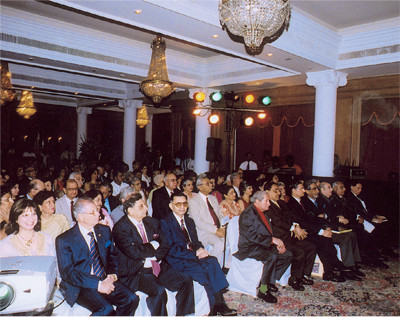
A section of the audience
The chapter on Dr Homi Bhabha by Jam-sheed Kanga was Ud-wadia’s second choice: "Homi worked in the Department of Physics (at the Indian Institute of Science) under Dr C. V. Ram-an, a great scientist and Nobel laureate who took a great liking to him and got him elected a Fellow of the Royal Society. Bhabha was elected as a Fellow in 1943 and later won the Adam’s Prize of the University of Cambridge for his work in Cosmic Rays. Raman introduced him at the national meeting of the Indian Academy in 1941 saying, ‘Bhabha is a great lover of music, a gifted artist, a brilliant engineer and an outstanding scientist. He is the modern equivalent of Leonardo da Vinci.’ His five-year stay at Bangalore was a very brief but important period in his scientific career. Prof M. G. K. Menon believes, ‘This was the period when he found his mission in life. He became aware of the role he could play in the development of India.’”
Sabavala read from Sohrab Modi – Historic Film-maker by Amrit Gangar: He "occupies a special place in the history of Indian cinema for his grand cinematographic creations and interpretations of the medieval and later history of India. It was not easy for him to make such films because they required long and arduous research and fat budgets…For Sikander (1941) Modi did a tremendous amount of research... Every alternate day the actors had to strip down to their underwear and stand on the weighing scales, closely scrutinized by the director. Then the cast was subjected to a strict regime of diet and exercises. Compared to the Hollywood films using multiple cameras for such films, Modi used only one single camera but achieved a remarkable cinematographic quality for the film. He achieved it through actual actions and operations on locations and partly on the editing table…”
From Novy Kapadia’s A Sporting Tradition Khodaiji read: "A perusal of historical documents and old newspapers reveals that in the 19th century and early decades of the 20th century every new kind of sport that took root in India, such as swimming, cycling, tennis, motor sports and flying, was eagerly taken up by the Parsi community. The eminent social historian Eckehard Kulke in his book The Parsees in India: A Minority as Agent of Social Change, aptly explains the reason for this. According to Kulke, ‘The Englishman’s enthusiasm for sports was fervently imitated by the Parsees.’ Sports was one more field of activity in which the process of assimilation of the Parsi community with the British took place…unimpeded by religious taboos and promoted by the enthusiastic and partially uncritical conviction that a new era had begun for the Parsis…”
The section on sports journalists begins with A. F. S. Taleyarkhan: "The greatest of them all was the incomparable, the late Ardeshir Faredoon Sorabji Taleyarkhan, popularly known as Bobby Taleyarkhan. For six decades the sun never set on Taleyarkhan’s sporting empire. His was the voice that launched cricket commentary on All India Radio…He was the first in India to start a separate sports page, with the full backing from his editor, the far-sighted Sadanand (of The Free Press Journal)... During the early phases of his career he campaigned vigorously against sports competition on a communal basis, like the Pentangular Cricket Tournament…and with his writings succeeded in getting such competitions discontinued…”
A "relieved and elated” Mody described her oeuvre as "a humble tribute to various great souls” and specifically the late great patriot Bhikhaiji Cama who "has inspired and guided me,” as she thanked various people beginning with Tata who "represents the quintessence of the legacy with his world vision, proactive views, global excellence, integrity and honesty.” Referring to the many who contributed to the book – some even from faraway Australia and Texas – Mody noted that some had passed away before the publication saw the light. Profusely thanking the four members of the Poonawalla family and the staff of Comart Lithographers "who brought out tattered pictures in the form you see,” Mody noted that the "production of the volumes changed because of Burjor Poonawalla…I owe so much to this technical team.” Designer Dhun Cordo, the Silverpoint Press who printed the volumes and Jenaz Printers who typeset the manuscripts received special mention as did Parsiana, a host of libraries, archives and personal collections from whom she has sourced her material. A special thanks was voiced to the many "sponsors who had faith in me and bought books in advance.” But it was friend and fellow secretary of the K. R. Cama Oriental Institute "Homai Modi’s inspiration that led to the presentation of the volumes in their present form,” while husband Bahadur "readily and gladly endured all the discomfort” entailed by the publishing process.
After the formalities were completed, eager readers browsed through copies of the four volumes of Enduring Legacy, priced for the occasion at Rs 4,400 (instead of its regular price of Rs 5,500) even as they partook of the conversations and cocktails that followed.
The book is available from various book sellers including Strand, the Parsiana Book Club and Jeroo Mango’s Danai book stores in the suburbs.
◆ ◆ ◆
From the archive