
History
A museum for Jamsetjee
The simple little house that witnessed Sir Jamsetjee Jejeebhoy’s birth is now a museum of uplifting memories
"A memorial for a great soul is not just built from granite, marble or bronze: it is built upon his accomplishments, his integrity, his kindness and his love.”
Rustom Jejeebhoy, the eighth Sir Jamsetjee Jejeebhoy, was speaking about his great forebear, Sir Jamsetjee Jejeebhoy (JJ), first baronet, as he welcomed a small but distinguished gathering to the inaugural of the Memorial Museum in Navsari’s Vatcha Mohalla on October 19, 2008. And it is nothing short of a miracle that this tiny, spartan house produced a man of such character and competence that from ignorance and penury he rose to rub shoulders with the high and mighty; to correspond with them on equal terms on matters of importance to his fellow citizens; to amass unbounden wealth and, unlike others who have done so too, spend it in such a way as to continue to hold the benchmark in social philanthropy 150 years after his death.
The simple house of wood and brick has endured to celebrate 225 years since Jamsetjee’s birth. But it has seen a sea change as restoration work under conservation architect Jamshid Bhiwandiwalla renewed and raised the timber roof, added a ventilator, replastered the walls for an optimum display of panels commemorating all that Jamsetjee did in his 76 years of life, introduced the spotlights to highlight the pictures, cutlery and glassware, models of medals and insignia that were so much a part of Indo-British society in the colonial era — exhibits provided by Jamsetjee’s faithful descendant to aid the work of curators Homai Modi, trustee secretary of the K. R. Cama Oriental Institute, and Dr Homi Dhalla, founder president of the World Zarathushti Cultural Foundation and dedicated representative of Zoroastrianism on various international interfaith bodies. While the original rough flooring of the structure has been purposely preserved, paint and polish have transformed the original bleakness into a proud period piece. Indeed, as per Bhiwandiwalla, the cost of restoration rose from the earlier estimate of seven lakh rupees to eight lakhs.
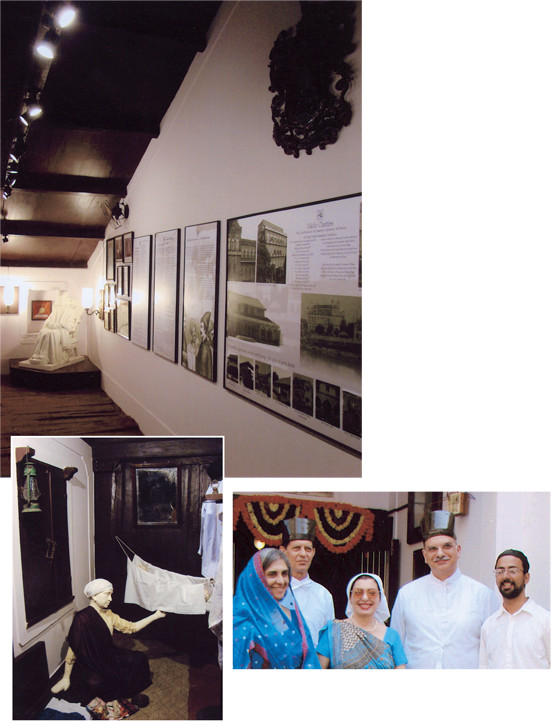
Top: an overview of the museum and (left) depicting his humble abode. Above (from left): Delara Jejeebhoy, Dr Homi Dhalla, Homai Modi, Rustom Jejeebhoy and Jamshid Bhiwandiwalla
An antique municipal plaque identifying the house as the birthplace of Jamsetjee remains intact over the front door. The platform of the tiny well, alas almost dry, at the entrance has now been merged with that of the house to present a distinct frontage. No major work had been undertaken on the structure for the past 80 years, as notes Bhiwandiwalla. There was only an asbestos roof and the plaster had fallen off the old walls. The long and narrow passage on the ground floor — barely eight to nine feet wide — now displays bilingual panels in English and Gujarati illustrated by paintings recounting how Jamsetjee’s life evolved. An old dilapidated loom that the team sourced from Tarapore and restored, adds to the ambiance as Jamsetjee’s father Jejeebhoy had been a weaver. In the minuscule bedroom is a mannequin representing his mother Jeevibai sitting by his string-strung, makeshift crib. An ancient wall cabinet and a tin trunk hold the family’s few possessions; a wooden stove in the little kitchen further down the passage and a few vessels denote their cooking apparatus.
The panels on the ground floor are devoted to the life of the man: starting with his birth and early years, how he left Navsari on foot to go to Bombay at the age of 16, after his parents died. Legend has it that a poor Parsi lady packed some food for the bereft teen to eat on his way. Fifty years later he returned to Navsari a very wealthy man, located the lady and showered her with gifts. His five trips to China, the great fire of 1803 that gutted the entire Fort area, destroying more than a thousand houses, bazaars, godowns, and much else devastated half his hard-earned wealth barely 12 days before his marriage to Avabai, a union that endured for 56 years and was blessed with seven sons and three daughters of whom only three sons and one daughter survived to maturity. The spot where the fire had started was later chosen by Jamsetjee to build the Sir Jamsetjee Jejeebhoy Parsee Benevolent Institution.
Jamsetjee had started out as his uncle Framji Batliwala’s apprentice in the business of selling glass bottles, then made the first trip to China as his cousin Tabak’s accountant. But the second time around he had invested Rs 40,000 taken as a business loan and traveled as his uncle’s partner. The partnership endured until his uncle’s death after which he inducted two new partners in his new firm, Jamsetjee Jejeebhoy and Company — Motichand Amichand and Mohamedali Rogay — an early mark of the cosmopolitan predilection that was the hallmark of his societal concerns. He renamed the concern Jamsetjee Jejeebhoy Sons and Company when his sons joined the firm later, as partners. Jamsetjee’s adventures on the high seas as French and British rivalry led to battles, imprisonment, commercial loss as also his links with William Jardine and James Matheison and the resulting profitable opium trade have all been recounted.
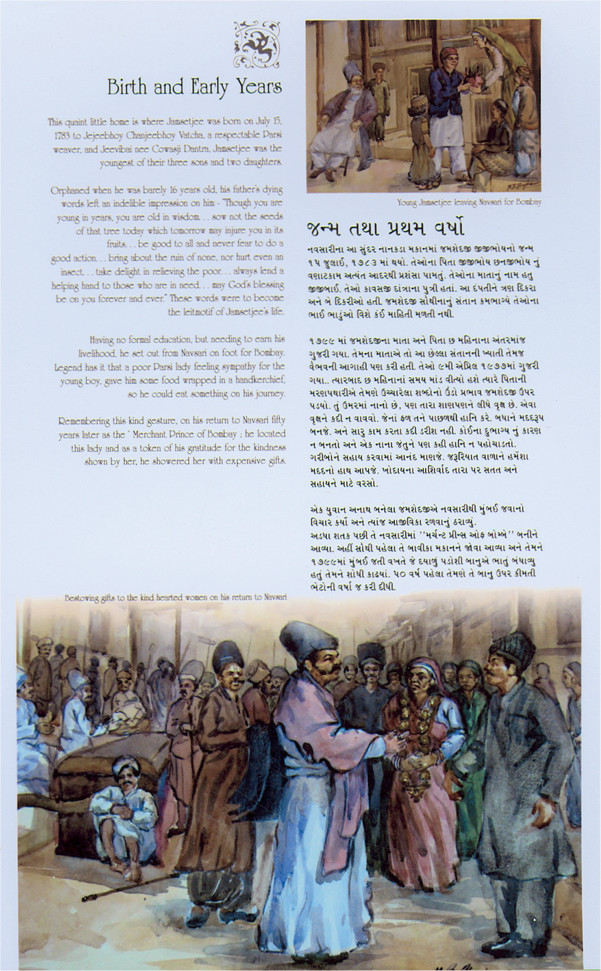
Bilingual panel offers insight into Jamsetjee Jejeebhoy's life
His personal involvement in the social issues of the time included 36 years as trustee of the Bombay Parsi Punchayet (BPP), as Justice of the Peace and one of the first Indian jurors, as a member of the Harbour Committee as the Port Trust was then known, as honorary president of The Bombay Association, a body formed under the chairmanship of Jagannath Shankerseth to lay the grievances of the people before the British rulers…He was appointed one of the first five Indian Fellows of the University of Bombay.
Jamsetjee’s voluminous public charities earned him governmental recognition initially as Knight and later as Baronet as also the Freedom of the City of London — each honor being the first ever conferred by the British government on an Indian subject. So great was the popularity and respect in which he was held that a statue was commissioned from public subscription, sculpted in London and installed at the Royal Asiatic Society when it arrived in Bombay, sadly a little after he had passed away. On the day of his death Bombay came to a standstill, flags flew at half-mast and Lord Elphinstone, the governor of Bombay, visited the Jejeebhoy residence to pay his last respects before the cortege wended its way to Doongerwadi followed by thousands of mourners.
If the well chosen words on nine panels on the museum’s ground floor by Jejeebhoy and Modi depict how JJ created his wealth and amassed the recognition and respect that he did, the display in what had been the attic, above, highlight this great man’s infinite concerns and their relevance even today. Starting as patron of education with the establishment of 19 schools in Bombay and Gujarat under his Sir J. J. Parsi Benevolent Institution in 1849, the patriarch overruled his trustees to ensure that initially two of them in Bombay were opened for girls in 1850. His daughter Pirojbai was one of the first Parsi women to speak English.
He pioneered freedom for women when Lady Jejeebhoy and his daughters-in-law were presented to the governor Sir James Rivett-Carnac at the banquet he hosted to celebrate the marriage of Queen Victoria in 1840 — a defining moment as well born Indian women had not hitherto been permitted to venture into public functions in the presence of men of other communities. "This landmark event took place when Dadabhai Naoroji was nine, Sorabji Bengallee was nine and Behramji Malbari was not even born. It is pertinent to note that the latter three were some of the most prominent social reformers of India,” states Dhalla, who has curated the display on the upper level, in the panel relating to JJ’s involvement with female education.
As benefactor of journalism Jamsetjee donated handsomely to the founding of The Bombay Samachar and the Jam-e-Jamshed and was one of a syndicate that launched the Bombay Times in 1838 which, in 1861 was renamed The Times of India. His secular credentials were further bolstered as he donated to a variety of causes in India and abroad including the Irish Famine, floods in France, the victims of the Crimean War as well as the victims of fires in Bombay and Surat. The establishment of the Sir J. J. Hospital, Bombay’s first civil hospital, its first School of Art, wells, roads including the Mahim Causeway named after Lady Avabai Jejeebhoy, the Bund and waterworks in Poona, dharamshalas, agiaries, a home for the destitute known as the Sir J. J. Dharamshala and the Panjrapol — the one of its kind home for homeless animals founded together with others — are but some of his many endowments.
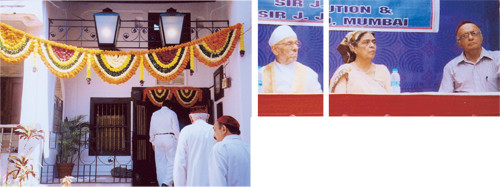
Left: Entrance to the new museum. Above (from left) Dastur Meherji Meherjirana, and his wife Mehroo and Homi Mehta
And while he pursued his commercial interests, his spirit of integrity and transparency earning him the sobriquet "The Merchant Prince,” he hosted banquets and balls, introduced the use of ice and served icecream for the first time, sought a say for Indians in the governance of their land in letters written in an impeccable hand and a courtly turn of phrase. The man who self-educated himself under a street lamp had come a long way.
The idea of creating a museum in the old home had occurred to the Jejeebhoy family "many years ago. My father used to think of it even when people resided there. Ever since I was a child, whenever we visited Navsari, we would go to the house,” recalls Rustom Jejeebhoy adding that the Solainas, a Parsi family of restricted means, lived there. "Their only responsibility was to keep the house clean and light the diva,” says Jejeebhoy. Years later he learnt from their son that the old couple had moved to Bombay and was ready to give up the place, asking only that their furniture be looked after, a responsibility Jejeebhoy undertook. That’s when the museum idea took root.
"There was not much material for the museum. It’s 150 years since he died and the family tree has spread so far. Whatever my father had was destroyed in the fire at White House (a building behind the Taj Mahal Hotel where Hotel Diplomat now stands),” says Jejeebhoy. In 1843 JJ had been presented a diamond studded gold medal bearing Queen Victoria’s portrait on one side and on the reverse the inscription, "Sir Jamsetjee Jejeebhoy, Knight. From the British Government in honour of his munificence and patriotism.” A replica of it is seen in the Museum but Jejeebhoy has no idea what became of it. The replica has been recreated from his statue, he tells us. Even the Kholasa-e-Punchayet, the Gujarati tract that JJ is said to have authored describing how he found the functioning of the BPP, is unavailable.
Jejeebhoy’s primary target comprised the students from the various JJ schools who needed to be educated in all that the founder stood for. Hence the short, succinct write-ups were translated into Gujarati by Sudha Mehta, a government approved translator from Ahmedabad, as noted Bhiwandiwalla. And, to maintain the interest of school children, the words are accompanied by old photographs and illustrations created by students of the Sir J. J. School of Art. "When the School celebrated JJ’s 225th anniversary, Mr Sable, head of the department of painting and fine arts, spoke to the students about 19th century Bombay. He organized a competition and identified four people to contribute 18-19 illustrations over three months after they were briefed at the K. R. Cama Oriental Institute,” says Bhiwandiwalla who functioned as the coordinator. "The paintings, all watercolors, were then computer scanned and digitally scaled to size.” The family crest was recreated in fiberglass with a bronze finish and the fiberglass copy of JJ’s statue was made by Behram Pochkhanawalla.
Modi, Dhalla, Bhiwandiwalla and Pochkhanawalla had worked as a team to create the Zoroastrian Information Centre (ZIC) at Udvada at the behest of the Foundation for the Development of Udvada and its financiers — the government of India and the government of Gujarat. The section there on Parsi stalwarts depicts the contribution of Sir Jamsetjee Jejeebhoy and hence entailed the involvement of the current baronet. Pleased by the end product he witnessed, Jejeebhoy invited Dhalla and the team to curate the Navsari project. It entailed innumerable trips to Navsari and took a year-and-a-half to complete, as noted Modi. Originally the inauguration was planned for June 2008, but fear of the rain led to its postponement to October.
"Such places should be encouraged and promoted. The community has not done much for culture,” avers Dhalla, noting that its top priorities are education, housing and medical relief, after that apathy takes over. "These places are becoming centers of learning,” claims Bhiwandiwalla citing the visitors’ book at the ZIC which is "full of positive responses. Hotel owners say people go again and again. People sit and copy the text!”
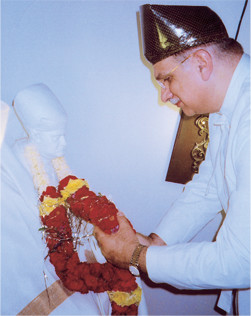
Rustom Jejeebhoy garlanding a statue of the first baronet
The Jejeebhoy scion believes that "actions are more important than family mystique” as defined by "what you can do, what you can achieve and what you leave behind,” though the availability of opportunity is important. "The Hospital and the School of Art are outside our purview now, though they try to stay connected and call us when there is a function.” In celebration of JJ’s 225th birth anniversary last July the Sir Jamsetjee Jejeebhoy Charity Fund undertook to refurbish the larger than life statue of the founder in the J. J. Hospital. The pedestal and surrounding area was renewed in marble. In connection with a heritage bus tour covering all the institutions with which JJ was connected (scheduled for February 21 and March 7, 2009) which Jejeebhoy was organizing, he said he went to the dean of the Hospital for permission to bring 60-70 people. He found the edges of the new marble base shattered. "The dean was very apologetic. He said people break coconuts; they shower the coconut water on the statue and garland it. People do not know his story apart from being the founder of the Hospital. But there is obvious devotion,” Jejeebhoy shares the experience.
We request him to relate the family legends surrounding his ancestor. He has one story to tell: In his early, bottle-selling days, Jamsetjee was resting one afternoon when a passing fakir saw the soles of his feet. Reading the markings, he predicted great things. JJ promised that if his predictions came to pass, he would build a special building in the name of the fakir. "He built two,” Jejeebhoy tells us. "Alahibaug in Surat where 20 Parsi families reside and another of the same name at the corner of Bombay’s Abdul Rehman Street and Yusuf Mehralli Road which is now a commercial building. Both buildings are part of the J. J. Trust properties.”
With Sir Jamsetjee’s 150th death anniversary on April 15, 2009 Jejeebhoy says he is planning a special event at the Convocation Hall where former President of India Dr Abdul Kalam is scheduled to preside. Scholar and historian Dr Asiya Siddiqi who has been studying JJ’s diaries in the Bombay University Library will give the keynote address to the specially invited audience including representatives from all the different institutions with which JJ had been connected, including the Bombay University and the Asiatic Society. New facets of this phenomenal personality are bound to emerge.
◆ ◆ ◆
From the archive