
Business
Badshah of Biryani
The popularity of biryani in Madras ensured clientele for Mahiar and Zavera Shroff’s business
Biryani and its origins have a history as varied and controversial as it can get. Some believe that the Mongolian ruler Tamerlane the Terrible (Taimur) brought the dish to India in 1394. Another interesting story is that Mumtaz Mahal, the Mughal empress, made a surprise visit to the army barracks and found that the soldiers were undernourished. She reprimanded the army cooks and asked them to make a nourishing and tasty dish of meat, rice, spices and ghee for the men. Yet others say biryani originated in West Asia. The nomads would bury an earthen pot of meat, rice and condiments in a smouldering pit and cover it. When they returned after a day’s herding or hunting, dinner was ready! And then there is the theory (I have a strange suspicion that it originated at the Bombay Parsi Punchayet) that the biryani came from Persia because ‘birian’ is the Farsi word for rice!
Be that as it may, on a recent visit to Madras we met Mahiar Shroff who had earlier worked in the sales department of the Empress Mills in Nagpur, Jamsetji Tata’s flagship industry. In the course of conversation with him we came to know that Mahiar, 57, has cooked up a storm in Madras, where he is known as the Badshah of Biryani. From bales of cloth, to bowls of biryani? It seemed to be an unlikely connection. But that is what life is all about. Twists and turns do result in unlikely connections!
Over a delectable lunch with Mahiar whom we knew, and his wife Zavera, 52, who we were meeting for the first time, the amazing story of "Delkhush Delicacies” unfolded. Named after their two daughters, Khushnum and Delshad, "Delkhush Delicacies,” has been operating from No. 15, Arathoon Road, Madras, since 1998. Tel: 044-25956841; 09840112137.
Be that as it may, on a recent visit to Madras we met Mahiar Shroff who had earlier worked in the sales department of the Empress Mills in Nagpur, Jamsetji Tata’s flagship industry. In the course of conversation with him we came to know that Mahiar, 57, has cooked up a storm in Madras, where he is known as the Badshah of Biryani. From bales of cloth, to bowls of biryani? It seemed to be an unlikely connection. But that is what life is all about. Twists and turns do result in unlikely connections!
Over a delectable lunch with Mahiar whom we knew, and his wife Zavera, 52, who we were meeting for the first time, the amazing story of "Delkhush Delicacies” unfolded. Named after their two daughters, Khushnum and Delshad, "Delkhush Delicacies,” has been operating from No. 15, Arathoon Road, Madras, since 1998. Tel: 044-25956841; 09840112137.
In the mid 1980s Mahiar, hailing from Nagpur, was posted in Madras. He was on cue when he befriended Jamshed Cawas Patel while playing snooker in the evenings. That is how he met and married Zavera, Patel’s daughter. During his heady and happy courting days, the axe fell, not on Mahiar’s head but on his wallet. The Empress Mills, beset by losses and labor problems since the past many years, closed its doors in 1986, rendering hundreds of people jobless. With nary a fear of how he would support a family, Mahiar married Zavera in 1987.
With the confidence of youth and the notion that he knew the ins and outs of the textile trade, he started the retail selling of cloth. But, he candidly admits, "I failed miserably.” He discovered with dismay that dealing with wholesalers on behalf of a big company was totally different from trying to get money out of retail traders. "I tried honestly and hard,” he says. "I was gullible enough to fulfil large orders on credit. But I only got sucked deeper into debt,” he rues.
To cut his losses, which had already run into lakhs of rupees, he closed his retail cloth business. The family went through hard times for a while.
Around this time a lady cook, Ayamma by name, came into their employ. "From day one, she was a great cook,” enthuses Mahiar. "Her gravy cutlets are the best in the world!” Driven by debt and despair and encouraged by Ayamma’s expertise in the kitchen, the Shroffs had a "Eureka!” moment and decided there was no business as fail proof as good food. That is how the biryani business was born in 1998. From then on it has been hard work, but no looking back.
The menu is limited, with biryani as the main attraction. Pepper Chicken, Chicken 65, Tomato Gravy Cutlets and Double-ka-Meetha are their other specialities.
"Biryani is very popular in Madras and there are many people who make it,” Mahiar informs us, "but we have an edge over the others because of our home delivery service and the quality of our food. All the spices we use are ground at home. Our prices are very competitive because we have no shop, no hoardings and no advertising budget.” Advertising by word of mouth and orders over the phone bring them more business than they can cope with.
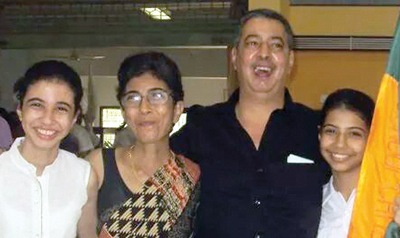
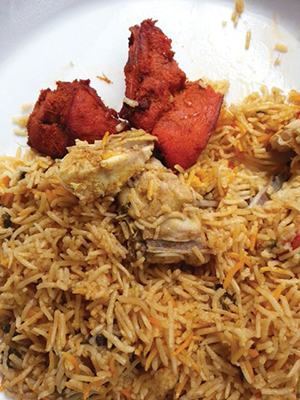
(L-R) Khushnum, Zavera, Mahiar and Delshad Shroff; (top) their biryani
"While the quality of rice, meat, ghee and spices can make or mar a biryani, the real secret of an aromatic and irresistible biryani lies in cooking it on the embers of a slow wood fire, over a long period of time, without stirring it. It is called dum pukht cooking.” Mahiar admits to leaning heavily on the late Bhikoo Manekshaw’s recipes with their own personal touch added.
Zavera does less of the talking, but a lot of her hard work has gone into making Delkhush Delicacies a success. She goes to the market to buy the vegetables as early as five in the morning. Mahiar shops for the mutton and chicken. They have a Muslim masterchef to do the cooking. He is assisted by Ayamma, their personal cook, and a dedicated group of helpers. Zavera’s eagle eye and Mahiar’s supervision completes the workforce.
Mutton biryani ranges in price depending upon the amount of meat used. One can order a biryani using one kilo of mutton to one kilo of rice (Rs 1,000); better still is 1¼ kg mutton to one kilo rice or best of all 1½ kg mutton to one kilo of rice (Rs 1,300). On an average, 12 people can eat from a kilo of biryani.
Their clientele includes the rich and the famous. They have catered to political bigwigs like Dayanidhi Maran and Kalanidhi Maran, Southern cine stars Shivaji Ganesan and Khushboo, the British Deputy High Commission in Madras, the Reserve Bank of India (at least two farewell parties a month for retiring officers), Stanley Hospital staff dinners and the Pentecostal and Zion Church Christmas parties. One church has been giving them the Christmas order for 750 kgs of biryani since the past 10 years! This speaks volumes of the loyalty and satisfaction of customers and the excellence and business ethics of the supplier. Very recently, a Parsi friend of theirs, Murad Shahuna has taken a franchise of selling the biryani, under the name "Fillbelly.”
Zavera is also the efficient manager of the Madras Parsi Dharamshala, looking after the adjoining aramgah and garden as well. The trustees of the Dharamshala have been very kind in allowing the Shroffs use of the open area at the back for the wood fires needed for cooking the biryani and other food items connected with their business.
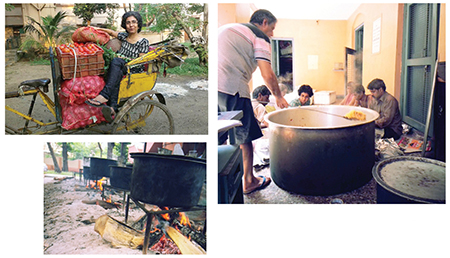
(Clockwise from top left): Zavera returning from bazar; supervising the kitchen
with Mahiar; biryani slow cooking over wood fires
Spending time with friends from Nagpur is always a pleasure for this writer. But this afternoon was made more ‘full-filling’ by the sumptuous lunch of pepper chicken, mutton biryani and the rich double-ka-meetha dessert. We were intrigued by the name till Zavera told us it is made of double-roti (bread). The plebian double-roti undergoes a delicious transformation as it blends and simmers with khoya (milk solids), butter and dry fruits. Rich and brown, it would put any French soufflé in the shade.
There is much more to Mahiar’s life story than being the Badshah of Biryani. He is a deeply religious Zoroastrian with a strong belief in the power of prayer. "I was secretary of the Madras Parsi Anjuman for 12 years. If I had to sweep and swab the agiary, I would even do that happily,” he avers. "Our prayers, if said with faith, full concentration and the correct pronunciation, can cure illness and set right many a wrong,” Mahiar claims with deep conviction. "Just the Ashem Vohu preceded by Khshnaothra Ahurahe Mazdao is a powerful weapon but even better is the Ardibehesht Yasht ni Nirang.” Mahiar claims he has cured many friends of their ailments, provided they had faith in prayer. "It was not this way always,” he muses. "I have developed this deep faith in prayer and the power of healing after my marriage.”
Twenty-six-year-old Khushnum, is studying Company Secretaryship (ACS) at the Institute of Company Secretaries of India in Madras, while Delshad, 20, is in Abu Dhabi studying Clinical Psychology at NYU.
Knowing the Shroffs has swept away any feeling of diminishing faith in our religion or lack of vigor in the spirit of entrepreneurship among youngsters. People like them have the makings of the Godrejs and Wadias of the new generation.
Jiyo Parsi!
◆ ◆ ◆
From the archive