
Travel
In the heartland of tribal Orissa
A rural guest house offers the timeless enchantment of unpolluted village life
Goudaguda. No, it is not a gourmet cheese. It is the destination we are driving to — a farming and pottery village in the Koraput district of Orissa.
We alighted at the Rayagada Railway Station late the previous day and spent the night at the Sai International Hotel, a five-minute drive from the station.
The next morning, refreshed, bathed and breakfasted, we left by road for Chandoori Sai, in the heart of tribal Orissa. The gently rolling hills and forests that accompanied us on the way made for a very pleasant drive. "Barish ké shuruat méin sabsé achha time hai, yehaan aané ka (the beginning of the monsoon is the best time to visit),” our driver informed us. The locals speak Oriya (which sounds a lot like Bengali), along with a smattering of Hindi and English.
The more we heard and saw of Orissa, the more favorably inclined we felt towards the ruling Naveen Patnaik government. Good roads in most parts, lush green paddy fields juxtaposed against the brick-red earth, rich with bauxite and iron ore and conversation with the locals of the large, well managed public sector units like NALCO (National Aluminum Corporation) and HAL (Hindustan Aeronautics Limited) were impressive.
We alighted at the Rayagada Railway Station late the previous day and spent the night at the Sai International Hotel, a five-minute drive from the station.
The next morning, refreshed, bathed and breakfasted, we left by road for Chandoori Sai, in the heart of tribal Orissa. The gently rolling hills and forests that accompanied us on the way made for a very pleasant drive. "Barish ké shuruat méin sabsé achha time hai, yehaan aané ka (the beginning of the monsoon is the best time to visit),” our driver informed us. The locals speak Oriya (which sounds a lot like Bengali), along with a smattering of Hindi and English.
The more we heard and saw of Orissa, the more favorably inclined we felt towards the ruling Naveen Patnaik government. Good roads in most parts, lush green paddy fields juxtaposed against the brick-red earth, rich with bauxite and iron ore and conversation with the locals of the large, well managed public sector units like NALCO (National Aluminum Corporation) and HAL (Hindustan Aeronautics Limited) were impressive.
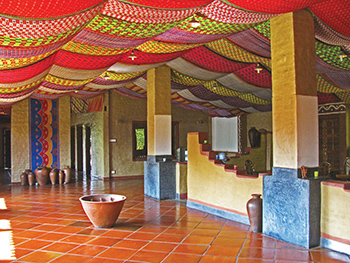
Main room at Chandoori Sai
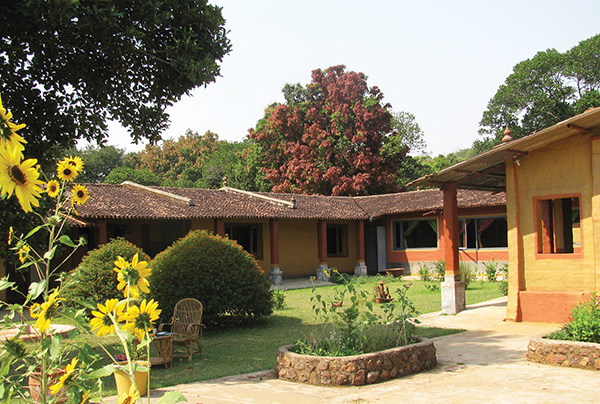
Center court of guest house
In less than two hours we were at Kakirguma, 10 minutes from Goudaguda. It was a Monday and the weekly market day. The crowds, the color and the cacophony made it impossible for us not to stop and visit the market. "Everything looks greener on the other side of the fence” is an age old saying but I have never found it to be truer. The brinjals were a deeper purple, the tomatoes a feisty red and the chilies an envious green and, of course, mostly organic. In one section the powerful smell of dried fish brought up from the fishing villages on the coast filled the air. Other than vegetables and produce, a part of the market was stashed with earthenware pots, kundis (flowerpots) and khullars (drinking cups). Another part had percussion instruments like the dhol and the dafli made by the villagers. Show any interest and they will immediately put up a two-minute recital for you. Very effective, because we ended up buying a dafli which is a flat, round drum made of cured goat skin stretched over a frame. Not to forget the sari stalls, a smorgasbord of colors and designs, none costing more than a few hundred rupees.
The tribal women with their flawless, dark, glistening skins, an array of nose rings, and ornaments around their neck and hair, looked beautiful. Laden with their weekly purchases, the villagers happily climb into waiting utility vans and jeep taxis. Women, children, poultry and vegetable bags crushed inside; men and boys on top, almost falling over the sides of the vehicle swaying in unison as it negotiates the roads. No one seems to mind and rooftop is the preferred seating.
Thirty minutes later, we reluctantly tear ourselves away from this colorful canvas to drive the last few kilometers to Chandoori Sai, the guest house where we are to stay. Driving through the village we pass a temple and a school; we see erect and graceful tribal women walking past with water pots on their heads and children playing with sticks and stones. After a last bump and heave over an open, flowing nullah (water channel), the car draws up at a closed gate. There is no gatepost or nameplate to announce where we are. But the green lawns and clumps of bright red Easter lilies tell us that we have reached a place that is cared for with love; the place we have heard so much about from our son who discovered it on the internet.
The beauty of this guest house is its reticence. It doesn’t announce its existence loudly. If the discerning tourist finds it, that’s great. If not, it is his loss. Leon Mahoney, fiftyish, who owns and runs the place, does not go out of his way to invite or entice the wrong guests. The place is in complete sync with nature in the materials used to build it and in its simplicity and style, with no compromise on comfort, convenience or cleanliness.
A clutch of local Paraja and Kondh tribal men and women under Mahoney’s supervision built Chandoori Sai from the bare earth up and now help run it with quiet efficiency. The place gives one a feel and a glimpse of village life, which even today is just a whisper away from what it was 100 years ago. The people one meets are simple and at ease with themselves. Their lifestyle is physically hard but otherwise relaxed.
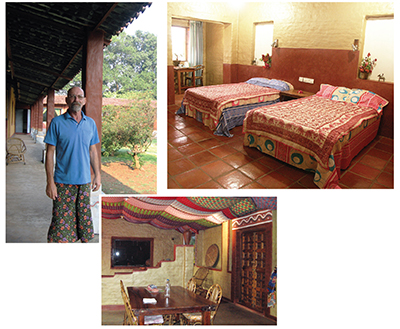
Center court of guest house
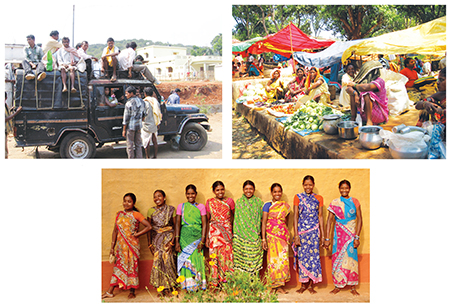
(Left): Utility vans; weekly market; tribal women of Goudaguda
‘Chandoori’ is the local name of the big mango tree at the end of the sprawling garden while ‘Sai’ is the Paraja word for the small avenues of houses that they live in. Chandoori Sai, the guest house, takes its unique name from both.
Mahoney, "of Irish descent as you can tell from my last name,” is from Australia. "In my previous life I worked in an oil refinery for Mobil Oil in Adelaide.” When probed on what brought him to India and kept him here, he responded, "It was the vibrancy and color of life in India compared to the order, the lack of options in, and the predictability of life in Australia that drew me, and now my Indian family keeps me here. Life in India keeps surprising and will keep me guessing till my last moments.”
From 2005 to 2009 he spent all his time, money, energy and ingenuity in building Chandoori Sai. A lot of thought and precision has gone into every aspect of realizing this vision. Thousands of terracotta floor tiles were hand made under his direction by the local potters. The walls are plastered with dung and earth then colored with the natural ochers traditionally used on the village dwellings. The lounge and dining area are bright and beautiful with a medley of colorful tribal saris forming an overhead canopy and ending as window drapes.
"How did the villagers take to you and you to them?” I asked with interest.
"Some curiosity and a little fear at first on both sides, but mostly friendly acceptance,” he replied. "I created a lot of employment, which they soon came to appreciate.”
Our rooms at Chandoori Sai were large, cool and comfortable. The attached bathrooms had everything one wanted. But no TV, no phone, no WiFi connection. Only the sound of birds and of wind chimes in the breeze while immersed in the pleasure of books one long wanted to read. And the locals to talk with.
In contrast to the simplicity of the rooms, the kitchen is very well equipped with the latest in baking, cooking and storing facilities. Every meal was a home cooked delight. Each time we came back from a walk in the village or a drive somewhere, we were greeted by one of the tribal women with "chai, coffee or lime juice, what would madam like to have?” Fresh, home baked cookies were another delight. Mahoney works in the kitchen with the women, and any guests who want to join the fun are more than welcome. The large clay oven (chula) built by the ladies, produced excellent pizzas, pies and crusty fresh bread, among other things.
The guests at Chandoori Sai are largely female, in the 60-70 year age group and mostly French/Belgian, Italian and British travelling in small groups, pairs and sometimes solo. "It is rural and tribal tourism.” Seeing the way they live, visiting the potter’s village and going to the weekly markets are great experiences for them. "Some of those who come sit with the potters, either teaching them or learning from them,” Mahoney told us. More recently, Indian families from Visakhapatam have started to come here to escape the stress and heat of city life and to give their children a glimpse of a different, pollution free world. The Indian guests are keen to know why Mahoney left his home and why he has settled down so far away. "Going from a lifetime of cities getting bigger and madder by the day to the timeless enchantment of unpolluted village life, working with a purpose, among these gentle and hardworking people is the preferred route at this stage of my life.”
When asked, "What religion do you follow?” he answers, while spreading his arms to embrace the landscape, "This is my temple and you, you and you are my Gods.”
We were one happy family that left Chandoori Sai with a promise to return one day.
The guest house is in the highlands of the Eastern Ghats at an elevation of 930 m. It lies 200 km from Visakhapatam easily accessed by two rail and three road (all are very scenic) routes, 500 km from Bhubaneswar by overnight train to Kakiriguma. High season tariff is Rs 5,000 for a double room; Rs 3,500 for a single one, fully inclusive of all meals and taxes. Off season (April-August) the rate is discounted. Monsoon is the best time to visit. Mahoney may be contacted by email at: leon@chandoorisai.com, tel: (0) 9443342241; website: www.chandoorisai.com
◆ ◆ ◆
From the archive