
Food
Biryani in Beijing
Beijing’s The Taj Pavilion restaurants offer mainly Moghlai cuisine along with regional fare from Bengal, Goa, Gujarat, Hyderabad, north and south India
Considering the few choices of foreign food restaurants in Beijing, China when I first arrived in 1991, I thought it would be a good idea to have another Indian restaurant even though language was a major constraint then and the number of foreigners was not much. Over a period of time it was noticeable that the country was on a major upswing and the economy was improving at a very fast pace. The clientele at our restaurant, The Taj Pavilion, was mainly foreigners. The Indians who used our restaurant were those based in Beijing and others who came for tourism or business reasons.
Our first restaurant admeasured 198 sq m. Now we have three Taj Pavilions, each manned by one manager and three Indian chefs (totally 12 expatriates) and a local staff of 26. Since the most authentic food is produced by the local hands from the motherland itself you need to get in good, well experienced chefs from India. We offer mainly Indian Moghlai cuisine with a melee of different regional foods from India like North Indian, South Indian, Bengali, Gujarati, Goan, Hyderabadi.
Indian food is getting a wrong reputation of being spicy in terms of pungent and burning-the-tongue type. When we use the term spicy it actually means the many different kinds of spices that go into each preparation. Certain preparations like Madrasi dishes or vindaloos are spicy and if a guest orders them we do not cut down on the chillies. Also we do not cut down on any spices so as to cater for a foreign clientele. We maintain all preparations as they would be served in India so as to keep the authentic flavor. Lately there is a trend towards more vegetables, especially the green types which are preferred. Among the locals in China, non-vegetarian food continues to be more popular.
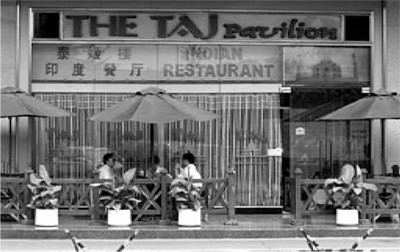
Indian presence in China: The Taj Pavilion in Beijing
Normally a whole meal for a group of eight-10 can be prepared within 15-20 minutes. As a thumb rule we hope to serve all our guests with starters at the table within the first five-10 minutes. The mains would normally reach the table within 15 minutes. As per our philosophy starters should be just a filler in terms of the time required between ordering and serving the main course so that the guest does not get impatient while waiting for the main meal. Two starters for a table of four people would be the best option under normal circumstances. It’s in the hands of the maitre d’hotel (who takes orders) to guide the guest in not over ordering the starters.
When we first started in China we would recommend Hara Bhara Kebab (a mixture of finely chopped veggies and spinach rounded, flattened and deep fried) as starters to many guests, but somehow it would not get ordered. On the next edition of our menu we retained the same starter and after the explanation added "packed with vitamins.” It was an immediate success... everyone started ordering it. This taught us the importance of presentation and marketing strategy. Samosas though continue to be the most popular starters as they are world renowned.
To keep the meal traditional we recommend lassi (buttermilk) mainly the mango lassi. We also serve sweet, salted or plain lassi. Lassi can help in cooling the tongue if the food ends up too spicy. We also recommend Kingfisher beer with the meal and finally the masala chai (tea). During summer kulfi is a very popular dessert whereas the gulab jamun and gajjar halwa are the traditional desserts in demand.
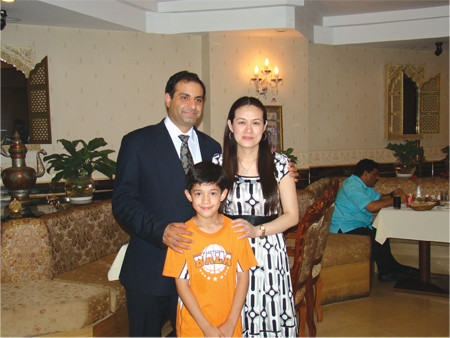
The Pastakia family: Mehernosh and Zheng Xiao Wen with son Kershasp (Kersi)
Costing plays an important role when offering a foreign cuisine in a foreign land. The restaurant needs to be visible in a good prominent location which would not come cheap. Getting the right Indian touch without overdoing the decor is equally important. Our locations are in areas where the rentals are exorbitant, hence optimum usage of space is necessary.
The designing of a restaurant is very important. Our restaurants have been designed by a well known Parsi designer, Jimmy Doctor of JFD Designs, Singapore (jayefdee@singnet.com.sg, tel mobile: +65 94565244, tel off: +65 63231792). Even at the age of 75 he personally visits us in Beijing for three-four days and helps in choosing the color combinations for the wallpaper, upholstery, furniture, etc. Because the restaurant is in a foreign land people tend to put in a lot of Indian artifacts and decorative items, making it look too cluttered and garish. Doctor gives the decor just the right Indian touch. Thanks to this perfection in designing we get innumerable compliments on the decor of our restaurants by international travellers who compare them with other Indian restaurants in different parts of the world.
In the first six to 12 months extensive advertising targeted at the right segment of your market is very necessary. After that initial period, advertising helps but the best advert is by word-of-mouth so give more attention to the quality and high standards of service. Each client or guest is different from the others. Also, tastes always differ. So make sure that all tastes or feelings are catered to when building up your clientele.
Running an Indian restaurant in China is not so easy considering the language difference between the workers of two nationalities and the logistics of maintaining stocks of food items imported from India. It is very important to maintain a par stock of at least three months which is approximately the time required to bring in the required ingredients. We import all the Indian spices, the basmati rice and dals from India directly once a year; in between if we expect to run out of a few things we import them from Hongkong which stocks almost all ingredients but at a higher cost compared to India.
Knowledge of the industry can be gained from the innumerable colleges and institutes that specialize in hotel management. Long-standing, good, reputed colleges are best. Institutes do prepare you for the field but the actual work exposure is again a totally different ball game. Whilst studying, if there are vacation jobs available, avail of the offer to get the maximum amount of knowledge. In fact if one has made up one’s mind to join this industry then one should start off with a vacation job as soon as possible. I had started working from the time of my SSC (Secondary School Certificate) vacation when I was 16 with Fariyas Holiday Resort in Lonavla in the early 80s until I joined the Institute of Hotel Management, Catering Technology and Applied Nutrition in Bombay.
The most important factor here is that one has to love this industry which does take a toll on the day-to-day normal life as the timings are not easy. Also we have to remember that we need to work when the world enjoys and we have to be on the job even on holidays.
◆ ◆ ◆
From the archive