
Food
A few choice dishes
Reasonable pricing and unique flavor of the food prepared over charcoal draw patrons to Dorabjee’s eatery in Poona
"Nowadays the trend is to have so many dishes with exotic names. Tell me how much can a person eat at one time? And if there are so many dishes how will the flavor of one dish actually be appreciated?” asks Marazban Dorabjee, the third generation from the family to evince a keen interest in running the family’s catering business and eatery, Dorabjee and Sons at Poona’s Sarbatwala Chowk. "Why is gahanbar nu bhonu relished by all? It’s because it is just two dishes and so people savor it,” declares Marazban who undertakes most of the catering orders for Parsi navjotes and weddings, his name being synonymous with Parsi food in Poona. Presently playing a key role in the business is his son Darius.
As is the hallmark of speciality cuisine restaurants the menu they offer is select comprising of a few choice dishes on a single page. Consciously done, their rationale is that any restaurant can have a menu card that displays 100 items but they are all simply permutations and combinations of the same ingredients that have been given fancy names. "When red chillies are put in chicken to make it spicy it gets called Kohlapuri chicken,” he elaborates.
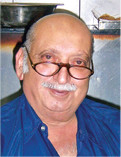
Marazban Dorabjee: joy of catering
The Dorabjee specialities are the mutton and chicken biryani, chicken farcha and lagan nu custard. Sundays see mutton dhansak with brown rice, chicken dhansak with brown rice, mutton shami kabab and patra ni machhi being relished.
Parsi patrons at the eatery constitute just 10 percent of its clientele. The cosmopolitan crowd includes plenty of Maharashtrian Hindus. That is because of their religious beliefs. They have faith in Dorabjee that he would not serve pork or beef. Dorabjee candidly asks that if in mutton kheema, beef is mixed how would a customer know the difference? It is all a matter of principles and values that the Dorabjee clan has stuck to. So much so that though Dorabjee eats pork himself even if someone brings it to his restaurant he doesn’t let it enter but takes it home and cooks it.
People come from far and wide to this eatery courtesy its reasonable pricing and the unique flavor of the food since it is prepared over charcoal. One can actually see what one has ordered being taken out from the degchi (vessel) and put into the serving dish. Many of their customers are from Bombay. They keep coming back once they have eaten the food here for the reasonable price and ample quantity. The patrons increase during April and May since it is the holiday season and in December during Christmas. There were times when food lovers alighting at the Poona railway station would make their first halt at Dorabjee’s to titillate their taste buds. During the racing season in Poona many would flock to this eatery after the event. In fact, "we had named two of our dishes as ‘Biryani win’ and ‘Mutton fry place’ to keep pace with the racing parlance where attention is given to the winner and the second place,” laughs Dorabjee.
Way back in 1948, the Kapoor family especially Prithvi Raj Kapoor and his children Raj, Shammi and Shashi would relish their biryanis. Among those who came frequently was Feroz Khan who once drove down from Bombay straight to their restaurant for their paaya (trotters) masala.
During the British rule, the Englishmen would come in their victorias and tongas to dine at Dorabjee’s. "My grandfather would tell me that a plateful of biryani would then cost only four annas. With the rising cost of raw materials the present cost is Rs 110,” adds Dorabjee.
"My grandfather’s elder brother Pestonji Chindy was in the catering business and when he expired my grandfather Dorabjee Sorabjee Chindy took over the business some 115 years ago. It was then taken over by his eldest son Jal Dorabjee and for a while run by my uncle till I took over in 1970,” states Marazban. The ambience has remained the same since Marazban took charge, with formica tables and plastic chairs, ceramic tiles on the ceiling and mosaic flooring. The joy of catering, according to Dorabjee, is to see the satisfied look of his customers. Some customers suggest ways in which Dorabjee’s should alter their food to suit different tastes. "It’s all part and parcel of catering,” laughs Dorabjee as he sips his tea.
Some of their NRI (non-resident Indian) clients have been known to carry abroad specially frozen Dorabjee favorites in aluminum foil to be enjoyed later. When former Attorney General of India Soli Sorabjee was in Poona a year ago he was taken to Dorabjee and Sons after a round of different five star hotels. Happy with the repast he reportedly told his hosts, "Since the last five days why were you making me eat rubbish? You should have got me here before.”
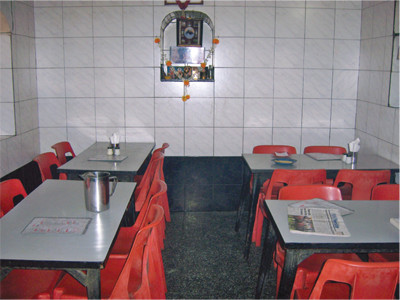
Interiors of Dorabjee and Sons in Poona
Simultaneously running a restaurant and a catering business has its advantages, reveals Dorabjee. Due to the lax attitude of invitees who do not send the reply cards often the exact number to be catered for is not known and the possibility of a larger number turning up is always there. In such cases Dorabjee has the convenience of getting food from his restaurant at the last hour. "In Bombay there are so many functions (being celebrated on a given day) that if one caterer falls short, the others come to his rescue. Poona has comparatively fewer functions and I have to rely on my own resources,” he notes. Helper shortage during lagan and navjote times is another difficulty that he has to surmount.
While some of the suppliers have remained the same, others have been changed on account of their laid-back attitude and assumption that they are irreplaceable. The recipes have been handed down through generations though the ingredients have changed. "The prices of taj (cinnamon) and garam masala (spices) may have increased but their fragrance has reduced. Chaaval ni pamraat kah ché (Where is the aroma of rice)?” he laments.
Though Dorabjee says he did try to experiment by introducing the likes of Russian salad, Chinese food and a few Continental dishes he prefers to stick to aapru (our) Parsi bhonu (food). "What you make must be finished. That is the satisfaction of being a caterer,” he believes. He is not in favor of starting another restaurant at the cost of losing out on personal interaction with his patrons. Besides, it would "affect the quality of the food and we would lose our loyal customers,” he adds. Over the years, he has got offers from reputed hoteliers and entrepreneurs to start similar joints abroad but he has shown no interest. As one old patron commented, "Dorabjee and Sons is not merely an eatery of Poona but an institution.”
◆ ◆ ◆
From the archive