
Cover Story
Passing the baton
The second generation of Zoroastrians in North America is slowly taking charge of community associations
When I came to America in 1963, I found myself in a culture quite different from what I had imagined from watching Hollywood movies. In India, even though Parsis are a minority, our life experiences are no different from those of any other Indian. For the first time in my life, I felt like a minority.
Soon I met a Gujarati in college, and then a Punjabi and a Maharashtrian. More and more Indians, mostly men, were now coming to study in America; and other Parsis were arriving on scholarships and loans. We congregated in each others’ dormitory rooms. Canada had opened up immigration to Indians. Many Parsis settled in Toronto and Vancouver. It almost felt like home.
After completing college, we were delighted to find well-paying jobs. Earning in dollars made us feel rich and independent. Some went back home for a quick wedding arranged by parents or relatives. But it was much easier to find a wife right here. When I moved to Chicago for my first job, there were six Parsis there already. Two of them had non-Parsi wives. We enjoyed each others’ company. The American wives tried to cook Parsi dishes and had become a part of the group.
By the mid-1970s, we began to have children. We sent for our parents to visit us here; and we invited our brothers and sisters to come too. Indians were also emigrating from East Africa and opening convenience stores. Indian groceries became available. Life became more settled. The thought of returning to India became less and less attractive.
At this stage we felt the need to organize. Zoroastrian associations were formed in New York, Chicago, Toronto, Washington, DC and Vancouver. These associations were mainly social clubs that arranged picnics, potluck dinners and religious functions in rented facilities. People drove long distances to meet each other to celebrate Pateti, Navroz, Thanksgiving and Christmas which helped to give a feeling of togetherness to the scattered community.
Soon I met a Gujarati in college, and then a Punjabi and a Maharashtrian. More and more Indians, mostly men, were now coming to study in America; and other Parsis were arriving on scholarships and loans. We congregated in each others’ dormitory rooms. Canada had opened up immigration to Indians. Many Parsis settled in Toronto and Vancouver. It almost felt like home.
After completing college, we were delighted to find well-paying jobs. Earning in dollars made us feel rich and independent. Some went back home for a quick wedding arranged by parents or relatives. But it was much easier to find a wife right here. When I moved to Chicago for my first job, there were six Parsis there already. Two of them had non-Parsi wives. We enjoyed each others’ company. The American wives tried to cook Parsi dishes and had become a part of the group.
By the mid-1970s, we began to have children. We sent for our parents to visit us here; and we invited our brothers and sisters to come too. Indians were also emigrating from East Africa and opening convenience stores. Indian groceries became available. Life became more settled. The thought of returning to India became less and less attractive.
At this stage we felt the need to organize. Zoroastrian associations were formed in New York, Chicago, Toronto, Washington, DC and Vancouver. These associations were mainly social clubs that arranged picnics, potluck dinners and religious functions in rented facilities. People drove long distances to meet each other to celebrate Pateti, Navroz, Thanksgiving and Christmas which helped to give a feeling of togetherness to the scattered community.
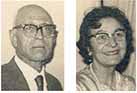
NA Zoroastrian benefactors: Rustam and Morvarid Guiv
Around this time, a wealthy Iranian Zoroastrian and his wife, Arbab Rustam and Morvarid Guiv, came to North America. They often visited Parsis and Iranis in Bombay and were aware of how Parsis had financed the building of community facilities, atash behrams and schools for persecuted Zardushtis in Iran in the 19th century. They realized the need for meeting and prayer halls in North America to keep the community together. Guiv donated seed money to build centers in New York and Chicago. When he passed away, he had formed a trust to help other cities build their centers. His donations were on the condition that non-Zoroastrian spouses, children and friends would always be welcomed at these facilities.
After the Islamic revolution in 1979, large numbers of Iranian Zoroastrians sought asylum in the US and Canada. They met with other Zoroastrians and Iranians and everyone began celebrating Tirgan, Mehergan, Sadeh and Yalda — Iranian festivals that the Parsis had forgotten in India.
As the numbers grew and associations were formed in many cities in US and Canada, North American Congresses began to be held in major metropolitan areas. The need for a federation became evident. The Federation of Zoroastrian Associations of North America (FEZANA) was formed in 1987 (see details at http://fezana.org/about/). One of the issues that the founders faced was the definition of "Zoroastrian.” Many Zoroastrians had intermarried and children from these mixed marriages had already had their navjotes performed. Some Iranian Zoroastrians had never had their navjotes performed and did not wear the sudreh or kusti. It was left to the discretion of the associations to decide who they wanted to accept as members, who was to be considered a Zoroastrian and how they wanted to conduct their meetings and celebrations. FEZANA’s constitution explicitly ensures the religious and administrative autonomy of each member association or individual Zoroastrians.
FEZANA dues are minimal. Most of its activities are conducted using donations from individuals and associations. Endowment funds have been established for scholarships, welfare/critical assistance and infrastructure. Funds are budgeted for the FEZANA office, Journal, FEZANA Information and Research System (FIRES), religious education, interfaith activities, public relations, UN-NGO (United Nations-nongovernmental organization) activities, youth, sports, etc. Many associations have their own programs and funds that overlap FEZANA activities. FEZANA acts as a coordinating body for these activities. Every association and many individuals attend the annual general meetings, held in different locations every year. Elections are held every two years. A congress is held every two years.
The North American Mobeds Council (NAMC), formed at about the same time, does not recognize any hierarchy among its member priests. There are no Vada Dasturs in North America who can exert authority in religious matters. All priests are free to decide whose navjote or wedding they would perform according to Zoroastrian rites. The NAMC has instituted several innovations like the mobedyar program which accepts male as well as female mobedyars of any age, even behdins, after receiving prescribed training from an ordained priest. This program has been very well received.
I believe that North American Zarathushtis are doing everything within their powers to ensure that the religion endures and spiritual values remain intact. The good news is that religious education classes, scholarships, interfaith activities, youth programs and congresses have had a positive influence in that direction in North America.
After Zoroastrian families started having children, it was realized that they had been taught next to nothing about their religion in India, other than the Avesta prayers and going to agiaries and atash behrams. At first classes were conducted in homes, but as the numbers grew schoolrooms were rented on Sundays for children’s religious education classes. This is where our exposure to interfaith activities and our intermarried spouses helped. We learned from them how religion is taught in churches and synagogs, how they raised funds at most communal events, and how they communicated their love of religion to their children in a secular world.
Since most Zoroastrians came to America for higher education, they recognize the value of education to ensure a meaningful and prosperous life. Scholarships are given on merit and evidence of community service; and are reserved for youth who have had their navjotes even if one of the parents is a non-Zoroastrian. Scholarship recipients in turn take pride in serving the community after graduation, so that the second generation is now slowly taking charge of the local associations and thereby of FEZANA. The first generation that came to North America in the 1960s and 70s is still carrying images and values and maps of the old country -- useful so long as the terrain does not change. The second and third generations that have grown up in North America are much better attuned to the terrain and so help us navigate the new maps for our future.
In 2006, a group called the Church of Cognizance based in Arizona claimed that marijuana was the same as haoma, revered by Zoroastrians in Hom Yasht; and hence by smoking marijuana, they were just following neo-Zoroastrian religious practices. FEZANA and the NAMC testified against their claims. The judge ruled that not only is the Church of Cognizance not a religion, but also that, even if it was a religion, the way that it is practiced by the defendants is not sincere. Sincerity is important. In her final statement, the judge pointed out that an established religion should have places for worship and rituals, ordained priests and clergy, special vestments for priests and lay people, religious celebrations and a well-run organization. Then she added, almost as an afterthought, that the Church of Cognizance did not conduct any mission work, and hence did not profess any deep spiritual values. This last observation clarifies how important it is for us to reach out to the non-Zoroastrian community and be able to articulate our spiritual values -- what we are all about -- to ourselves and to others.
Interfaith marriages are a fact of life today not just in North America, but also in India and all over the world. Trying to stop intermarriages is like trying to stop a freight train by crashing it into a wall. You need to stop the train gradually and carefully by cutting off the fuel supply and applying the brakes. The fuel for intermarriages is indifference about religion and lack of understanding of our values and principles. Ideally, a marriage ceases to be considered as an interfaith marriage when both the spouses espouse a full understanding and love of the Zoroastrian faith and pass this on to their children and grandchildren, regardless of what religion one of them was born under. We must do everything in our power to assure that this happens.
Dr Rustom Kevala is a past president of thew Federation of Zoroastrian Associations of North America and the Zoroastrian Association of Metropolitan Washington. He went to the USA from Bombay in 1963 to pursue studies in aerospace engineering. Kevala continues to study the thoughts and aspirations of Zarathushtis from all corners of the world through travel and correspondence. He lives in Florida with his wife Yasmin.
◆ ◆ ◆
From the archive