
Zoroastrians Abroad
Promoting unity
Rustom Kevala, president of the Federation of Zoroastrian Associations of North America, speaks of the organization’s goals
"People don’t know that Navroze is the Zoroastrian New Year since ancient times. Others like the Baha’is also claim it. But we want to emphasize its Zoroastrian roots in North America,” says Rustom Kevala, president of the Federation of Zoroastrian Associations of North America (FEZANA). This Navroze the celebrations were planned to coordinate with all associations across the continent. Kevala spoke to Parsiana on January 16, 2008, after the World Zarathushti Chamber of Commerce (WZCC) and Round Table meets were over.
This is a part of FEZANA’s plan to create more homogeneity between Iranians and Parsis, to get them to work together. To that end there is also a concerted attempt to celebrate events like Tirgan and Mehergan — traditional festivals important to Iranians – by both wings of the community. Celebrating these festivals together could have a unifying effect on the community, notes Kevala who is all for the celebration, especially Navroze, to be held on the actual day — not on the most convenient weekend before or after. "If we set up the celebration on that day, people would come,” he says. The Navroze parade has become an annual feature in New York. It has been spearheaded by Iranians, both Zarathushti and non-Zarathushti, but the Parsis also participate. Now Kevala feels the need to spread the idea to other cities and probably for the first time Los Angeles and San Jose may also have the Navroze parade this year. Kevala’s first priority however is not the parade but a celebration in the Zarathushti tradition and its reflection in the national Press.
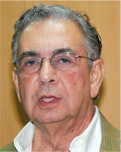
Rustom Kevala: "We can’t throw away tradition”
Besides, he says, "Iranians don’t want to be called Parsis or Iranis. While the non-Zoroastrians prefer to be called Persians, the Zoroastrians want to be called Iranians or Zarathushtis,” the latter term finding favor with Parsis also.
An important area he is working on is the creation/revision of the terms of reference under which the North American Zoroastrian congresses are held. "Up to now, the congress is the joint responsibility of FEZANA and the host association. As the host association does a lot of work, it gets a lot of leeway (in organization). But it doesn’t achieve the main purpose of promoting unity in the community. We don’t have to talk about scholarly subjects and the religion but at the conclusion there must be a resolution on what we all want to do…we need the FEZANA congress committee to make sure of a follow up.” The next FEZANA annual general meeting is due in Los Angeles on May 10 and 11, 2008 when the matter will probably be addressed.
FEZANA’s new office has already been set up in Chicago as reported in this column earlier. Previously it worked out of the Rivetna home. And there is an endowment fund of $250,000 set up for it, Kevala informs us. "It’s a start,” says Kevala, adding, "We’d like a more professional setting. One purpose of the office is to reach out to the public about Zoroastrian and FEZANA affairs, collect information about the population of Zoroastrians.” They have been looking for a librarian cum executive assistant who would be the central point of contact. But with an offered salary of $ 1,000 for part-time work (for the first four months) no candidate has been forthcoming. "We were assured we’d find someone, a pro-active person who is computer literate. But nobody among the Zoroastrians wants to do this kind of work! Perhaps the remuneration is too meager,” he hazards.
To correct misconceptions about the Zoroastrian religion is another FEZANA aim. Kevala holds up the "dualistic religion” concept as such an example. "We don’t worship ahriman!” he notes emphatically. Jim Engineer, chair of their public relations committee, has been addressing the issue thanks to his contacts in the Press, Kevala adds.
Also, "Most people don’t know that most religions came after Zoroastrianism. We need to expand on Roshan Rivetna’s book (The Legacy of Zarathushtra), make it a better publication, make it into a college textbook.”
In fact, religious education for the whole Zoroastrian community is the FEZANA aim, says Kevala. Lovji Cama of the Zoroastrian Association of Greater New York (ZAGNY) chairs the committee set up to oversee this project and so far three workshops have been organized in different parts of North America where teachers get together and discuss the curriculum and the problems. One problem he talks about is that parents are not willing to spend time with the children in the religious classes. "When the children find that their parents are also there, they are more enthused to learn,” says Kevala noting that the aim is to learn the different prayers, why we pray them, the significance of the Nyaishes, Yashts, Gathas. "Our religion is not just the Gathas. Though the Gathas state the basic doctrine, other scriptures define us as Zarathushtis. We can’t throw away that tradition. If we don’t understand it, we might discard it, though the emphasis will remain on the philosophy and doctrine. If we do it right, some children will pursue it at the college/university level. The Faridoon Zartoshty scholarships are there for them.
"But we don’t have enough books, material for scholars. We need to develop it. Also, if people get PhDs in Zoroastrianism, what job would they find? Have we the financial strength to support the scholars not only in study but to research afterwards? If we have the money, they could tie up with our (proposed library and) research center,” where everything would be ultimately digitized and which Kevala estimates would cost five to 10 million dollars to establish. "One person can’t do it. It needs an organization. A world body would have been ideal, but FEZANA could do it…We now have many Zoroastrian centers in North America.” Increasing the scope, like establishing a university chair, would increase the cost. "It would bring Zoroastrianism into the mainstream. Its importance would be known, like that of Hinduism or Buddhism,” he argues. "FEZANA’s job is to look after the Zarathushtis already in North America... If it is realized that there are Zoroastrians living in North America, our children would feel more secure…Our job is to increase our pride and understanding of the religion and the community. It has to be a religion that means something to us as well as to others.”
As part of the process, a two-day scholars’ conference had been organized in Chicago last October where six to seven Zoroastrian scholars spoke on the first day, three non-Zoroastrian scholars on the second, he informs us. Though Palan Ichaporia had organized the meet, he was unable to attend. Among the speakers who came readily to Kevala’s mind were James Russell, William Malandra and Kersey Antia.
According to Kevala eventually everyone wants one calendar, at least in North America. "We do not want to force anybody. If people feel their rituals are tied to the Kadmi or Shahenshahi calendar, that’s fine. But only the seasonal calendar should be emphasized. We have the support of many North American mobeds,” he adds.
Kevala says he was quite involved in interfaith activity while he resided in Washington DC but has left it to Dr Behram Pastakia of Washington DC and Homi Gandhy of ZAGNY to carry on their good work since he relocated to Florida. FEZANA promotes people to attend interfaith meets to find out how others conduct business. By attending these meets they learn how to talk about Zoroastrianism to others. It is happening more often now than before, he says though not all young people feel comfortable talking about it. "But they are not hiding their religion any more,” he notes the progress.
Kevala is into his first term as FEZANA president, but he is not sure he will seek a second term. Earlier he had served as treasurer and as chair of the publications committee among other assignments. About a year ago when a case had come up in New Mexico of a group of alleged drug consumers/peddlers seeking the provision of a US law permitting the use of cannabis for valid religious purposes, by claiming to be Zoroastrians, Kevala as president of FEZANA had intervened and delegated Ervad (Dr) Jehan Bagli, president of the North American Mobed Council, to testify against such false allegation against the religion. We now ask him about the US government’s case against Noshir Gowadia who had earlier worked in the country’s strategic establishments. The government has accused him of selling its strategic secrets. Kevala says they have not been able to communicate with Gowadia. "We would like to help but don’t know how to, as FEZANA is not a political organization and cannot be involved in or lobby for political objectives. It seems like the government has no case but are holding him and won’t release him on bail. His son says the lawyers are not willing to take up his case for free.”
Being the head of the Zoroastrian community on the North American continent is a mixed bag…
◆ ◆ ◆
From the archive