
On the right path
Priests in North America serve the Zoroastrian community without differentiating between men and women, Parsis, Iranians or any others
In the ’70s, Parsi social groups included families where both parents were Zoroastrian and also mixed marriage couples, where one spouse was Zoroastrian. As children reached navjote age, priests of the North American communities started receiving requests to perform the navjotes of children in both these groups. As most of the priests were also new in North America, and lacking much experience to fall back on, they started writing to the priests in Bombay asking for their opinion on performing the navjotes of children of couples of mixed marriages. And what we got from them were mixed opinions that confused the priests of North America.
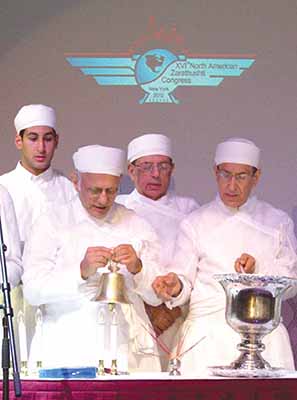
Priests blessing the XVI North American Zoroastrian Congress
When I was in India in 1973, I met Dastur (Dr) Hormazdyar Mirza at his home near the Vachaghandhy Agiary. After two hours of answering all my questions, he gave me some advice which I will never forget. He told me to ask the priests in North America to stop asking for opinions from Indian and Iranian priests, but to think for themselves and guide the Zoroastrian communities in North America. The words he used was "Navo dao chhè, navo ball chhè” (it’s a new opportunity, a new ball game), so think for yourselves as we in India are not aware of the needs and dynamics of your communities to guide you.
Most of the priests decided to use their own Vohu Mano (good mind) to decide on the religious requests coming from the laity. As a result some priests began to bad mouth other priests who performed mixed marriage wedding ceremonies and their children’s navjotes. I remember that in Toronto I received a request to organize the navjote of three children of a mixed marriage family — one being own and two adopted. Several active priests of Ontario met and after five hours of discussions, accusations and pleading with each other, we all decided to participate in the navjote. That started the trend among the priests of discussing thorny religious issues and was the precursor of the North American Mobeds Council which had its first meeting in Toronto.
Many priests in North America took bold steps to serve the Zoroastrian communities, one of which was to treat men and women equally with regard to Zoroastrian religious practices. This is what our scriptures teach us, and we are obliged to follow these teachings.
I remember a major controversy in Toronto when Iranian Zarthoshtis started immigrating to Canada, and wanted navjotes performed of their children aged 12 to 17 years. In some cases, even their parents’ navjotes had not been performed! When some priests contacted the Bombay priests, we once again received mixed and divergent guidance. Some priests warned us that we would be converting Muslims and others encouraged us to reach out to these families and help them become good Zoroastrians. We ended up doing the latter and the Iranians have become very good Zoroastrians.
The North American Mobeds Council has played a very significant part in guiding the North American Zoroastrian communities on to the right path. We have among us some very learned priests. We research our scriptures, we debate (sometimes acrimoniously), but when we reach any decision we keep the North American communities in mind. We are here to serve the community and not to dictate and foist our own prejudices on them. Priests are free to follow their own convictions without censure. Priests from all over North America attend our annual meetings where we share our experiences and learn from each other.
When was the last time that Indian priests met and discussed how to serve the Parsi community better, educate each other, debate issues while respecting every priest’s opinion, and then vote? Maybe it is time for India’s athornan community to learn from the North American athornans.
We treat all Zoroastrians in North America equally, male or female, Parsi, Iranian, Russian or from anywhere else. At navjotes and weddings we pray in the Parsi or Iranian way. As priests we do not impose any one view or the other. Our goal is to serve the Zoroastrian community, which priests in North America have done well. Perhaps in the next 50 years, North American Zoroastrians will have one calendar so we will have one gahanbar, one muktad, and one Navroz, instead of two as we do now.
We do not call North American Zoroastrians liberal or orthodox, but a community on the right path.
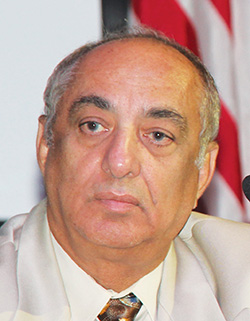 Founder president of the North American Mobeds Council, the Ontario Zoroastrian Community Foundation and the Zoroastrian Cricket Club, Ervad Kobad Zarolia has been an active community worker in Toronto for the last 37 years and has twice been the president of the Zoroastrian Society of Ontario.
Very well said Kobad. I concur with most of your views. Seeking advice from Bombay, only brings into play old prejudices and sectarian rivalry. We consciously made a decision for a fresh start by coming to Canada. We should think of ourselves more as Zoroastrians and not just Parsis. A. Bamji