
Cover Story
FEZANA to the fore
Non-Zarathushti spouses generally have been welcomed within our associations and communities with open arms
The Federation of Zoroastrian Associations of North America (FEZANA) was formed 27 years ago. Its founding principle was that each member association retained its autonomy with regard to its bylaws, rules, guidelines and customs. It is this local independence that is the cornerstone of the successes and strength of FEZANA, it is worth noting on the eve of the upcoming North American Zoroastrian Congress.
When the Zarathushti diaspora from India, Iran and other parts of the globe put down roots in North America, its members started to rethink and re-evaluate their social customs and practices. Over the years they have come to set their own standards. Women and men have equal status in all things religious, cultural and social when it comes to FEZANA. That is our overarching principle. Individual associations located all over the continent also pretty much follow an ethos of inclusion rather than exclusion, with slight variances, some tending to be more liberal, others tending to be more traditional.
When the Zarathushti diaspora from India, Iran and other parts of the globe put down roots in North America, its members started to rethink and re-evaluate their social customs and practices. Over the years they have come to set their own standards. Women and men have equal status in all things religious, cultural and social when it comes to FEZANA. That is our overarching principle. Individual associations located all over the continent also pretty much follow an ethos of inclusion rather than exclusion, with slight variances, some tending to be more liberal, others tending to be more traditional.
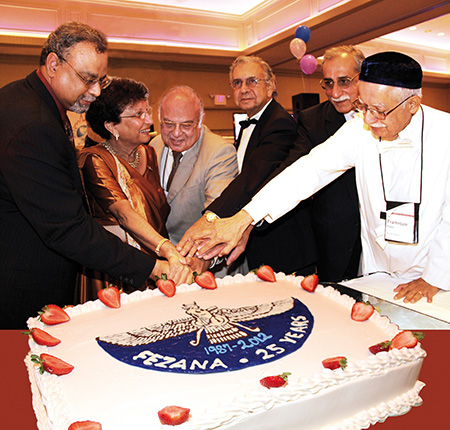
Past presidents Bomi Patel, Dolly Dastoor, Firdosh Mehta, Rustom Kevala,
Rohinton Rivetna and Framroze Patel at FEZANA’s silver anniversary
Historically this mindset has come about as the direct result of the sparse numbers of Zarathushtis living in geographical proximity of each other. It also stems from awareness that in a newly adopted land, our customs and mores had to keep up with and fit our new surroundings. As a result, non-Zarathushti spouses generally have been welcomed within our associations and communities with open arms and so too have their children. Everyone who has had his/her navjote/sudreh pushi done and follows the tenets of the religion is considered Zarathushti for all practical purposes.
As an umbrella organization for the community, FEZANA supports and strengthens these basic principles with programs and activities, all with an eye to inculcating our core religious, social and cultural ideals in the generations that grow up here. Regular biennial Congresses showcase the rich and varied accomplishments of our communities. FEZANA’s support of programs for youth, be it Zoroastrian Youth of North America (ZYNA) or initiatives such as the Zoroastrian Return To Roots Program — a PARZOR initiative — shows its commitment to investing in our youth and providing them with the right tools and value sets to become leaders of our community in the years to come.
The demographic studies initiated by FEZANA under the leadership of Khorshed F. Jungalwala and then carried on by Roshan Rivetna have shown a drastic dip in the community’s numbers in India and Iran – but a very encouraging rise in North America.
FEZANA maintains a collaborative approach toward associations in India and Iran, respecting their autonomy while at the same time coming together to celebrate our commonalities.
In that cooperative spirit, FEZANA has been an active participant in the Global Working Group (GWG) of the worldwide Zoroastrian organizations. FEZANA has also hosted the 7th World Zoroastrian Congress in Houston and was a pioneering organization in hosting the first World Zoroastrian Youth Congress.
FEZANA and its member associations have supported the teaching of our religion, history and culture to the community’s children for decades. There are associations in North America now where the second generation of children is attending religion classes, many of them in the same Darbe Mehr building their parents attended as kids.
With technology enablers such as social media, video chat programs and instant messaging, the world is today a global village. The day is not far off when Zarathushti kids in Rustom Baug, Bombay, can attend a religion class at the Arbab Rustam Guiv Dare Mehr in New York. And in the coming years these children will maybe meet up at a World Zoroastrian Youth Congress. Youth in North America are taught about their roots and where their parents and grandparents came from. And it was no surprise that the largest representation on the very first Zoroastrian Return to Roots Tour in 2013 came from North America.
FEZANA has always encouraged inclusiveness at all levels, including of the two diverse cultures of Iran and India. Therefore Parsi Zarathushtis celebrate Mehergan and Yalda and other traditionally Iranian festivals and Iranian Zarathushtis join in celebrating the gahanbars and Parsi New Year.
FEZANA now consists of 26 member associations and 14 corresponding groups and its activities are supported by 26 committees. We are recognized as a faith-based NonGovernmental Organization (NGO) by the Department of Public Information at the United Nations (UN) and the Economic and Social Council (ECOSOC) of the UN. The FEZANA UN-NGO committee has actively participated in the annual NGO conferences and Commission on Status of Women (CSW) meetings, successfully hosting panel discussions at these events. This has also provided an excellent opportunity to North American Zoroastrian youth to participate at high levels of international forums. Zoroastrians from India and Australia also have participated in these events.
North American community leaders have represented FEZANA at many interfaith gatherings on the continent and also at international interfaith assemblies, including the Parliament of World’s Religions.
FEZANA continues to strengthen its presence in North America and is a vibrant and dynamic organization because of the foundations laid by community leaders and thinkers who came to North America decades ago. Operating on the basis of consensus in responding and adapting to the unfamiliar conditions and society we live in, we have settled on guidelines that allow for the growth and preservation of our faith and culture even in this new land. We have set up institutions of philanthropy, educational scholarships and critical assistance, building upon the foundation of good work laid out by our fellow Parsis and Irani Zarathushtis in India, other parts of South Asia and Iran.
We intend to continue nurturing the worldwide brotherhood and sisterhood of Zarathushtis in the spirit of celebrating and cherishing our commonalities and respectfully understanding our differences.
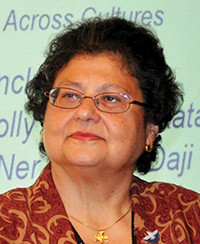 Current president of the Federation of Zoroastrian Associations of North America, Katayun Kapadia had previously served as the secretary, treasurer and vice president of this apex body. Based in New Jersey she is a certified internal auditor and certified fraud examiner.
◆ ◆ ◆
From the archive