
Cover Story
For a common destiny
For Zoroastrians in North America building trust, relationships and understanding with each other is a continuum
It is a matter of great pride to note that in North America the Zoroastrian community is working steadily towards that vision for the community that has been developed over many years: "To nurture a caring, compassionate, altruistic, harmonious, observant, esteemed, prosperous and sustainable worldwide community, with respect for diversity of belief and practice, working to move Ahura Mazda’s creation forward towards frashokereti.”
Like in the mother countries of Iran and India, here in North America we are working hard to make the name Zoroastrian synonymous with integrity, industry, charity and philanthropy. Our one concern is that perhaps we have not been able to engage our Next Generation as fully as we had hoped to take on the responsibilities currently shouldered by the first generation, but that too is gradually changing. Before long one will begin to see a new face of North American Zoroastrians, one that does not carry the baggage that the first generation does.
Like in the mother countries of Iran and India, here in North America we are working hard to make the name Zoroastrian synonymous with integrity, industry, charity and philanthropy. Our one concern is that perhaps we have not been able to engage our Next Generation as fully as we had hoped to take on the responsibilities currently shouldered by the first generation, but that too is gradually changing. Before long one will begin to see a new face of North American Zoroastrians, one that does not carry the baggage that the first generation does.
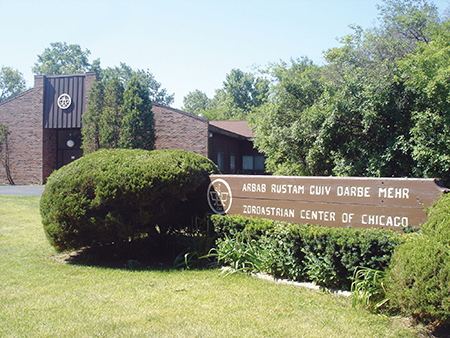
Zoroastrian center in Chicago
"Now how did we get to this place and are there lessons to be learnt?” The simple answer is that "it has not been easy!” Building trust, relationships and understanding with each other is a continuum. We have come this far, but still have a long way to go.
It is now over a half century since Zarathushtis settled in any significant numbers in North America. We have a mix of approximately 70% from India and Pakistan and 30% from Iran, each with their own customs, traditions and ideologies, yet all sharing a common faith, a very different mix from that in India. Being a community that thrives on individualism one can imagine the differing points of view that existed and still exist. Added to that, we also had to deal with geographical dispersion, in small pockets across these vast lands. The turmoil and the struggles we experienced in the beginning were unpleasant, unbecoming and exhausting. As the invectives flew, clouding our vision, there also arose a voice from within sounding a knell, if such behavior continued.
Out of this turmoil and sense of foreboding arose the Federation of Zoroastrian Associations of North America (FEZANA). All associations participated, but with trepidation. It took hard work to quell the fears and build trust for a common destiny, but we did. Today one sees a sense of calm, trust and harmony. One may visit any of our associations or congresses or our flagship FEZANA and one will witness our resolve, perseverance and dedication to come together and work together towards that vision.
We have evolved and are continuing to evolve. While Canada is a multi-cultural society, the United States is a melting pot. The Zarathushti penchant to be the sugar in the milk is in full gear. We adopt and absorb but we do not dissolve. We are proud to be Zarathushtis and proud to be good Canadians and Americans. We live in civil societies, with norms and standards — not liberal, as some tend to judge us. The golden rule is the prescribed way of life. "Do unto others as you would have them do unto you.” That says it all, requiring strict self-discipline and gentle conduct. We welcomed, nay encouraged, non-Zoroastrian spouses and their offspring to become involved in community matters and participate in our gatherings and ceremonies. We felt it was the right path to follow for the continuation and perpetuation of our faith and community on this continent. That is not to say that there weren’t any Zarathushtis who objected. In any society there are bound to be those with differing views. But we are learning to respect the others’ views and find ways and means to harmonize them with ours. In other words, we are learning to be cordial with each other. It would be disastrous for our tiny community to do otherwise.
We have learnt to live together in a civil manner despite differing views. We have learnt to engage in civil discourse knowing that dialog results in convergence and convergence leads to consensus. And most important, we have learnt to let go. We have learnt not to force solutions lest they be wrong. We have learnt that it is in the nature of things to resolve themselves given time. We know that societal changes are not ruled by committees or governing bodies. A society evolves gradually, and so does its thinking. We have learnt to measure the community’s pulse and act accordingly. Our governing bodies engender dialog from which blossoms progress.
In North America we have now reached a comfortable level. We have 27 associations, several with centers and dar-e-mehers, we have a central coordinating body, FEZANA and we have our own North American Mobeds Council which is gradually gaining the confidence of our communities. In order to reach the next level we know that we have to develop our infrastructure both organizational and physical. The strength of a community lies in its people and its infrastructure. This requires massive amounts of capital. We are on a quest to find philanthropists from the worldwide community to fulfill our infrastructure needs.
The way forward for the worldwide Zarathushti community is to come together and work on our needs and concerns together. In unity lies our strength. We must have a sense of one community. In India, sadly, there is a preoccupation with local interests; the diaspora communities might as well not exist. If we are to arrest our alarming demographic trends, and realizing that about one-third of our Zarathushti population now lives in the diaspora, outside Iran, India and Pakistan [see "Our Zarathushti World,” FEZANA Journal, Fall 2013] we must begin to think and act globally. Our mission must be "To come together and work together in hamazori for the worldwide Zarathushti community.”
Let history record that this generation of Zarathushtis worldwide, recognizing the challenges facing the community, came together and set in motion the process to restore the community to its pristine glory. May Ahura Mazda guide us and grant us the vohu mano to seek the right path.
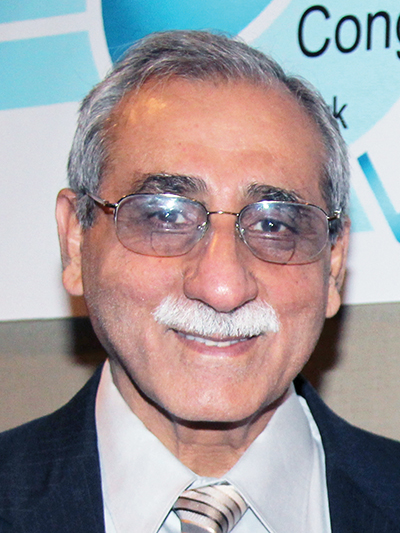 Rohinton Rivetna spearheaded the formation of the Zoroastrian Association of Chicago in 1976 and served as its president and trustee. The prime architect of the Federation of Zoroastrian Associations of North America, in 2000, he initiated the founding of the World Zarathushti Chamber of Commerce. He served as president of both organizations. He was founding vice president and is trustee emeritus of the Council for a Parliament of the World’s Religions. A professional engineer, he retired in 1997 as director of environmental engineering at American National Can Company, Chicago.
◆ ◆ ◆
From the archive