
Cover Story
Religion and rituals
Zoroastrians in North America are seeking and disseminating knowledge of traditional practices though they remain an open-minded society
To pinpoint the rationale for change in the thought processes of Zarathushtis of North America (NA) it is important to revert to history, to recap why the mindset of Zarathushtis in India has remained unchanged over the past nearly 1,300 years.
Zarathushtis who fled their ancient homeland in 716 CE did so with fresh memories of the massacre and sacrilege by Macedonians, and subsequent slaughter by the Arabs, Mongols and Turks. They were psychologically scarred and became obsessed with the idea of protecting their religion and ethnic identity at all costs in their new homeland. They maintained rigid ground rules with sectarian attitudes of exclusivity to preserve the religion.
These inflexible rules of selectivity were man-made and a result of their past historic experiences. The rules were formulated to protect the religious heritage, but were not backed by any doctrinal dicta.
Zarathushtis who fled their ancient homeland in 716 CE did so with fresh memories of the massacre and sacrilege by Macedonians, and subsequent slaughter by the Arabs, Mongols and Turks. They were psychologically scarred and became obsessed with the idea of protecting their religion and ethnic identity at all costs in their new homeland. They maintained rigid ground rules with sectarian attitudes of exclusivity to preserve the religion.
These inflexible rules of selectivity were man-made and a result of their past historic experiences. The rules were formulated to protect the religious heritage, but were not backed by any doctrinal dicta.
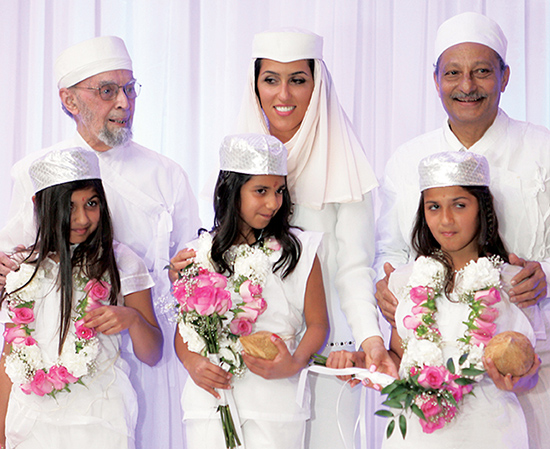
Priests and a mobedyar performing navjotes
The migration of Zarathushtis to the West, and particularly to NA, has a very different background. A significant number of first generation Zarathushtis came to NA for postgraduate studies and continued to stay on and settle here. Highly educated professionals and their families who migrated directly for employment did so to improve their economic status, to better their standard of life and for the future education of their children.
In the early 20th century it was farthest from the minds of immigrant Zarathushtis to NA to preserve and protect their religious heritage. It took nearly 25 to 30 years before the Zarathushtis began organizing themselves as Zoroastrian associations in various locations. Even then, it was mainly to get together for social functions and celebrations. Religious needs were gradually felt when it was time for navjotes, weddings and funerals.
The early Zarathushtis living in a secular democracy with no supporting religious institution must have been influenced by the social environment to think in terms of an open, equal and inclusive society. It was not until 1990 that the North American Mobeds Council (NAMC) was formed and registered in Ontario, Canada, that the Zarathushtis began to notice ritual observances and follow traditional religious customs.
Several Zarathushti associations began to perform jashans regularly for all the gahanbars, and on occasions such as Mehergan and Tirgan. Jashans are now performed following both the Shahenshahi and Fasli calendars. Despite these religious activities, the open and inclusive thinking of Zarathushtis in NA has continued, mainly because many of the priests, while attempting to preserve traditional ritual practices, are open and inclusive in their thinking.
Another factor that has supported and even promoted such reasoning is the open-mindedness of the Iranian Zarathushtis. Iranians, both Zarathushtis and non-Zarathushtis, who came to NA during the Islamic revolution of 1979 are highly educated and trained professionals — doctors, lawyers as well as academicians. They hold fairly high positions and have a profound impact on Zoroastrian society, as the Parsis and Iranis integrate into a homogenous Zarathushti community. Iranians are also more dedicated to the religion as compared to Parsis. Such an outlook has led most Zarathushti associations to permit non-Zarathushtis in the prayer halls as long as basic principles such as cleanliness and covering the head are observed. This attitude also leads to smoother integration of non-Zarathushti spouses in an interfaith marriage.
In the case of children of interfaith unions, unless the parents themselves unanimously make an effort to bring up the child as a Zarathushti by teaching some basic prayers and having the navjote performed, despite having religious knowledge, the child is not identified as a Zarathushti. The majority of priests in NA have no inhibitions about performing the navjote of children of interfaith couples.
However, there still are Zarathushtis as well as priests in NA who are fairly conservative in their thinking, though they are in a minority. It is indeed sad to see some of our very dear priest friends whose children are married to non-Zarathushtis hesitate even to stand as witness during a Zarathushti ceremony performed for an interfaith wedding, let alone perform the ceremony themselves. However, we do not dwell on our differences but thrive on our commonalities; that is what makes it work.
In my experience with Zarathushti youths in NA I have noticed that several of our educated young professionals do not participate in rituals and ceremonies at the darbe-mehr, nor do they get actively involved in community matters. However, in their day-to-day life they seem to be quite conscious of their Zarathushti heritage, live by the basic teachings of our faith and are helpful to the poor and underprivileged. Some of them belonging to ZYNA (Zoroastrian Youth of North America) have organized themselves as Zarathushti Youth Without Borders and are recommending opportunities to others who would wish to serve in underdeveloped countries or in poor regions in India.
On an average, NA Zarathushtis have far better awareness of the knowledge and teachings of Zoroastrianism than those in India as awareness of basic religious education is taken much more seriously on this continent. In India there is such a strong emphasis on rituals by the priestly class that the actual knowledge of the religious teachings are taken for granted. The Federation of Zoroastrian Associations of North America has taken the lead for the religious education and has set up a religious education committee which conducts workshops to ensure that religious knowledge disseminated in local religious classes has a uniform curriculum throughout the country.
Zarathushtis of NA are in the process of raising the level of religious knowledge, but we do not want to create an elite group dictating to the community. During my tenure as president of NAMC I started, among others, a program of having seminars every alternate year by priests. Initially the talks were planned by priests, for priests, but with time these seminars were made open to the Zoroastrian community. Slowly, I am happy to say, not only have some of the priests contributed to the program in Toronto and other cities, but they have enthused the community to invite lay persons to give talks at other places. We have actually travelled to New York, New Jersey, Chicago, Texas and Washington to hold seminars on various topics.
To bring knowledge of rituals to young priests as well as the public we have written and published a series of books titled Understanding and Practice. These deal with jashans, navjotes, weddings and obsequies. The final book in this series, Understanding and Practice of Concise Navar Ceremony, is under print. Each book explains in the first chapter the rituals in extensive detail, followed by pertinent prayers in English. All the books were written in close consultation with priests [Dastur (Dr) Firoze Kotwal, Ervad (Dr) Ramiyar Karanjia] in India to ensure that we preserve, as closely as physically possible, traditional religious practices.
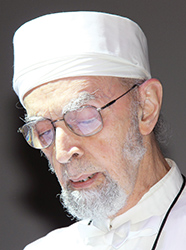 After retiring as Distinguished Research Fellow from Wyeth Pharmaceutical Research, Ervad (Dr) Jehan Bagli serves as a research consultant. He is chairperson of the Research and Preservation Committee of the Federation of Zoroastrian Associations of North America and was president of the North American Mobeds Council.
◆ ◆ ◆
From the archive