
Zoroastrians Abroad
Seminar on rituals
"It was a historical first of its kind,” a full-day seminar on April 19, 2003 at the Ramada Hotel, Toronto Airport co-sponsored by the North American Mobed Council (NAMC), the Federation of Zoroastrian Associations of North America (FEZANA) and the US Chapter of the World Zoroastrian Organisation , notes the report submitted by NAMC president Ervad (Dr) Jehan Bagli. Participating in the analysis of "Zarathushtrian Ritual: past, present and future,” were Dr Almut Hintze of SOAS and Cambridge, UK, Mobed Kamran Jamshidi of Sweden, Ervad Parvez Bajan of Bombay and Bagli.
Profs Jamsheed Choksy, Gernot Windfuhr and Pallan Ichaporia, all of the US and Ervad Godrej Sidhwa of Karachi withdrew from the program at the last minute because of the SARS outbreak in Toronto and Bagli had to step into the breach. A viewing of the Yasna ritual recorded on video by Dastur (Dr) Firoze Kotwal at the Colorado State University also helped to take in the slack.
FEZANA president Firdosh Mehta, Zoroastrian Society of Ontario president Sam Vesuna, Ontario Zoroastrian Community Foundation president Ervad Kobad Zarolia and Bagli on behalf of the NAMC welcomed the international scholars on the panel. All agreed on the imperative to keep minor differences in proper perspective and work in harmony to preserve Zoroastrian faith around the world.
Hintze’s paper investigated "the dual role of Zarathushtra as a visionary on the one hand and as priest and initiator of a new type of worship on the other,” writes Bagli. Arguing that the Prophet derived his spiritual authority from the revelations he received from Ahura Mazda, establishing a new devotional model, he established a new type of ritual worship preserved in the Yasna Haptanhaiti.
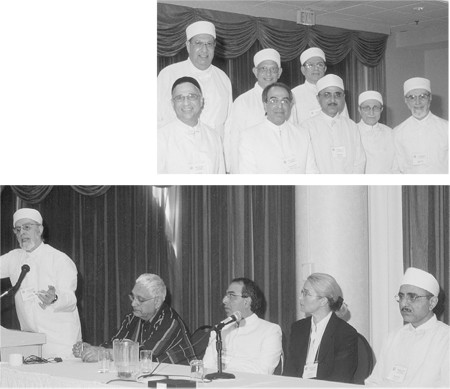
L to R (front row): Jamshidi and Bajan (2nd and 3rd) with NAMC executives and members Below: Bagli, interpreter Behram Parsi, Jamshidi, Hintze and Bajan
Jamshidi, a grandson of Dasturan Dastur Ardeshir Azargoshasp of Iran, traced the history of Tajikistan along scriptural lines, notes Bagli. Sogdiana is the first among the 16 lands mentioned in the Avesta and later scriptures. From the Achemenians to the Sasanians the land was known as Soghd-e-Haftashyan — land of seven nests as seven glorious kings including Jam, Fereydoun, Manochehr, Keykhosrow, Lohrasp and Goshtasp had nestled there. After the Arab occupation those who converted to Islam came to be recognized as Tajik. Tracing the connection with Avestan culture, Jamshidi had noted that the river Daaiti and mount Hara-Berezaiti, mentioned in Zoroastrian religious texts, are located in the vicinity of Tajikistan. Like the Zarathushtis of Iran the Tajiks celebrate the Nowruz, Mehergan and Sadeh festivals. They also respect and revere all the elements of Nature.
Bajan provided a historical perspective of Zarathushti ritual, its traditional values, spiritual significance and social relevance, writes Bagli. The Indian diaspora witnessed the development of five groups of priests — the Bhagarias, Godavaras, Bharuchas, Khambattas and Sanjanas — each catering to its own diocese. Bajan traced the odyssey of the Iranshah from Sanjan to Bahrot to Navsari to Udvada. He told the gathering that the oldest extant Zoroastrian manuscript, written by the Meherwan family, is housed in the Bodleian Library at Oxford while later manuscripts are preserved in India and in several European cities. He underscored the value of faith in religious practices because rituals are expressions of religious aspiration and the tranquility of these solemn acts appeal to mankind’s spiritual yearnings. While changes in the mechanics of rituals are inevitable due to varying circumstances in time, Bajan held that such change should not be allowed to weaken the community’s faith in their performance. He described a true athravan as one who seeks wisdom, relieves distress and inspires the laity to the best existence.
Bagli’s colloqui on the significance of some Zarathushti rituals traced their chronological development beginning with Gathic times when rituals and priesthood as we know them today were absent. They evolved gradually through the era of the Younger Avesta and culminated in "an explosive growth of rituals in the priest laden society of the Sasanian period.” Maintaining that rituals depict a "precious treasure of doctrinal information from the scriptures,” Bagli elaborated the flower exchange ceremony of the Afringan recital: the two priests represent cosmic duality — the zaotar and raspi depicting celestial and terrestrial realities respectively — while the holy fire incarnates the wisdom of Ahura Mazda. The exchange of flowers between the priests symbolizes the transmission of souls from the spiritual to the physical world and back. Bagli also explained how the importance of purity in the Zoroastrian faith had led to the subsequent evolution of purificatory rites.
Bagli’s talk ended with the delineation of the inner liturgy of the Yasna appropriately followed by Kotwal’s video. A discussion with the panel speakers and an open forum for questions from the floor drew the event to a close.
◆ ◆ ◆
From the archive