
In Memoriam
The adroit attorney
Died: Rusi Nusserwanji Sethna, 81, well known solicitor and trustee of several community organizations, on May 11, 2014 in Bombay after suffering from renal cell carcinoma for the last four years.
"Brilliant… analytical mind… master of his subject… be careful: Rusi is on the opposite side” were the comments reserved for Sethna by his peers in the legal fraternity. A standing joke concerning Sethna’s style of functioning was recalled by his nephew Bhikhaji Maneckji: When clients showed their concern at his delay in starting on their work, he invariably responded, "It will get done when it needs to get done.” It is to his credit that his clients had implicit faith in his abilities. He was known to attend business meetings with his clients but without taking any notes he could produce a document that covered every point several days later.
Specializing in corporate and general civil law, some of his prestigious clients were K. Raheja Group, Wadia Group, Shapoorji Pallonji Group and the Hong Kong and Shanghai Banking Corporation (HSBC) Limited.
For nearly a decade he was a member and chairman of the Indian Advisory Committee of HSBC. His association with The Great Eastern Shipping Company Limited as non-executive director lasted for 36 years making executive chairman K. M. Sheth comment, "We enjoyed his company and jovial nature and could always rely on him for his advice and unstinted support. In fact, Rusi was considered more a family member and it will be difficult to fill this void.” The other companies where he was non executive director were Pudumjee Pulp and Paper Mills Limited, Modern India Limited and Modern Industries Limited, National Peroxide Limited and Chalet Hotels Limited.
"Brilliant… analytical mind… master of his subject… be careful: Rusi is on the opposite side” were the comments reserved for Sethna by his peers in the legal fraternity. A standing joke concerning Sethna’s style of functioning was recalled by his nephew Bhikhaji Maneckji: When clients showed their concern at his delay in starting on their work, he invariably responded, "It will get done when it needs to get done.” It is to his credit that his clients had implicit faith in his abilities. He was known to attend business meetings with his clients but without taking any notes he could produce a document that covered every point several days later.
Specializing in corporate and general civil law, some of his prestigious clients were K. Raheja Group, Wadia Group, Shapoorji Pallonji Group and the Hong Kong and Shanghai Banking Corporation (HSBC) Limited.
For nearly a decade he was a member and chairman of the Indian Advisory Committee of HSBC. His association with The Great Eastern Shipping Company Limited as non-executive director lasted for 36 years making executive chairman K. M. Sheth comment, "We enjoyed his company and jovial nature and could always rely on him for his advice and unstinted support. In fact, Rusi was considered more a family member and it will be difficult to fill this void.” The other companies where he was non executive director were Pudumjee Pulp and Paper Mills Limited, Modern India Limited and Modern Industries Limited, National Peroxide Limited and Chalet Hotels Limited.
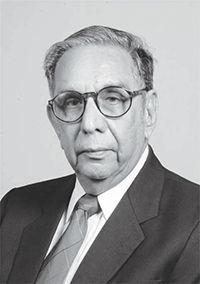
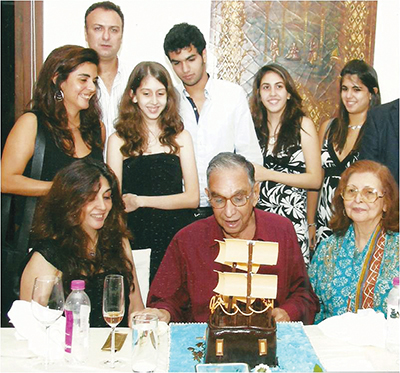
Rusi Sethna (above) with Arnavaz, daughters, son-in-law and grandchildren
"His desk was covered in a mound of papers so high that when you walked through his door you couldn’t see him or his chair on the other side,” reveals his elder daughter Navaz Ginwalla. The only way his presence could be assumed was from the large cloud of smoke billowing out from his pipe. But when asked to trace any document from the piles, he could fish it out in seconds! His friends and grandchildren enjoyed seeing him "perform his little feat!” attests granddaughter Lianne Ginwalla.
As commented advocate and solicitor Aziz Parpia, "His passing away ends a golden era of solicitors who practised the profession more by way of a crusade and not merely to earn a livelihood. Rusi had in him all the ingredients to make him a crusader — grit, hard work, capacity to go into details and a spirit of aggression… Over the years Rusi and I had our differences but that did not alter our friendship. When it came to selecting a solicitor to file a suit to protect the estate of my father-in-law Dr V. L. Parmar, the choice was obvious, it was Rusi. When it came to filing a petition in the High Court on behalf of the Rahejas for protecting the Juhu property (J. W. Marriott) the choice was obvious, it was Rusi.”
"His greatest assets were his ability to make the most complex situations look simple and his remarkable memory (he would pull out judgments which he had referred to last during his student days),” recalled Kaiwan Kalyaniwala, initially his junior and subsequently his partner at Manekshaw and Sethna. "He thought out-of-the-box and brought issues to the table that nobody had thought of,” stated the younger partner who realized that Sethna had "a very short attention span — he would lose interest in a matter very fast; hence it was important to place all the facts of a matter clearly before him” to ensure that he emerged with a solution.
"A brilliant single example of the way Rustomji’s mind worked is illustrated by an example of what we had to do in Kalyan,” mentioned Sethna’s close friend and co-trustee of The Parsee Zoroastrian Anjuman of Kalyan Dosu Bhiwandiwalla. He related, "On the outskirts of Kalyan we as a trust had a dakhma. This was disused for over 40 years. We were approached by the Swami Narayan Temple Foundation to give them the land on which they would construct a medical college. In this college they would reserve seats for Parsi students whom we could nominate. Many members of the community were up in arms holding us responsible for the desecration of the holy land. But Rustomji and I stood fast. We had a simple argument: What would serve the community better — seats every year in a medical college for Parsi students or a disused piece of land which was being encroached upon on a daily basis?” This matter continues to be embroiled in legal controversy to this day.
Having closely observed the Bombay Parsi Punchayet (BPP) electioneering system, Sethna had played a key role when the Committee for Electoral Rights was formed to bring about an awareness within the community in 1980. In the 1992 elections too his timely legal intervention ensured that the Anjuman Committee seats were not cornered by any one group. In an interview with Parsiana, (see "Leading the court campaign,” September 1992) Sethna had opined that BPP trustees should not be "treated as gods; view them as servants.” He believed that a good BPP trustee should possess "vision…to see far ahead into the future; the ability to take a decision, right or wrong; and boldness and persistence to implement that decision.” On the subject of cremation, he championed each individual’s right to make his own choice.
Sethna served as trustee on some community institutions like the Girton High School and Avabai Petit School, the R. D. Sethna Scholarship Fund and the Mottibhai and Nowroji Contractor Charity, the Umrigar Agiary and Sanatorium. As trustee of the Petit Fasli Atash Kadeh he would also make innumerable donations towards its upkeep.
Sethna’s early education was at St Xavier’s School after which he graduated in Arts from St Xavier’s College, in Law from the Government Law College, ranking first in the Bombay University, and once again topped the batch at the solicitors examination. He then joined his father’s law firm, Romer Dadachanji Sethna and Company where his mentor was Faredoon Dotivala and where he was later made a partner. After the dissolution of this firm he was a partner at Maneksha and Sethna.
During his student days, his love for dramatics manifest itself at different times, attest his batch mates. Senior advocate of the Supreme Court Tehmtan Andhyarujina referred to their amateur recital from Shakespeare’s Julius Caesar on All India Radio. Director Sam Kerawala remembered Sethna acting and serving as assistant director in The Necklace, a play written by Adi Marzban.
"My father had a wonderful way with words,” mentions his younger daughter Behroze Mistry who admired his prowess at both the spoken and written language. "He would have made a great professor, right from Shakespeare to history to political science to music… he could teach me any topic on any subject…all last minute.” In fact he even taught Shakespeare and poetry to all his four grandchildren during their school days. Behroze was appreciative too of his assistance with their debate speeches, the mock debate practice at home, as also his guidance for their school drama competitions which helped them emerge winners.
Describing her father as "a total family man, supportive and rock solid always,” she recalled the children looking forward to their Saturday night dinners at favorite restaurants with the parents and their group of close friends. Every Sunday was a family day when they would visit their grandparents in Bandra. Whilst Sethna’s favorite hill station was Mahableshwar, every year the family would proceed to different holiday destinations in India.
"We at the Willingdon Club will always remember him as a pillar of strength and a great administrator. We shall miss his advice over the years,” noted a condolence letter from Adi Narielwala to recall the services of Sethna as a trustee of The Willingdon Sports Club. Sethna’s favorite jaunt in Bombay though was the Ripon Club where he had served as president and his standard lunch from Monday to Friday for nearly 50 years was the Club’s chicken sandwiches.
An active Freemason, his interests extended to horse racing, cricket and classical music though he enjoyed Frank Sinatra, Beatles and Abba too. He was computer savvy and managed to familiarize himself with new technology effortlessly.
On the subject of religion and the Parsi community, Sethna had "very distinctive views,” according to Bhiwandiwalla. "In his personal belief and in his personal actions he was a very orthodox and ultraconservative person…However he always maintained and lived by the adage ‘to each his own.’”
The popular member of the Bar is survived by his wife Arnavaz, daughters Navaz Jehangir Ginwalla and Behroze Shapoor Mistry, and sister Dhun Dorab Adenwalla.
◆ ◆ ◆
From the archive