
In Memoriam
“The custodian... and conscience”
Died: Noshir Dinsha Sidhva, 90, industrialist who built Grindwell Norton Limited (GNO) into India’s leading manufacturer of abrasives and silicon carbide, in Bombay on May 11, 2014 following cardiac arrest.
"A strong, visionary leader, a fountainhead of knowledge, a sharp mind, an eye for detail... You challenged us to be the best, you empowered us to achieve the impossible,” noted a tribute from the management and employees of GNO whom he steered for several decades as vice chairman and managing director. The financial year (2012-13) saw GNO achieve gross sales of Rs 991 crore, an operating profit of Rs 137 crore and a net profit of Rs 98 crore, reported his son-in-law Anand Mahajan who is the current managing director of the company. GNO also manufactures and markets high performance refractories and performance plastics products.
"A strong, visionary leader, a fountainhead of knowledge, a sharp mind, an eye for detail... You challenged us to be the best, you empowered us to achieve the impossible,” noted a tribute from the management and employees of GNO whom he steered for several decades as vice chairman and managing director. The financial year (2012-13) saw GNO achieve gross sales of Rs 991 crore, an operating profit of Rs 137 crore and a net profit of Rs 98 crore, reported his son-in-law Anand Mahajan who is the current managing director of the company. GNO also manufactures and markets high performance refractories and performance plastics products.
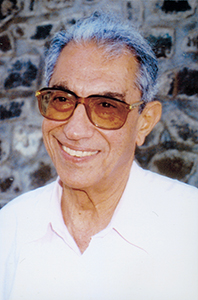
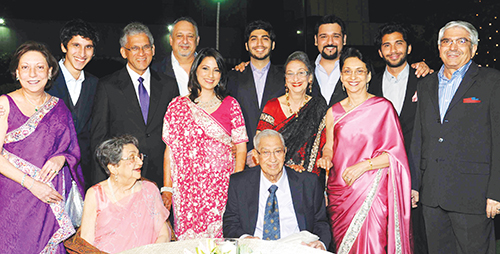
Noshir Sidhva (above) with Aloo, daughters, sons-in-law and grandchildren
Sidhva was "a true leader and he laid the foundation on which GNO prospered in later years,” stated Amal Chakrabortti, chairman of GNO until last year, who recalled being "deeply impressed by his honesty, integrity and ethical standards.”
In 1967 it was Sidhva who led the Grindwell team in negotiations for a technical collaboration with Norton, an American company and a world leader in abrasives. Four years later the two companies entered into a financial partnership with a 50:50 stake to create GNO. In 1983 GNO became a public company and was listed on the Bombay Stock Exchange after Sidhva managed to convince the promoters that this move was in the best interests of the company. A year later, at the age of 61, he stepped down as managing director as he wanted to set an example. He continued to guide the fortunes of GNO as vice chairman though and was appointed director emeritus. Following Compagnie de Saint-Gobain (CSG) acquiring Norton Company in 1990, Grindwell became a majority owned subsidiary of CSG, paving the way for substantial expansion and profitable growth in the subsequent decades.
"I will remember Noshir as a man of great wisdom. A strong businessman with a long-term vision, we owe him a lot,” noted a condolence message from Pierre-Andre de Chalendar, chairman of CSG. Yet another international colleague Jean-Pierre Floris wrote, "I know that without him we would not have done the partnership…” To Philippe Crouzet, he was "a kind of the essential Wise Man, after being a successful businessman.”
Having initiated several schemes for the well-being of his workforce, Sidhva was respected and admired by his team. "He was a great people’s man who connected very well with his employees,” commended M. R. Ramarathnam, vice president, Project Engineering Group at GNO, who further appreciated his "high energy levels, not to speak of his intense knowledge of abrasives, business and processes.”
As acknowledged Babu Vichare, "Noshir Seth is the man who built this company…He was so hard working and so disciplined…he would be in office even on holidays… I joined the company at a very early age and whatever I have learnt…is due to Noshir Seth.” To Baji Kalvachia who had worked for GNO, Sidhva was "a towering personality… The custodian of enhanced Grindwell profile and conscience who touched many lives… who made many lives.”
Ever gracious and generous, office space at Grindwell was made available to the nascent Committee for Electoral Rights (CER) for its meetings when it was devising strategies to generate community involvement in the run-up to trusteeship elections of the Bombay Parsi Punchayet (BPP). When the CER booked Sir Cowasji Jehangir Hall for a public meeting in 1980 several leaders were apprehensive whether they would be able to fill the venue. But Sidhva along with Behram Hathikhanawala used his networking skills to ensure everyone was aware of the meet and persuaded to attend. Finally only standing room was available at the Hall. He never lost sight of the group’s objectives and saw the body as a ginger group to create awareness about electoral rights rather than as a political party contesting BPP trusteeship elections.
Born to Dinsha and Frani Daruvala in Karachi, Noshir had studied at St Patrick’s Boys High School and appeared for his Inter Science examination from the D. J. Sind College. Since he was not academically inclined his father sent him to Bombay where a year earlier, in 1941, his uncle Pirojsha Sidhva and cousin Rustom had started Grindwell Abrasives that pioneered the manufacture of grinding wheels in India. Like many others in the family in Bombay, he too chose to adopt the surname Sidhva instead of Daruvala. Working at Grindwell alongside two Czech engineers, E. J. Kaufmann and F. B. Lima, Noshir soon grasped the logistics of every department in the business and was competent to handle the responsibilities. His visits to factories in Europe and America further helped him to gain an in-depth knowledge of the subject.
Being drawn to water sports since his younger days in Karachi he would invariably win swimming competitions conducted by his School and the Karachi Parsi Institute. With his two close friends, Kerse Naoroji and Rusi Kabraji (the latter subsequently married his sister Meher), Noshir would frequently escape to the Bath Island Creek for a swim in the forbidden area. In Bombay, he often chose to travel the distance from the Gateway of India to the factory’s Mora Plant at Uran, skiing on water, if the weather conditions were favorable. Referring to his love for dogs, his sister Meher recalls, "Once when his dear Chico jumped or fell in the sea between the launch and the wharf at Bombay Docks, Noshir promptly jumped in and brought him to safety.”
The debonair young man who had expensive tastes also learnt tap dancing for which their father arranged for special wooden flooring in the house. When ballroom dancing came in vogue, Noshir’s skills on the dance floor made him a much sought after partner. Shortly after the Partition of India and Pakistan, he got married to Aloo (née Dubash) in Bombay but would visit his parents and sisters in Karachi as frequently as he could. When two of his daughters chose marriage partners from outside the Zoroastrian faith, the liberal father respected their decision.
Among his close friends in Bombay were Naoroji and Soonu Godrej, and in a tribute paid by their son Jamshyd, chairman and managing director of Godrej and Boyce, he refers to Sidhva’s "entrepreneurial genius and interest in the latest management techniques (that) stood him well throughout his career… He believed in the power of philanthropy for social change. He was a trustee of the Pirojsha Godrej Foundation and a director on the board of Godrej and Boyce (whose) contribution will long be remembered.”
As summed up by Hathikhanawala, Sidhva’s life was "an essay on the history of industrialization in India (with) his hands-on experience of the challenges the country faced in industrializing an otherwise agrarian economy, straddling the Raj years, World War II, freedom struggle years, State planning, socialistic pattern of society, harsh tax regimes, crony socialism, the crises years and globalization. In all these challenges Noshir together with Anand built Grindwell into one of the much envied successful operations… To me, Noshir was a boss, colleague, friend... The years spent in adjoining offices were the most cheerful, productive and happy years of my life I still want to remember.”
The visionary entrepreneur is survived by his wife Aloo, daughters Khursheed Malvinder Narang, Vera Anand Mahajan and Nina Gayomard Bharucha, and sisters Mani Cowasji Cowasji and Meher Rusi Kabraji.
◆ ◆ ◆
From the archive