
Nurtured by Neterwala
As a 12-year-old student in Deolali, Neterwala had shown the makings of an entrepreneur by launching his first business, repairing radios for British officers. Even when he was 93, by which time he had created an empire of 15 ethically run, technologically driven manufacturing companies under the banner of Neterwala Enterprises, he would regularly visit his office. He had pioneering companies in industries as diverse as speciality chemicals, pharmaceuticals and detergents, construction and mining, engineering goods and technology, iron and steel and alloy steel foundry, finance, exports and electronics.
"He was a visionary who understood the value of advanced technology and the importance of research and development in progressive joint ventures,” acknowledged his daughter Shernaz Vakil adding, "He always taught us to be fair in a deal and ensure that the other side got more than what we took for ourselves. This resulted in his creating a wealth of goodwill for himself amongst his peers in industry.”
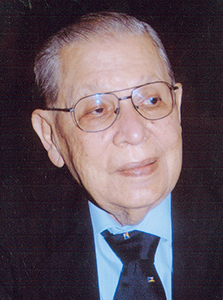
Dhunjishaw Neterwala: a wealth of goodwill
Several of them attested to his largesse in their condolence messages. Referring to his "considerable contribution” to the cause of Indian Speciality Chemical Manufacturers’ Association, president Deepak Bhimani mentioned that their former president was "a friend, well-wisher and guide of the Association for many years.” Neterwala had thrice served as president of Indian Ferro Alloy Products’ Association and twice as president of Indian Chemicals and Auxiliaries Manufacturers’ Association. On two occasions he was nominated by the Government of India as a member of Development Council for Oils, Soaps and Detergent Panel.
Nalin Shah, owner of B. S. International and M & C Holland, referred to Neterwala as the generator of "kind, pleasant, caring and loving memories.” Larry Ito, global director of Tolling Global Supply Chain, NALCO Champion, similarly expressed, "Memories of his contributions to our lives will be endearing.” Declared G. V. Sanjay Reddy, vice chairman of GVK Power and Infrastructure Limited, "He was a great man who has impacted so many people positively.” Chairman of GVK Biosciences Private Limited Davinder Brar remarked, "I carry an image of a humble, sincere and strong willed man with great character.”
Attested Gill and Mike Hardy of Onyxnet, Neterwala was "courteous but firm and certainly did not suffer fools gladly in negotiating mutually satisfactory business relationships.” Describing him as "a gentleman in the truest sense of the word,” another collaborator Rene Trevino wrote, "I doubt if there are many men who possess his vitality, integrity and his high regard for others.”
Believing in research, he was able to recognize the worth of scientists and technologists who helped him venture into uncharted territories, creating opportunities and empowering his employees. Stated T. L. Hill, associate professor at the Department of Strategic Management, Fox School of Business, Temple University, "He had great dignity and calm, as well as a lot of curiosity.”
Referring to his "dear client for almost 40 years,” chartered accountant Vispi S. Dastur recalled him as "a very intelligent, tall, graceful gentleman who was very kind not only to me in my younger days but also to my staff and others.” Soli Contractor, director of Ave Marine Services Private Limited, wrote "Dhunji Uncle was a very dear family friend…He was a very special person.” At his funeral, the family was overwhelmed by the number of people who came up to them to appreciate how the patriarch gave them their first break when they had nothing.
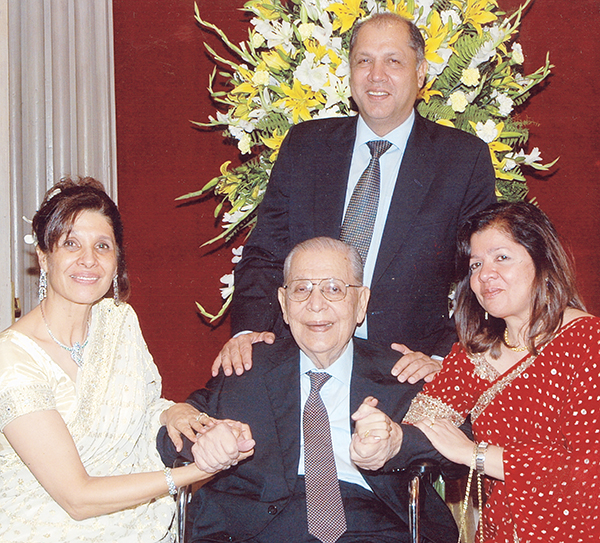
From left: Pervin Mehta, Dhunjishaw and Feroze Neterwala, and Shernaz Vakil
Dadi Mistry, former president of the Delhi Parsi Anjuman recalls the time he was working for J. N. Marshall in Poona in the early 1960s and had bagged a contract from Neterwala to install steam piping at the Dai-ichi Karkaria factory there. Meeting at the site, the two decided to have breakfast at The Coffee House then run by Piloo and Perin Balsara. The bill came to a little over eight rupees and Neterwala instructed Mistry to pay as he would be receiving a one percent commission on the piping contract.
"I had only a 10-rupee note in my pocket,” recalled Mistry. "I paid and quickly put the change in my pocket.” Once outside Neterwala stuffed a hundred-rupee note in Mistry’s shirt pocket and told him to take his "girlfriend out for a meal!”
Years later Neterwala donated Rs 45,00,000 in two instalments to construct 12 additional rooms on the second floor of the Mengusi Dharamshala, commonly referred to as the Delhi Parsi Dharamshala.
Growth potential
Neterwala always acknowledged his humble beginnings. At the age of 15, with a loan from his father he started a small radio repair shop and three years later ran his own construction and transportation business. On completing his education from St Xavier’s College in Roorki, he assisted his father Maneckji who was an army contractor.
After constructing a ferro manganese plant in Maharashtra in 1954, over the next 25 years he had floated diverse companies: for the manufacture of reclaimed rubber, a chemical company at Pimpri, mining activities in Madhya Pradesh, an alloy steel foundry at Thana, a detergent facility in Punjab and Andhra Pradesh plus many other industries with the collaboration of his international partners. Known for his financial acumen and ability to identify growth potential, he served as chairman of eight companies and was on the board of nearly a dozen.
"He was extremely transparent in whatever he did and would treat everyone with the same respect… He walked the talk,” summed up his son Feroze who marvelled that his father "created a huge conglomerate and yet died almost like a pauper if you were to see the condition of his room or his car.” Dhunjishaw believed that his son should come up the hard way and Feroze recalled that when he joined the business in the 1970s, for the first three years his daily morning commute required him to walk from their residence at Malabar Hill to Grant Road station, then take a train to Dadar, change over and take another train to Thana and from the station avail of the fastest road transport to their factory. "Today I am reaping the rewards of that,” he acknowledged.
Particularly interested in the welfare of his employees, at Tumsar near Nagpur, he had introduced several facilities including a school and a hospital in the name of his parents that benefitted not only the workers and their families but also the other poor villagers. His charitable disposition had earned him respect and reverence from his employees. His elder daughter Pervin Mehta related how some of his dedicated staff members decided to pay him a tribute by "getting his portrait made and asking the family to hang it up at the office.”
Besides serving as president of the Theatre Owners’ Association of India for two terms he was also involved with community organizations. In deference to his mother Shirinbai’s wishes he built a hall and guest house at Deolali, mentioned Mehta. After serving as president of the Deolali Parsi Anjuman for a short span he handed over the reins to his brother Bomi. Dhunjishaw was also a trustee of the Dr K. N. Bahadurji Sanatorium there.
As chairman of the Bai Shirinbai and Maneckji Neterwala Charitable Foundation that he founded in memory of his parents, his main focus was to educate the youth. He encouraged young students to return to India after their foreign education and to contribute to nation building. "He had a fierce love for his country and would try to bring in the latest technologies to ensure India could and would compete with the rest of the world,” remarked Vakil.
His charities also extended to the old and ailing who would regularly apply to his foundation for aid. Even at the age of 93 he would vet every application and decide how much assistance should be extended whilst never seeking publicity or gratitude. "Leading a simple, austere life, for years we only saw him dressed in white. Never content to sit idle he always impressed on us the need to do something worthwhile,” said Mehta.
"He lived a life of a true Zoroastrian; not only did he have strong belief in the faith, he practised the tenets spontaneously and from his heart,” stated Vakil who added that "he continued to hold the traditional views of his Parsi background but had the vision to be practical, where it counted, often admitting that the community needed to change on many fronts.”
The visionary entrepreneur is survived by his daughters Pervin Russy Mehta and Shernaz Firoze Vakil, son Feroze, brother Minoo and sister Dosu Dara Nalladaru.