
In Memoriam
The iconic industrialist
"I have never read a book on management. My concept of management is to make people happy in the work they do and so get the best out of them. Two Biblical injunctions have guided me throughout my career, ‘Do unto others as you would have them do unto you’ and ‘Love thy neighbor as thyself.’” Russi Mody, the former chairman and managing director of Tata Iron and Steel Company Limited (now known as Tata Steel) as also of Tata Limited, London, Tata Incorporated, New York, Tata Timken Limited, Tata Metaliks Limited, Tata MANN GHH Limited, Air India, Indian Airlines and Hotel Corporation of India Limited had shared his management mantra in an interview with Parsiana (see "The Great Achiever,” Parsiana, May 1995) two decades prior to his demise in Calcutta on May 16, 2014 at the age of 96.
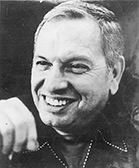
"An iconic figure and an eminent industrialist, Mody was known for his vision, hard work, determination and immense contribution to the Indian steel industry. His entrepreneurial abilities resulted in Tata Steel becoming a benchmark for the rest of Indian industry,” noted a condolence message from the President of India Pranab Mukherjee.
Committed to the steel behemoth for over five decades, Mody emerged as "an institution at Tata Steel. Under his leadership Tata Steel grew significantly and he instituted many human resource initiatives,” acknowledged Ratan Tata, chairman emeritus of Tata Sons. "Russi’s vision was all encompassing: excellence in business, enduring commitment to society and focus on the dignity of the individual,” read a tribute from Cyrus Mistry, group chairman, Tata Sons.
At a reception hosted at Bombay House to celebrate Mody’s 50 years at Tata Steel, J. R. D. Tata had stated, "What is Russi’s real claim to fame? I have no doubt that it is his spectacular capacity for leadership… The capacity to inspire respect, admiration, affection, friendship and, above all, trust… Russi has all the strengths as well as the foibles of a leader… He has endeared himself to all — and certainly to me — by the fact that he has remained not only human but modestly human… Russi is a man who has his own ideas and his own ways of doing things. He is a strong man. He has shown it throughout his career and caused a lot of trouble to some of us at some time or the other! But as all strong men, he has a mind of his own, and he has pursued it, occasionally against the views of others, (although) always in great honesty and in a spirit of human service.”
For his part, Modi acknowledged JRD’s "considerable influence,” being "a person whom I admired greatly, the way he did things, the way he behaved. If I had not known him, sometimes I feel I would have grown into a very pompous individual… I think he had a lot to teach me on how to behave naturally, irrespective of what position one holds.”
Born to luxury, being the eldest son of Sir Homi (a member of India’s Constituent Assembly) and Jerbai Mody, he learnt early in life "that all my education, training and background at Harrow and Oxford was not going to be of any use” when he came face-to-face with the brazen hostility of the workmen. Once he understood their difficulties and managed to rid them of their antagonism towards management, he was able to establish an easy rapport. From dining at exclusive restaurants like the Savoy Grill and Claridges in London, the short, stocky leader had now adopted an inclusive approach, visiting the humble abodes of his workmen on Holi or joining them at the workers canteen wearing his famous Hawaiian shirts. On his birthdays he would be given royal treatment when 20,000 or so workers would troop into his bungalow, garland in hand, and later join a procession with Mody atop an elephant!
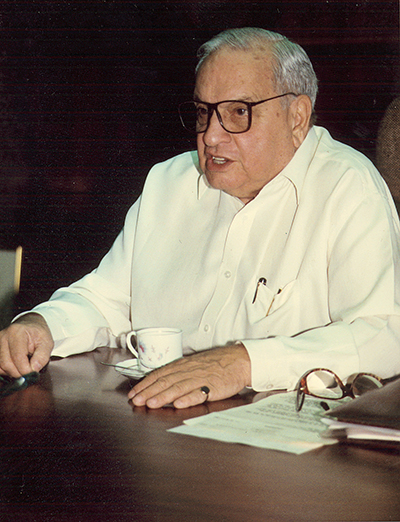
Russi Mody
Photo: Spectravision Lab
That a large, modern company like Tata Steel was undisturbed by strikes or other labor problems for nearly 50 years was primarily due to Mody’s accessibility. Whether redressing workers’ grievances, acceding to or rejecting requests, Mody always believed in giving a rationale for his decision. As he had related to Parsiana, "Our talks were free and frank. No holds barred. My workers had the right to call me ‘bloody fool,’ so long as I could also call them the same!” It is to Mody’s credit that in 1978, the Tata Workers Union unanimously adopted a resolution opposing the nationalization demand instigated by George Fernandes and Biju Patnaik. Despite joint opposition from the management and union, the Bihar government took possession of the town of Jamshedpur but when they realized they could not handle the once efficiently run model township, they returned it to the Tatas.
Under Mody’s leadership Tata Steel had registered a massive growth from 56,000 tonnes to 7,98,000 tonnes. Sales had grown from 33,000 tonnes to 6,80,000 tonnes, as per figures shared by Mody’s nephew Jimmy Mody who summed up his uncle’s philosophy of management as "The three ‘C’s: credibility with his peers and subordinates, courage to follow one’s convictions, and compassion for everyone.” Having earned the sobriquet of "India’s steel man,” he was conferred Business India’s Businessman of the Year award in 1983 that acclaimed him for being "scrupulously fair. His charm and sense of humor combined with candor and a certain driving honesty, earned him universal respect.”
Within the next decade he had won 13 other honors including the Padma Bhushan from the Government of India. For its television serial, "The Money Makers,” the British Broadcasting Corporation selected Mody among the six greatest industrial personalities of the world. Some years later, it was against his wishes that he was compelled to relinquish his responsibilities at Tata Steel when he had reached the retirement age. At an extraordinary general meeting of Tata Steel, a shareholder had then enquired what award should be conferred on him. Known for his wit and sense of humor, Mody promptly responded, "I got the Bamboo of the Year!”
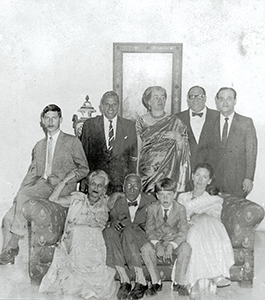
Russi Mody with family (standing, from left) Vina, Piloo, Kali,
(sitting) Jimmy, Lady Jerbai, Sir Homi, Danny and Nina
In 1993 at the invitation of P. V. Narasimha Rao’s government, Mody took up chairmanship of the ailing Air India and Indian Airlines but soon realized, "Running an industrial culture and running a government department are two different things. I can no more run a government department than a secretary can run a corporation. I cannot break or change the system… I have been able to make some improvement in the working of Indian Airlines… Many more such improvements are necessary without which — make no mistake about it — Air India may have to close down and Indian Airlines cannot hope to flourish. In Tatas things were much better. JRD encouraged me and gave me a free hand.”
Besides Tata Steel his influence had extended to other national bodies like the Engineering Export Promotion Council (now EEPC India) where Mody as former chairman was known "for his humility, compassion, hard work, determination and sincerity,” stated current chairman Anupam Shah.
The bon vivant who enjoyed a full and varied life could fly an aeroplane, ski, enjoy his games of tennis and golf, play the piano and had once, during their Oxford days, accompanied Albert Einstein when the latter was giving a violin recital. The gourmet who is known to have had a voracious appetite was a good cook himself. His association with Tatas from 1939 to 1993 brought him many perks, a lovely residence, houses abroad, his private plane… and as he unabashedly declared, "I enjoyed this lifestyle, lived it up to the hilt — as long as it lasted.” One of his "greatest blessings” was the family life he enjoyed with his parents and younger brothers Kali and Piloo. With his privileged upbringing, Mody had studied at Harrow School in England and Christ Church College in Oxford. He was married to his cousin, the late Siloo. Though not a ritualist, Mody who was cremated believed in "a Supreme Being who regulates my life beyond myself and my work” and would regularly seek divine blessings through the two prayers of Ashem Vohu and Yatha Ahu Vairyo.
For five years he was president of the Jamshedpur Parsi Association which held a condolence meeting on May 30 when many spoke of his multifaceted life and shared their personal encounters. "The people of Jamshedpur and our own community in particular will dearly miss Russi,” noted the chairperson of the Association Katy Gabba. The only time an executive council meeting of the Federation of the Parsi Zoroastrian Anjumans of India was held in Jamshedpur was in December 1987 when Mody was president. When he was categorically asked whether the Parsis should pursue reservation, Mody had then commented, "Even today the community is in the forefront of activity… I don’t think reservation is required for the next few years.”
He was also chairman of Friends of Trees, West Bengal and Xavier Labour Relations Institute, Jamshedpur. At the All India Organization of Employers, the Indian Chamber of Commerce and the Academy of Fine Arts he served as president. The football fan had started the Tata Football Academy. "The first thing that strikes you about Russi is his inconsistencies — he conforms to no pattern,” his personal assistant S. P. Sarathy had written in the book Russi Mody: Glimpses of a Legend. "He can be a corporate leader on Monday, a mischief maker on Tuesday, an aristocrat on Wednesday, a labor leader on Thursday, a friend of the poorest on Friday, hobnob with aristocracy on Saturday and indulge in the most childish pleasures on Sunday… He lives like a king ...” revealed Sarathy.
For his company he had coined the catchphrase "We also make steel.” It was only fitting that obituary announcements in his memory released by Tata Steel referred to him as "The man who also made steel.”
◆ ◆ ◆
From the archive