
In Memoriam
Guzder’s geniality
"God give me thy wisdom, thy guidance, and the wherewithal, so that I can do good in this world by bringing peace and happiness in the minds and hearts of my fellow men…” This daily prayer, recited by Jamshed Nusserwanji Guzder every morning on waking up and each night before retiring to bed, helped him face many of life’s challenges to emerge as a respected businessman who founded Airfreight Limited and popular chairman emeritus of the Bombay Parsi Punchayet (BPP).
Bonhomie and savoir faire were Jimmy’s (as Jamshed Guzder was popularly known) most abiding characteristics, together with his generosity, as speaker after speaker at the condolence meet convened by the BPP at the Walchand Hirachand Hall of the Indian Merchants’ Chamber (IMC) on September 17, 2010 had stories to tell that illumined the many social and business involvements of 93-year-old Guzder who died in Bombay on August 20, 2010.
"He genuinely and truly believed that life is worth living only by giving joy to others,” attested economist and management expert Minoo Shroff who had succeeded Guzder to the BPP chairmanship, recalling his "cherubic face and friendly smile.”
"He enjoyed all the good things in life but did not lose the common touch. He could run businesses and yet be very comfortable with the labor unions,” noted BPP chairman Dinshaw Mehta.
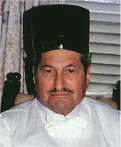
Alongside the notice of Guzder’s passing in The Times of India (September 21, 2010) was another from the Free Trade Unions Multipurpose Trust stating it felt "orphaned” by his demise. After the initial sparring, Guzder had established rapport with dreaded trade unionist R. J. Mehta which enabled him to renew labor contracts without acrimony, not only in the companies which he directly managed but for other concerns like the Breach Candy Hospital. Later he had served as chairman of the above named charity trust that R. J. Mehta established.
Well-known solicitor and former BPP trustee Dadi Engineer recalled the first board meeting of National Peroxide he attended where Guzder was managing director, always dressed in a white suit with a colorful necktie, speaking in measured tones. Guzder would insist on driving his own red Mercedes in the night, having sent the driver home earlier, and on one occasion stopped the car in the middle of the road to pray to the moon, reminisced Engineer, highlighting Guzder’s commitment to Ahura Mazda’s creations.
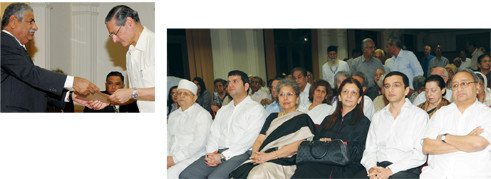
Above: Dinshaw Mehta handing the BPP resolution to Cyrus Guzder Alongside: Dastur (Dr) K. JamaspAsa with son Jamasp, Statira Wadia, Navaz, Jamshed and Farokh Guzder Photos courtesy: Nazneen Vajifdar, Spectravision
BPP trustee Khojeste Mistree recalled Guzder walking the tightrope when the DDD-AG (Disposal of the Dead with Dignity — Action Group) had demanded a bungli at Doongerwadi for the funerary ceremonies of those who opted for cremation. Himself traditionally inclined and deeply religious, Guzder had to contend with the elite of the community who were also his friends. He had asked Mistree "whether dakhmenashini functioned without vultures,” and was told to seek his answer from the holy fire. "He gave his casting vote against it and the controversy died soon thereafter,” noted Mistree attributing the development partly to Guzder’s "negotiating skill.”
Community activist Phiroze Amroli-walla referred to Guzder’s compassion for labor and his insistence that the dues of a sweeper at the Punchayet which had been denied to him on disciplinary grounds, should be restored. Noted solicitor and former BPP trustee Burjor Antia spoke of Guzder’s contribution of 1.25 crore rupees for the construction of the auditorium in the Sir Pherozeshah Mehta Bhavan at the Bombay University campus in Kalina.
"He was an icon for all of us Rotarians,” noted Rotary governor Vijay Jalan, also a member of the cargo clearing and freight forwarding industry where N. S. Guzder and Company was one of the oldest in the field. "He was a great charmer, he made people bond with him.” Guzder would contribute a lakh of rupees to Rotary every year on his birthday, without waiting to be asked, added Jalan.
Dilip Dandekar, chairman of Camlin and president of the IMC referred to Guzder’s association with the body over 30 years and his generous donations including one that enabled the construction of the terrace, thereafter named the IMC Jamshed Guzder Terrace. "The beauty of Jimmy Guzder was that he would attend meetings and contribute a lot even after his term was over,” Dandekar added.
"When Jimmy gave, the beneficiary was never made to feel humble…His actions invariably sent out a strong signal that the dignity of any human being is inviolable and sacrosanct,” noted former BPP trustee Dinshaw Tamboly in a tribute in the Parsi Press. "He loved people so much that he had neither the time nor the inclination to judge them,” remarked BPP trustee Noshir Dadrawala in another tribute.
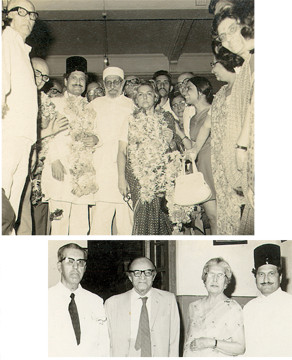
Above: Garlands for Jamshed and Shirin after the first election to the BPP. Below: With BPP chairman Boman BomanBehram (2nd from left), Nanabhoy and Dosibai Jeejeebhoy
The only son among seven daughters born to Goolbai and Nusserwanjee Guzder, Jimmy schooled at the Cathedral and John Connon while his sisters studied at the Alexandra Girls’ English Institution. Each day the family car would ferry them to and fro, until Jimmy reached the last year of school. Then his mother decided that he may go by car in the morning but had to return by the public bus. As she explained to him, "If you are brought up in luxury, you won’t know how the other half of the world lives. You won’t know how God has blessed you and what others have to go through.” The incident, included in his informal autobiography, Short Stories From a Long Life published in 2007, is one he often referred to, on and off the podium. Another dictum from his beloved mother he often spoke about, was to go to the agiary in his spare time, to pray and reflect. He took it seriously and it was a rare day he missed out. His mother’s death in 1940 was "one of the greatest blows I have suffered in my life,” he notes in the book.
A year later Jimmy wed Shirin Saher, a neighbor he decribes as "attractive, highly educated, played the piano beautifully and was always a joy to talk with.” The marriage was blessed with four children. Shirin passed away circa 2000.
"As the eldest and the only daughter in the family, I think I was very special to my father,” notes Statira Wadia. "Looking back our parents gave us a wonderful childhood. He also gave us the best possible education — never stopped me from studying archaeology though he did say ‘...don’t be a bloody fool, are you going to spend the rest of your life on a mound in the desert of Rajasthan?’…
"Something that always bothered me about Papa though, was his quite explosive temper and many were the equally explosive bouts between him and me. However, when I was marrying he told me that I must not lose my temper in my new home the way I lost it with him because even if I apologized it would be like sticking together a broken saucer — the scar would always remain.” Ironically, "One of the things that moved me deeply during his last two years, in darkness due to loss of his sight, was the stoic and good humored way he dealt with his situation. Gone was the temper, he was good humored at almost all times, never complained even when he was obviously in some distress, and somehow even with a very limited remembered vocabulary, made appropriate responses to the doctors and everyone around him.”
As recalls his eldest son Cyrus, "My father Jimmy seemed permanently to be like a ball of energy in our household. Though he worked late hours, as soon as he arrived at home… he infused all of us with energy and enthusiasm... He was not a strict disciplinarian as far as we were concerned — he left that to our mother. However, he would insist on dropping us to school everyday and, thereafter he would go on to the office, generally via the Banaji Agiary at Flora Fountain.”
Deeply religious though he was, he did not insist his family follow suit and even trips to Udvada were in the nature of family outings where he spent his time with the priests and concerned himself with the welfare of poor families while the others enjoyed the legendary Udvada breakfasts and lunches, notes Cyrus. Summer holidays alternated between Matheran/Mahableshwar and long car trips to northern hill stations or a marathon trip across South India. "In retrospect, giving us children this Bharat Darshan was an important contribution by him in our childhood…
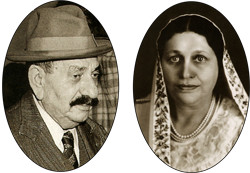
Father Nusserwanjee and mother Goolbai
"The best years of my business life were the first eight to 10 years, when he continuously mentored me. This was no formal mentoring because by then, he was heavily involved in his own business life, first in the Bombay Dyeing Group of companies and, later, on the boards of many large listed companies. But we had a sort of ritual at home: in the evening over dinner I would read out from my notes of the day all the things that I encountered which I did not fully understand and he would give me his point of view. In these discussions, I must have learnt much more quickly the fundamentals of business than had I worked elsewhere or struggled on my own,” notes Cyrus.
While easy on several other issues where his children had views different from his own — including Cyrus’ social activism that boded potential conflict with firms and businesses with which Jimmy was connected — it was on the issue of BPP trusteeship that he would not tolerate opposition.
"I remember well the evening when he came home and said he wanted to become a trustee of the Parsi Punchayet,” recalls Cyrus. "All four of us children urged him not to be distracted by an organization that appeared to be dysfunctional and riddled with inter-personal conflicts. This was one of the few occasions when I recall him getting terribly angry with the family. We got an aggressive lecture from him on why it was necessary to spend time serving the community; and that he was hugely disappointed with us if we didn’t see the values that were driving him at this late stage of his life. I think he was disappointed over the next few years that we children did not share his passion for serving the community through the Parsi Punchayet. As time went by, the only thing that we could observe was his growing and obsessive concern about the large number of people in our community who seem to be so badly in need of assistance, whether for housing, for employment or medical treatment.”
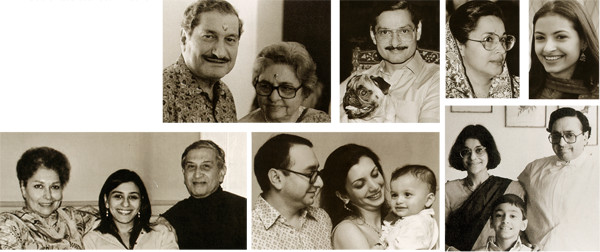
Jimmy and Shirin with their children: (alongside) Cyrus with Manek and Ayesha; (below, l to r) Statira, Shirin and Farrokh Wadia; Farokh, Navaz and Jamshed; Jaswant, Rumi and Jehangir Guzder
Guzder’s first term of BPP trusteeship spanned the decade 1975-85. He came in when solicitor Shiavax Vakil was constrained to resign following his visit to the dakhmas and report to the press on their dismal functioning. Guzder won the bitterly contested election against lawyer Jimmy Shroff but at the end of the term was faced by challenger Naoroji Godrej, "one candidate who could defeat Guzder (see "The election that never was,” Parsiana, January 1985).” On the last day for filing his nomination Guzder issued a press release stating he would not contest against Godrej but reserved the right to opt for a subsequent vacancy. It materialized when retired High Court judge Jal Vimadalal resigned from the Pun-chayet in January 1986 and Guzder came in unopposed. After that, there was no looking back. In 1993 he was elected chairman of the BPP board when Dr Aspi Golwalla retired but had to face a legal challenge from trustee Eruch Desai who had become senior to him as he had lost a year when he was out of the Punchayet. The court upheld seniority as the criterion for chairmanship and Guzder had to step aside until Desai’s term ended three months later. As Desai chose to retire from the Punchayet, Guzder returned to the chairmanship until 2003 when he was designated chairman emeritus.
At various junctures during his long innings Guzder had spoken to Parsiana about the need for the accountability of trustees to the community, his concern for keeping the youth within the fold, providing his Marve shack for picnics organized by the BPP’s matrimonial bureau, keenness to develop more housing for the community, etc. His biggest obsession was the dwindling size of the community and he introduced a scheme for the Punchayet’s support of the third child until the age of 18, later widened to include the second child of low income families. He had told Parsiana in 1993, "Getting elected and occupying the chair of president is only the beginning. It is like opening a door and there’s a fairly long road ahead which one has to travel to see what’s at the end.” As the BPP resolution read by BPP PRO Godrej Dotivala noted, "His lifespan of 93 years covered an entire era.”
Guzder is survived by his daughter Statira Wadia, and sons Cyrus, Farokh and Jehangir.
◆ ◆ ◆
From the archive