
Heritage
Exhibition euphoria - II
“Painted Encounters — Parsi Traders and the Community” and “No Parsi is an Island” exhibitions mirror the community’s achievements
"Absorption, harmony and concord is an insignia of the Parsis of India,” commented Prof (Dr) Rajeev Lochan, director of the National Gallery of Modern Art (NGMA), New Delhi, the venue of the exhibition: "Painted Encounters — Parsi Traders and The Community” curated by Pheroza Godrej and Firoza Punthakey Mistree, and "No Parsi is an Island” curated by Godrej, Nancy Adajania and Ranjit Hoskote. To visitors from Bombay, this two-month exhibition inaugurated on March 20, 2016 was reminiscent of the one they had enjoyed two years earlier: "Across Oceans and Flowing Silks: From Canton to Bombay 18th-20th century” and "No Parsi is an Island.”
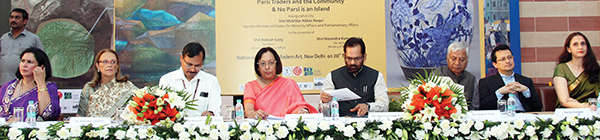
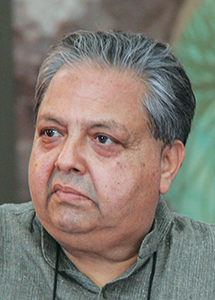
(From left): Firoza Punthakey Mistree, Pheroza Godrej, Narendra Kumar Sinha,
Dr Najma Heptulla, Mukhtar Abbas Naqvi, Rakesh Garg, Ranjit Hoskote and Nancy Adajania;
Dr Rajeev Lochan
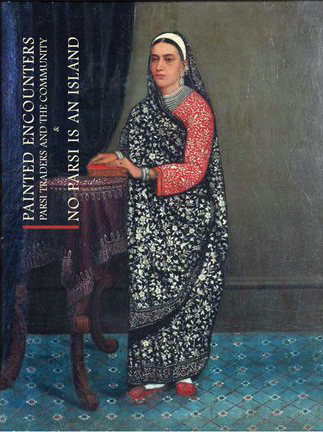
Catalog cover
As reminded Lochan, the Delhi exhibition traces "the Parsi narrative as it emerges in the early colonial world. The community’s collective struggles to assert its economic independence as traders, shipbuilders and mediators in a strange land is exhibited through documents, ship models, portraits, paintings and memorabilia. It addresses the Parsi artist as a participant in the history of modern and contemporary India, and as a cosmopolitan navigator… Their intelligence, wit and humor is articulately depicted in this exhibition.”
The small Parsi community is one of the most liberal, educated, development-oriented and modern, commented Mukhtar Abbas Naqvi, union minister of state for parliamentary affairs and minority affairs, when inaugurating the exhibition. In his speech in Hindi he conveyed his "salaam (salutations)” to the community that has contributed to different fields of art and literature and sacrificed for the nation.
"‘Painted Encounters’ has been a journey of research with a cosmopolitan narrative. We hope to spread the knowledge of Irani Parsi culture and rediscover (the community’s) role in Indian history,” stated Godrej. She referred to the ravages of floods and Shivaji’s attacks on Surat that compelled many to leave the shores of Gujarat over the last three centuries. With Lovji Wadia and other shipbuilders "there was a slow exodus to Bombay.” Lucrative trade opportunities in China in the 19th century drew many and it proved to be "a vast learning ground” when in the absence of language skills they "used their business acumen” to hold their own against other foreign companies. "They brought their wealth to Bombay to build hospitals, schools, promote art…” the audience was told.
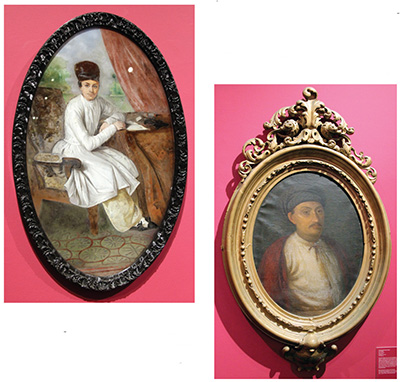
Portraits of Sohrabjee Jamsetjee Jejeebhoy (left) and Hormarjee Bomanjee Wadia
It is their mirth that has helped the Parsi community do "so well in life with a smiling face,” observed Dr Najma Heptulla, union minister for minorities, whose support was considered crucial for the success of the exhibition. "If a community can crack a joke on itself, it is the best humor; on others it becomes vulgar,” added Heptulla. She recalled her interactions with parliamentarian Piloo Mody who dared to send a note to then Prime Minister Indira Gandhi, simply signed ‘PM.’ On another occasion he told Heptulla, "Now that you are the chair (of the Rajya Sabha), I can take more liberties.” Looking him up and down to insinuate his rotund size, she told him that he wouldn’t be able to take too many!
According to Adajania, the curators "negotiated the ethnographic framework to reflect on how Parsi artists have engaged with the nationalist movement…the dilemmas of globalization…” "No Parsi is an Island” focuses on artists from the late colonial period to the present whose work "connects them to larger questions, concerns and urgencies.”
To create "an exhibition of this scale and this magnitude” required the support of the community and Lochan thanked "the lenders for believing in us and lending something so precious.” Keen that the exhibits on view should not be only those "in the possession of NGMA but ones which Delhi may never have an opportunity to see again,” he declared, "A museum is not a warehouse but a catalyst… a facilitator to enrich lives and provide opportunities for community engagement.”
Expanse of the exhibition
HMS Trincomalee, the oldest British warship built in Bombay by the master shipbuilder from the Wadia family, was launched in 1817 and is still afloat at Hartlepool, UK. The model of HMS Trincomalee, borrowed from the Indian Navy, enjoyed pride of place at the "Painted Encounters” exhibition at the NGMA. To bring in the model, the glass doors at the entrance had to be removed from their hinges, revealed Godrej.
HMS Trincomalee, the oldest British warship built in Bombay by the master shipbuilder from the Wadia family, was launched in 1817 and is still afloat at Hartlepool, UK. The model of HMS Trincomalee, borrowed from the Indian Navy, enjoyed pride of place at the "Painted Encounters” exhibition at the NGMA. To bring in the model, the glass doors at the entrance had to be removed from their hinges, revealed Godrej.
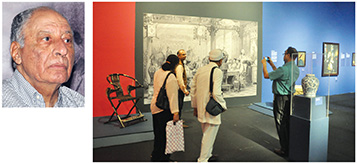
Above: Keki Daruwalla; (right) visitors at the NGMA exhibition
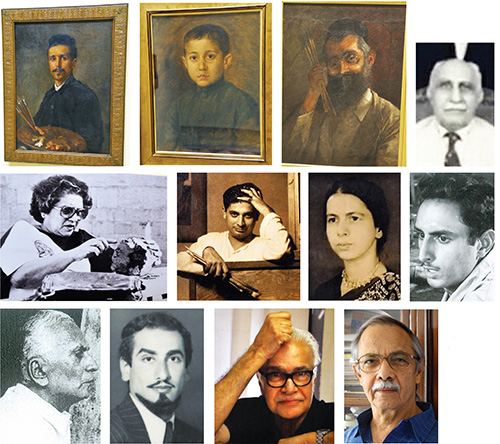
From left (1st row): self portrait of Manchershaw Pithawalla, Manchershaw’s portrait of his son, self portrait of
Pestonjee Bomanjee, Jehangir Lalkaka; (2nd row) Piloo Pochkhanawala, Shiavax Chavda,
Nelly Sethna, Jean Bhownagary; (3rd row) Homi Patel, Jehangir Sabavala, Mehlli Gobhai, Gieve Patel
Comprising over 200 works, the exhibition traces through the media of paintings, engravings, lithographs, carved furniture, embroidered textiles and photographs the extraordinary evolution of Parsi traders who built ships and facilitated trade with Canton in the 19th century. Parsi merchants hailing from hamlets in Gujarat and rich from the China trade commissioned Indian and European artists to paint portraits. The activities of the leading Parsi traders boosted capital accumulation and helped shape 19th century Bombay into an international financial metropolis.
"Their long stay in China… had resulted in close contact with British traders, sea captains, soldiers and officials of the East India Company… The homes of wealthy Parsis in India took on a European look and apart from furniture, drapes, porcelain and statuary, portraits became increasingly popular… These traders brought back with them portraits executed by Chinese artists either from engravings made in London or from photographs that were taken once this medium was introduced in India… Several Parsi portraits done by Lamqua (1801-60) and Sunqua (active 1830-1870) are in existence,” explain the curators in the 330-page hard bound catalog.
"Once the transformation to westernization took root and European ways were grafted onto Parsi thought process, they began to associate European ideas with being progressive and having enlightened values and they were able to shed their old traditions… Westernization demanded a change in approach, an embracing of new ideas and brought with it its own contradictions. It affected traditional Parsi society and social behavior and transgressed the boundaries set by the elders and challenged the established mode of thinking. At a time when a safe profession that brought in money was of being a trader or a businessman, the idea that a Parsi could in any way make a profession out of art was incredulous and defied community’s time honored perceptions,” added the curators.
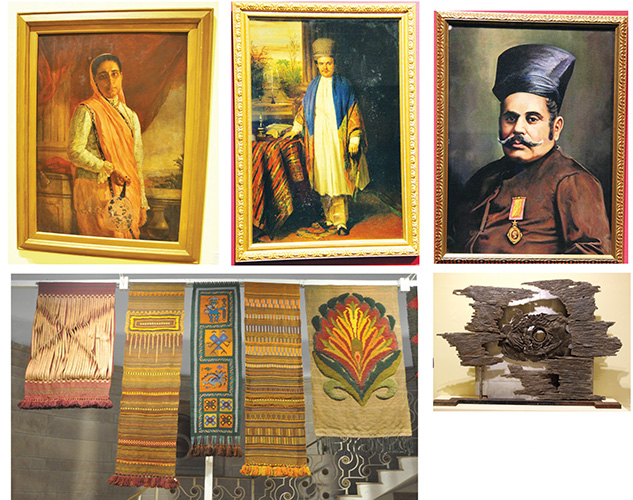
Clockwise from above left: M. F. Pithawalla’s Study of Parsi Girl, NGMA, Delhi;
Rustom Jamsetjee Jejeebhoy (1824-1872), Cursetjee Jamsetjee Jeejeebhoy,
2nd Baronet; Pochkhanawala’s Monsoon, collection NGMA; Sethna’s tapestries
European art was an innovative idea and its increasing popularity and appearance in Bombay, accompanied the dramatic and rapid westernization which took place post 1857. By 1867, there were nearly 22 schools of art that had been established all over India. Foremost in training Indian artists in the Bombay Presidency was the Sir Jamsetjee Jejeebhoy (JJ) School of Art, the impetus for its endowment having come from Sir JJ… who hoped it would nurture skills of the unemployed and the artistically inclined.
"No one learned the European technique of ‘rendering art convincingly’ better than Pestonjee Bomanjee. His portrayals were a depiction of life perfected through art,” state the curators. His ethnographic depictions of Parsis are evident in At Rest, Feeding the Parrot and Parsee Priest.
"Perhaps the best known Parsi artist whose paintings continue to ring up high prices at auctions was Manchershah F. Pithawalla who achieved fame in India and abroad and was regularly commissioned by members of the Parsi community to paint portraits of priests, merchants, scholars and academics.” He had gained fame for his paintings of Zarathushtra and scholar priests in their religious regalia.
"Erach Bhiwandiwalla traveled widely and in Japan having painted portraits of Prince Kaya and his wife at a garden party by the Royal Academy of Japan, he requested them to autograph the paintings which they did. Unfortunately for Bhiwandiwalla, anything with the royal signature was seen as having a touch of divinity and he was pursued vigorously to hand over the portraits. He refused to part with the portraits despite several requests from the Japanese government…” the viewer learns.
Subsequently Jehangir Lalkaka, Rustom Siodia, Hormusjee Deboo and E. A. Tachakara became household names. "These artists have also developed enduring and productive relationships outside the community: through friendship, collegiality, collaboration, participation and intervention. Parsi artists have contributed to numerous cultural economies and ecologies, and been influenced by these in turn…”
"No Parsi is an Island” not only showcases the works of 14 Parsi artists across 150 years but also displays for the first time their rich and varied contributions to the domains of film, poetry, theater, classical dance, crafts activism and children’s literature as "they negotiated many cultural elements.” The exhibition commences with a poem "Migrations” by Keki Daruwalla expressing the loss of a birthplace, Lahore. The diaspora becomes the common heritage of many communities, depicting relatedness and not insularity.
"From all these artists, we could imbibe a major lesson: that art is not confined to the art market or the institutions of the art world. To be truly effective, the life of the imagination must surge across a variety of spheres of human activity and expression... reveal the reserves of energy that are latent,” emphasize the curators.
Mehlli Gobhai is known not only for his abstract art but also children’s books. Shiavax Chavda was not only a painter but a fellow pilgrim of dance. Gieve Patel was a painter, playwright, poet and medical practitioner. Piloo Pochkhanawala was a sculptor and a tireless cultural organizer who lobbied for the Bombay branch of the NGMA.
"While Jehangir Sabavala achieved both popular celebrity and critical acclaim,… Chavda has receded from public memory and Homi Patel has faded into oblivion. Adi Davierwalla and Pochkhanawala, having died early, are recalled as figures from a utopian past of sculpture but have not received their proper place in art history. Alongside them, we have positioned other artists whose practices have been eclipsed or lost to amnesia, and who, we believe, deserve renewed attention: the weaver, researcher and crafts activist Nelly Sethna as well as the filmmakers, Jehangir Shapurji (Jean) Bhownagary who once headed the Government of India’s Films Division and gave it exemplary direction, and Homi D. Sethna,” reveal the curators.
"There are disruptive continuities” with a juxtapositioning of Bomanjee’s realism with Gobhai’s abstract works mention the curators. "We have chosen to treat the ethnographic framework of the exhibitionary occasion – a celebration of the culture of the Parsi micro-minority – as a point of departure rather than a limiting condition… We have borne witness to the ‘worlding’ of many of the artists included in this exhibition…to indicate the continuous and regenerative process of being-in-the-world, embracing its circumstances and potentialities, and mapping forms of belonging within it. Another key concept that arises from worlding is that of ‘relatedness’ which we dramatize through the connections between some of the Parsi artists and their friends, colleagues and collaborators beyond the community…”
Patel’s presence in the exhibition was expanded to include works by his closest artist friends and colleagues who influenced his life and work like Sudhir Patwardhan’s Man in Irani Restaurant and Riot as also Atul Dodiya’s Dr Patel’s Clinic, Lamington Road and Anju Dodiya’s Arachne. It was reassuring to learn that Patel’s painting Off Lamington Road which at the time of the 2013 exhibition was considered lost to view in an overseas private collection has since been acquired by the Kiran Nadar Museum of Art in New Delhi.
As noted Lochan in his Director’s Note in the catalog, "The show is a great platform to glimpse an insider view to a small yet significant community of the Indian society… The works are not mere documentations of the society or its developments but sensitive observations that subtly examine their nuances and moods. The images and objects encapsulate transformation, transitions and lurking human presence over a period of hundreds of years.”
A report on "Threads of Continuity” exhibition will appear in the next issue of Parsiana.
◆ ◆ ◆
From the archive