
ART
An Asian art aficionado
At Christie’s auction house South Asian art is gaining ground greatly
Nishad Avari filled in for a friend during the international exhibition "Picasso: Metamorphoses 1900 — 1972” in February 2002 at the National Gallery of Modern Art. He took on her responsibility as the student had to appear for an exam. He stepped in as an art docent — a person who assists in market research, planning itineraries and oversees the promotional needs of an exhibition. At the time, Avari drew inspiration from Dr Saryu Doshi, the well-known art historian, research scholar, editor and curator whose broad canvas was a source of encouragement for him to decide to enter the art profession.
"I love every aspect of my job,” he says about his current employment over the past three years with Christie’s, the nearly 250-year-old international auction house which also opened an office in New Delhi last year. His tasks cover all aspects of the annual India Sale. "Each has its joy — the discovery, the source of finding (a new piece of art),” he elaborates; he also enjoys the acquiring, researching, marketing and selling, catalog preparation and then putting the sale together. The finale is of course the auction day.
"I love every aspect of my job,” he says about his current employment over the past three years with Christie’s, the nearly 250-year-old international auction house which also opened an office in New Delhi last year. His tasks cover all aspects of the annual India Sale. "Each has its joy — the discovery, the source of finding (a new piece of art),” he elaborates; he also enjoys the acquiring, researching, marketing and selling, catalog preparation and then putting the sale together. The finale is of course the auction day.
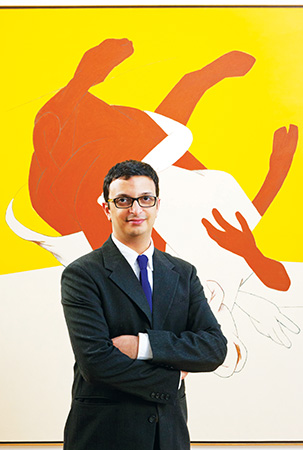
Nishad Avari sources South Asian art
This December, Christie’s will conduct its third Indian auction at the Taj Mahal Palace in Bombay targeting a sale of Rs 100 crores (about US $ 15 million). The auction house set up by James Christie in 1766 in London trades in sculpture, prints, videos, neon pieces and installation art — three-dimensional works which Wikipedia describes as created often for a specific site and designed to transform the perception of that space. Christie’s has even sold a block of acrylic by British-Indian sculptor Anish Kapoor, in London. The firm commenced trading in Indian art in 1994 after establishing its first office in Bombay and has a worldwide presence with 12 salerooms and over 75 offices.
Avari specializes in South Asian (SA) art in the sub-continent — India, Pakistan, Bangladesh, Sri Lanka, Nepal and Bhutan. In fact his designation is associate specialist, South Asian modern and contemporary art department. The SA auctions are held annually in London, New York and Bombay. India sales comprise 85% of the total value of this genre, he details saying it begins with the works of Indian artist Raja Ravi Varma (1848-1906).
Online bidding is open during the auction of the SA category, not earlier. Around 60% of bidders are experienced. Potential customers can log on, view the ongoing auction and place their bids via the website, Avari tells us, adding, "New clients may register on the phone before a sale. A room with paddles, dedicated phone lines, on-line facilities, logistics and operations is all mobilized on every occasion.” The art aficionado continues that Christie’s also auctions works of lesser known artists and has secondary sales of works which have been sold at least once before.
People and infrastructure move from auction to auction. Walls, wood of museum quality, lighting, quality archival material to protect the work, are all shipped around for each exhibition to protect the frames and artifacts from any damage. Art handlers accompany each display to every city. Christie’s publishes 6,000 catalogs annually which are eagerly awaited by buyers and sellers.
Avari specializes in South Asian (SA) art in the sub-continent — India, Pakistan, Bangladesh, Sri Lanka, Nepal and Bhutan. In fact his designation is associate specialist, South Asian modern and contemporary art department. The SA auctions are held annually in London, New York and Bombay. India sales comprise 85% of the total value of this genre, he details saying it begins with the works of Indian artist Raja Ravi Varma (1848-1906).
Online bidding is open during the auction of the SA category, not earlier. Around 60% of bidders are experienced. Potential customers can log on, view the ongoing auction and place their bids via the website, Avari tells us, adding, "New clients may register on the phone before a sale. A room with paddles, dedicated phone lines, on-line facilities, logistics and operations is all mobilized on every occasion.” The art aficionado continues that Christie’s also auctions works of lesser known artists and has secondary sales of works which have been sold at least once before.
People and infrastructure move from auction to auction. Walls, wood of museum quality, lighting, quality archival material to protect the work, are all shipped around for each exhibition to protect the frames and artifacts from any damage. Art handlers accompany each display to every city. Christie’s publishes 6,000 catalogs annually which are eagerly awaited by buyers and sellers.
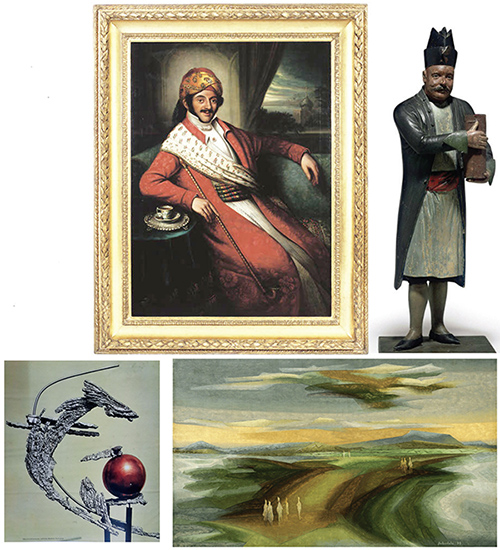
(L to R): A Parsee Gentleman of Bombay in the style of 19thC English School (artist unknown),
sold in London for US $ 60,726 in 2008. The port of Bombay can be seen through the window,
hinting at the sitter’s wealth and status. Sitter has adopted elements of British dress seen from
the starched collar layered beneath his opulent robes; A China Trade Nodding Head Parsi Merchant in
earthenware sold in New York for US $ 20,000 in 2011
SA art touched sale of Rs 75,27,45,000 (about US $ 12 million) during the second auction of 2014. William Robinson, the international head of group world art notes on their website, "We had a very successful year selling classical Indian works of art and paintings, the most recent sale in New York giving us the highest sell-through (sale) rate that we have had in many years…We also supported charities as we did with Magic Bus… and our recent Bombay sale to benefit Khoj International Artists’ Association…” Bombay based nongovernmental organization (NGO) Magic Bus strives to move children out of poverty with skill building and education. New Delhi based NGO Khoj supports contemporary art and emerging artists in SA and has benefitted from the sale of 10 contemporary works donated by the artists. Khoj received a total of Rs 1.9 crores (about US $ 306,450) in 2014 from this sale.
The first ever sale in India, held in Bombay in 2013, included works from the estate of Kekoo and Khorshed Gandhy owned by two of their daughters Rashna and Behroze. Ranjit Hoskote, poet, art theorist, independent curator and friend of the Gandhys states, "Kekoo and his wife, Khorshed, ran Gallery Chemould. Or rather, Khorshed ran it while Kekoo dreamt, talked, shared his infectious enthusiasms, drew up manifestos and formed coalitions. Married for nearly seven decades, they were the archetypal portrait of beautifully wedded opposites.” Kekoo’s love of art and concern for budding artists led him to establish Gallery Chemould now renamed Chemould Prescott Road as per its new address, after shifting out from its initial location inside the Jehangir Art Gallery. Chemould pioneered specialized methods to mount and frame art works in India, notes Christie’s catalog First Auction in India, 19 December, 2013. About 83 works of art of practically every contemporary Indian artist, using various mediums was represented here — whether painter, sculptor, etcher or draughtsman — from the 1940s and some from beyond.
Making a career of it
Avari "learnt a lot about Indian art here,” when he interned first till February 2002, with Saffronart, which is one of the largest international Indian modern art auction houses for Indian art, fine art, paintings, collectibles, jewelry and antiquities. He then journeyed to Macalester College, St Paul in Minnesota, USA to do post-graduation in political science and international studies, continuing with the subjects he pursued at St Xavier’s College for his bachelor’s degree. He then took a two-year fellowship at Saffronart in New York and was later employed by them in 2007 in Bombay for almost six years before he joined Christie’s. One of Christie’s catalogs specifies, "Nishad has contributed articles and essays to exhibition catalogs, scholarly journals and news publications.”
Avari "learnt a lot about Indian art here,” when he interned first till February 2002, with Saffronart, which is one of the largest international Indian modern art auction houses for Indian art, fine art, paintings, collectibles, jewelry and antiquities. He then journeyed to Macalester College, St Paul in Minnesota, USA to do post-graduation in political science and international studies, continuing with the subjects he pursued at St Xavier’s College for his bachelor’s degree. He then took a two-year fellowship at Saffronart in New York and was later employed by them in 2007 in Bombay for almost six years before he joined Christie’s. One of Christie’s catalogs specifies, "Nishad has contributed articles and essays to exhibition catalogs, scholarly journals and news publications.”
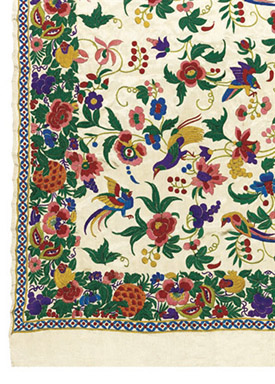
A gara sari from Surat auctioned in London in 2008 for about US $ 3,000
The ex-student of Bombay International School was taught by the late eminent Indian artist, illustrator, author and story-teller Badri Narayan. Avari recounts, "I was fortunate enough to have him as my art teacher in junior school for a couple of years. He was fantastic.”
When Parsiana interviewed Avari on October 12, he was preoccupied with the third auction to be held in December 2015. The art specialist made two forays into the digitally secured premises from the reception area, to supervise their professional framer. Christie’s has only five employees in Bombay. Avari’s colleague Navaz Sanjana, looks after administration in Bombay and is the only other Zoroastrian in the auction house currently.
The 32-year-old son of Kavi (Koover) who is an electrical engineer and Freni a language translator for German, French and Spanish, has a younger brother Jamshed, 30, who is a technology journalist with NDTV Gadgets360. The reserved art collector has a personal collection of photos by Pakistani and Bangladeshi artists and few Indian artists as well.
Asked if he believes Zoroastrians would do well in the art trade and whether he would recommend it to community members, Avari avers with a "yes.” He slots himself as a Zoroastrian who is on neither side of the two extreme factions. The art specialist is more comfortable with associations that come from the religion rather than taking definite stands. He attends family jashans, funerals and other rites. "Based on our history, it’s our good fortune we have done well… but are we living up to this (reputation) or not is the question.”
◆ ◆ ◆
From the archive