
ART
Auctioning art
Pundole’s maiden art auction on behalf of the National Centre for the Performing Arts was a resounding success
"I am in a state of daze,” commented art dealer Dadiba Pundole following the windfall in the first art auction conducted by his new auctioning firm ‘Pundole’s,’ a logical extension of the noted Pundole Art Gallery located at Flora Fountain in Bombay. The newly formed auction house sold 20 paintings on April 20, 2011 at the Jamshed Bhabha Theatre of the National Centre for the Performing Arts (NCPA), raising a total of Rs 11.49 crores (US $ 2,553,333), 80 percent more than the upper limit set for the sale. Dadiba thanked the audience and the telephone bidders for the "generosity and support to NCPA and Pundole,” adding, "you all did a fantastic job.”
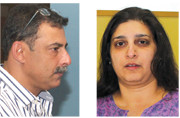
Dadiba and Khorshed Pundole
Photo: Jasmine D. Driver
An untitled oil on canvas by Vasudeo S. Gaitonde fetched Rs 2,97,00,000 (US $ 6,60,000). A 1945 landscape by the late scientist Dr Homi Bhabha estimated to sell at Rs 50,000-70,000 sold for Rs 15,40,000. Narayan S. Bendre’s oil on canvas of a mother and child sold for Rs 99,00,000, reportedly a record for this artist’s work.
The auction team consisted of Dadiba and Khorshed Pundole, Mallika Advani, Rob and Sonali Dean. The bidding was driven by Advani, a trained auctioneer. Dadiba had been senior consultant representing Sotheby’s until last year.
Dadiba, 47, elucidates that the idea of auction started with the NCPA wanting to raise some money. It offered some of the paintings from the estate of the late Jamshed Bhabha bequeathed to the NCPA. Of the ones offered for sale, Pundole and his team chose these specific 20. He finds "Gaitonde is one of the finest artists India has produced.” There were three paintings of his favorite in the auction.
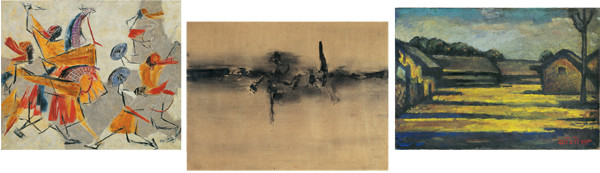
Extreme left: Horse Dance, K. K. Hebbar; center: Untitled, Vasudev Gaitonde; Left: Untitled, Jamini Roy
The Progressive Artists Group based in Bombay who combined Indian subject matter with post-Impressionist colors, Cubist forms and brusque, Expressionistic styles were heavily represented at the auction by its pioneers — Krishnaji H. Ara, Gaitonde, Maqbool Fida Husain and Syed Haider Raza. Many paintings appeared to be departures from the artists’ usual style. Husain’s Portrait of Two Sisters of two western women is representative of portraits which he obsessed with in the late 50s as a counter to the criticism of his friend and art critic, the Hungarian Fabri who proclaimed that portraiture was not his forte, Dadiba recounts from his telephone conversation with Husain. This particular painting had been sold by Husain to the late Dr Bhabha, brother of late Jamshed (Bhabha). In fact several of the paintings are Jamshed’s inheritance on the sudden death of Homi in an air crash over the Alps in January 1966.
Similarly, Raza’s experiments with currents of western Modernism move from Expressionist modes towards greater abstraction and eventually incorporate elements of Tantrism from Indian scriptures. Raza chose to focus on landscapes in the 1940s and 50s, inspired in part by his move to France. Raza’s paintings with herringbone triangles, blue moons, licks of flame and inner vistas trigger transcendental experiences. Again, Raza’s painting for Pundole’s auction does not typify the artist’s style described above.
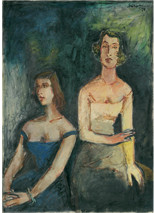
M. F. Husain’s Portrait of Two Sisters
Two landscapes by Jamini Roy show a shift in his style. His usual Impressionistic style is barely evident in either painting, as also the Indian folk element. In a departure from his early training in the Bengal School and western tradition he portrayed the essence of simplicity embodied in the life of simple folk. It was his attempt to make art accessible to a wider section of people and to give Indian art its own distinct identity.
Dadiba has been at the helm of Pundole Art Gallery since his father Kali’s demise. He recalls his early exposure to the Gallery where he went to do his homework after school, till his mother Freany picked him up. "I never found it difficult (to work) with my father (in contrast to what) I hear other people talking about their fathers.” Dadiba adds, "Dad never taught… He just told me ‘Keep your mouth shut. Look and listen. Dadiba don’t ever lie. In any case it shows on your face.’” So Dadiba, "learnt more by example than by tutoring.”
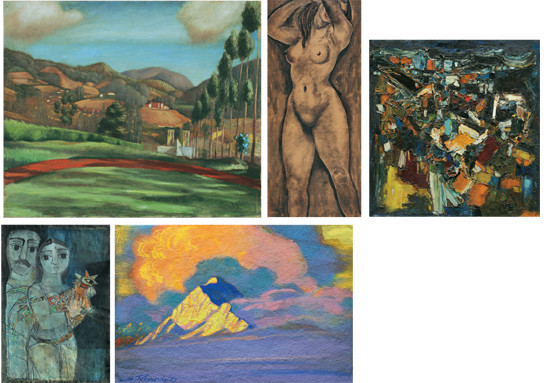
Clockwise from top far left: Untitled by Dr H. Bhabha; Standing Nude by K. Ara; Cityscape by S. Raza; Untitled by S. Roerich and Kukuta-Jataka by B. Narayan
Whilst acknowledging the perception of Parsis being equated with honesty and trustworthiness Dadiba does not believe that being a Parsi has made him more successful. Of all the greats amongst Parsi artists, surprisingly well-known senior artist Jehangir Sabavala’s works were not part of the auction. Dadiba says he was not offered any Sabavala paintings. He cites Pallon Daruwala, Adi Daruwala, Pilloo Pochkhanawala, Homi Patel as some of the other well-known contemporary artists. This art dealer wears his sudreh and kusti religiously and proudly proclaims he is a navar maratab.
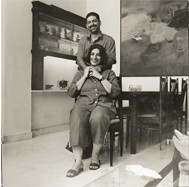
Dadiba and Khorshed at the Pundole Art Gallery Photo: Dayanita Singh
The art scene changed in the early 90s in India, says Pundole. "The value of art increased substantially at first, then plateaued. From 2001 to 2002 a great catalyst was Husain but no one seemed to have the courage to price art appropriately. Husain wanted radical change. He was contemporary but some thought him to be gimmicky. However, he could see the bigger picture which no one else could at that time. He was also articulate about it. He still believes there is a long way to go but he at least stoked the fuel.” Art hit big money first with non-resident Indian buyers. Today, however, the art market is domestic driven.
"Collecting art requires a belief in the art and the artist,” states Dadiba. "I don’t question it. Responses to art change with time.”
According to British painter Lucian Freud, artists are cheap. Sometimes they also seem to be over priced. "We seem to be driven more by intellect than physical input,” says Dadiba. Indian artists "do not seem to experiment; we do not seem to have the skill of other leaders.” Dadiba states, "Collecting art is an illness. It’s a disease. Of course I have to thank those who suffer from this illness!”
◆ ◆ ◆
From the archive