
Felicitations
The rites of spring
The Delhi Parsi Anjuman celebrates Navroz with a thought provoking function
The Delhi Parsi Anjuman (DPA) had much to celebrate this Navroz. Poet and writer Keki Daruwalla had been awarded a Padma Shri, DPA patron and former president Dadi Mistry had been appointed a member of the National Commission for Minorities (NCM), author and scholar Pilloo Jungalwalla was celebrating her 100th birthday, and designer Ashdeen Lilaowala along with community activist Dr Shernaz Cama observed the Delhi release of their book Threads of Continuity — The Zoroastrian Craft of Kusti Weaving.
The crowd of around 275 gathered at the DPA grounds adjacent to the Kaikhushru Pallonji Katrak Dar-e-Mehr and the Mengusi Parsi Dharamshala complex, celebrated in addition the 50th year of Parsiana and of the Padma Shri award being conferred on filmmaker and scriptwriter Sooni Taraporevala. Being unable to attend, Taraporevala was to be subsequently felicitated in Delhi.
Welcoming the guests on March 21, 2014 DPA trustee and honorary secretary Adil Nargolwala noted that legal luminary Rustom Gae had passed away a day prior and "our first reaction was to postpone our Jamshedi Navroz function today.
"However, on second thoughts, we realized that he was fortunate to have lived a full and blessed life till the end and had made substantial contributions to the DPA and also in his professional life. All those who knew him well are certain that he would not have approved of cancelling our Navroz function today. Instead of expressing sorrow at Rusi’s passing away, we should indeed feel joyous that such a noble soul lived and walked amongst us.”
The crowd of around 275 gathered at the DPA grounds adjacent to the Kaikhushru Pallonji Katrak Dar-e-Mehr and the Mengusi Parsi Dharamshala complex, celebrated in addition the 50th year of Parsiana and of the Padma Shri award being conferred on filmmaker and scriptwriter Sooni Taraporevala. Being unable to attend, Taraporevala was to be subsequently felicitated in Delhi.
Welcoming the guests on March 21, 2014 DPA trustee and honorary secretary Adil Nargolwala noted that legal luminary Rustom Gae had passed away a day prior and "our first reaction was to postpone our Jamshedi Navroz function today.
"However, on second thoughts, we realized that he was fortunate to have lived a full and blessed life till the end and had made substantial contributions to the DPA and also in his professional life. All those who knew him well are certain that he would not have approved of cancelling our Navroz function today. Instead of expressing sorrow at Rusi’s passing away, we should indeed feel joyous that such a noble soul lived and walked amongst us.”
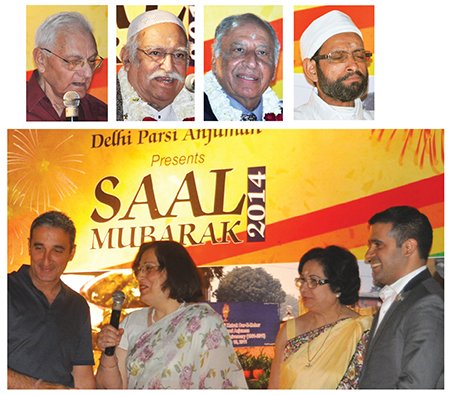
(Top row) Yezad Kapadia, Dadi Mistry, Keki Daruwalla and Ervad Cawas Bagli.
(second row) At the launch of Threads of Continuity (from left): Adil Nargolwala, Dr Shernaz Cama,
Veera Mavalwala and Ashdeen Lilaowala
While wishing the gathering a happy Navroz DPA president Yezad Kapadia noted the occasion was "celebrated widely in a stream of countries.” DPA was "following the tradition in Delhi.” He noted the presence of dignitaries such as former Tata Sons director Dr Jamshed Irani and his wife Daisy from Jamshedpur as well as noted jurist Fali Nariman and his wife Bapsy at the function.
A greeting was read out from the Lieutenant Governor of Delhi Najeeb Jung who noted Navroz "is a celebration which is dedicated to the symbolism and spirit of spring, fire and righteousness. It is a time to look forward to new beginnings and pledging oneself to the spirit of Navroz, a new day, a renewal.”
Honoring Daruwalla DPA trustee and honorary joint secretary Veera Mavalwala noted the author had "published three volumes of short stories and 10 of poetry.” His writing is "prescribed reading in schools and colleges.” His novel, For Pepper and Christ was shortlisted for the Commonwealth Fiction prize. A former Indian Police Service officer he retired as an "analyst on international affairs in the Research and Analysis Wing (RAW) of the cabinet secretariat.” Aside from serving as special assistant to the prime minster he was also secretary and chairman of the joint intelligence committee. He served as a member of the NCM for three years, prior to Mistry.
In his thank you address Daruwalla made mention of Gae and wished Mistry well in his new NCM posting. He added that Mistry "had done a great job for the DPA and Zoroastrians all over.”
The citation for Taraporevala commended her contribution to the film industry and the screenplays written for the movies Salaam Bombay, Mississippi Masala, My Own Country and The Namesake. She has also published a coffee table book "a first ever visual work on India’s Parsi Zoroastrian community, entitled Parsis: The Zoroastrians of India — A Photographic Journey. A 24-year labor of love, the book offers rare photos, as well as historical and personal essays on the Zoroastrian religion and Parsi social history.”
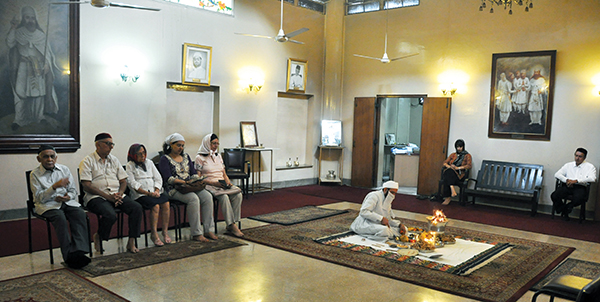
Jashan on Navroz day at the Kaikhushru Pallonji Katrak Dar-e-Mehr
Parsiana editor Jehangir Patel thanked DPA for honoring the semi-monthly magazine noting that Delhi, in addition to being the capital of India, is also the liberal capital of the Indian Parsis. The magazine had received its first ever donation of Rs 500 in the mid-1970s from the DPA. He recalled that past DPA presidents such as Khushru Rustomji, Shiavax Nargolwala, Lt Gen Adi Sethna and Mistry and the present president Kapadia had all upheld the tradition of liberalism. Also how the senior Nargolwala with able support from the then honorary secretary of the Federation of the Parsi Zoroastrian Anjumans of India Keki Gandhi was able to stay a step ahead of the Bombay Parsi Punchayet (BPP) in the Federation imbroglio in 1979 and the early 1980s. The DPA permits non-Parsis to be present for the funerary rites and also allows the children of Parsi women married to non-Parsis entry to its Dar-e-Meher. Non-Parsis are also allowed to avail of the Dharamshala facilities run for the DPA by Dhun Bagli. Her son Ervad Cawas recited the opening prayers at the new year function.
Patel noted that Delhi based jurists Nariman, Soli Sorabjee, Tehmtan Andhyarujina and Gae have all been involved with the community and also directly and indirectly with Parsiana. He pointed out that key issues pertaining to the community were to be decided in Delhi, referring to the cases of Goolrookh Gupta and the so-called renegade priests matter before the Supreme Court. Gupta’s matter referred to the right of entry to doongerwadi and fire temples denied to Parsi women married to non-Parsis, and the priests’ case to the powers of the trustees to ban priests from performing religious ceremonies.
Elvis look-alike Vipin Khanna entertained the crowd with songs made popular by the "King,” while a sumptuous dinner rounded off the evening.
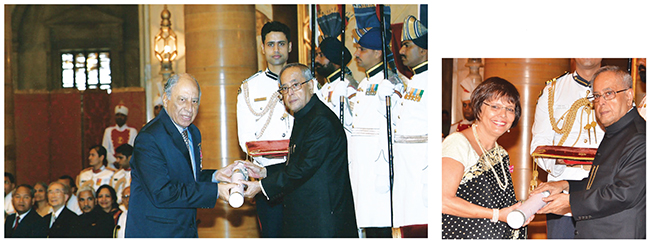
Writer Keki Daruwalla and filmmaker, scriptwriter and photographer Sooni Taraporevala
receiving the Padma Shri awards from the President of India Pranab Mukherjee in New Delhi
on April 26 and March 31, 2014 respectively
Unbroken thread
The next day, as one of the organizers noted in jest, Parsi snacks of patrel, dar-ni-pori (from RTI especially flown in from Bombay), ravo and chutney sandwiches (courtesy the Cama kitchen) ensured a large turnout at an event to introduce Threads of community — The Zoroastrian Craft of Kusti Weaving at the prestigious and spacious India International Centre. (The book was earlier launched at the DPA Navroz function and at the 10th World Zoroastrian Congress in Bombay in December 2013). Among the speakers were culture aficionado and designer Rajeev Sethi, writer Keki Daruwalla and authors Ashdeen Lilaowala and Dr Shernaz Cama.
Daruwalla noted in his talk, "The title of the book is misleading. It is not just about kusti weaving. It is a sweep across the Zoroastrian faith, starting with the Gathas and the linguistic linkages with the Rig Veda, moving to the Yasnas and its 72 chapters (replicated in the 72 strands of the kusti), the eternal tussle between Spenta Mainyu (good) and Anghra Mainyu (evil).”
Cama explained the book "has taken over 10 years in the making. We are grateful to Thomson Press and particularly Cushrow Jassawalla for an excellent production at very short notice. The book is important because it is the first ever explanation of an oral tradition which has come down in an unbroken thread — pardon the pun — since the Bronze Age. A unique weaving technique creates the kusti. The kusti is an inverted, hollow tube of 72 wool fibres created by an intricate process…
"The sudreh-kusti is the Zoroastrians’ sacred armor. Worn around our body, it accompanies us from (childhood) to death. It gives us a ritual through which we lead active, purposeful lives. I sincerely appeal to all Zoroastrians not to cast off this sacred armor” even while wearing spaghetti tops! Understand the intense craft and intense philosophy in the creation of these ritual garments. Do please read this book and respect our badge of faith,” she urged the gathering.
"Once considered a domestic skill necessary for every young girl and taught in all Parsi schools, kusti making, has with changing times become a specialized craft practiced mainly by elderly women,” noted Lilaowala. "Kusti-making is an art that takes years to master and due to poor returns very few women care to take up kusti weaving as a profession...
"The actual process of kusti weaving is carried out on the loom or the jantar. This small wooden, folding loom consists of a simple framework of shafts and pulleys... Most weavers believe that this loom must have originated in Navsari around the 1930s...
"In Iran, camel hair began being used since it was widely available. In India, only sheep’s wool is used for weaving kustis.”
Sethi recalled how his grandmother "would sit in the courtyard of our home and weave the first cord (nada) that held up my pyjamas. Basic to the garments I use, the nada still keeps them in place. Each year — and I could tell the seasons by her silent actions — had a sense of time and space. Around summer, she would acquire raw cotton and spin threads. Then she would use the charpoi — no longer used in the monsoons — to mount her frame loom. Using dozens of bamboo sticks she would weave threads into cords with myriad patterns, visible only when uncurled and stretched. The ubiquitous whole seemed so simple and yet continues to evocate fond and deep memories.
The next day, as one of the organizers noted in jest, Parsi snacks of patrel, dar-ni-pori (from RTI especially flown in from Bombay), ravo and chutney sandwiches (courtesy the Cama kitchen) ensured a large turnout at an event to introduce Threads of community — The Zoroastrian Craft of Kusti Weaving at the prestigious and spacious India International Centre. (The book was earlier launched at the DPA Navroz function and at the 10th World Zoroastrian Congress in Bombay in December 2013). Among the speakers were culture aficionado and designer Rajeev Sethi, writer Keki Daruwalla and authors Ashdeen Lilaowala and Dr Shernaz Cama.
Daruwalla noted in his talk, "The title of the book is misleading. It is not just about kusti weaving. It is a sweep across the Zoroastrian faith, starting with the Gathas and the linguistic linkages with the Rig Veda, moving to the Yasnas and its 72 chapters (replicated in the 72 strands of the kusti), the eternal tussle between Spenta Mainyu (good) and Anghra Mainyu (evil).”
Cama explained the book "has taken over 10 years in the making. We are grateful to Thomson Press and particularly Cushrow Jassawalla for an excellent production at very short notice. The book is important because it is the first ever explanation of an oral tradition which has come down in an unbroken thread — pardon the pun — since the Bronze Age. A unique weaving technique creates the kusti. The kusti is an inverted, hollow tube of 72 wool fibres created by an intricate process…
"The sudreh-kusti is the Zoroastrians’ sacred armor. Worn around our body, it accompanies us from (childhood) to death. It gives us a ritual through which we lead active, purposeful lives. I sincerely appeal to all Zoroastrians not to cast off this sacred armor” even while wearing spaghetti tops! Understand the intense craft and intense philosophy in the creation of these ritual garments. Do please read this book and respect our badge of faith,” she urged the gathering.
"Once considered a domestic skill necessary for every young girl and taught in all Parsi schools, kusti making, has with changing times become a specialized craft practiced mainly by elderly women,” noted Lilaowala. "Kusti-making is an art that takes years to master and due to poor returns very few women care to take up kusti weaving as a profession...
"The actual process of kusti weaving is carried out on the loom or the jantar. This small wooden, folding loom consists of a simple framework of shafts and pulleys... Most weavers believe that this loom must have originated in Navsari around the 1930s...
"In Iran, camel hair began being used since it was widely available. In India, only sheep’s wool is used for weaving kustis.”
Sethi recalled how his grandmother "would sit in the courtyard of our home and weave the first cord (nada) that held up my pyjamas. Basic to the garments I use, the nada still keeps them in place. Each year — and I could tell the seasons by her silent actions — had a sense of time and space. Around summer, she would acquire raw cotton and spin threads. Then she would use the charpoi — no longer used in the monsoons — to mount her frame loom. Using dozens of bamboo sticks she would weave threads into cords with myriad patterns, visible only when uncurled and stretched. The ubiquitous whole seemed so simple and yet continues to evocate fond and deep memories.
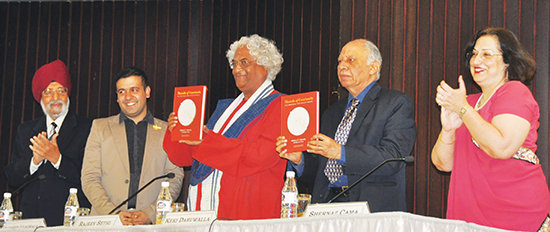
(L to R): Trilochan Singh, Lilaowala, Rajeev Sethi, Daruwalla and Cama.
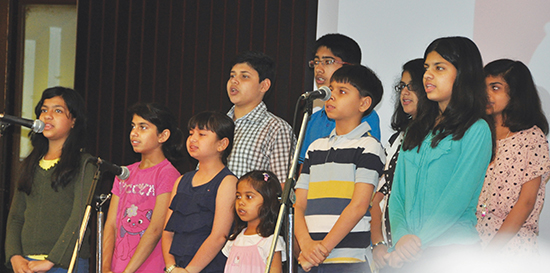
Young Delhiites singing a monajat about the sudreh and kusti
"The nada may not be as sacred as the cord of kusti… Nor is the nada as significant as the Yajnopavita at the Upnayan of the Brahmins, with its three individual strands twisted together with a knot representing the four Vedas; but this prolific gift along with the many pashmina shawls hand spun and woven by someone I have cherished, continue to be the simplest statement of love, care and dexterity. Their recurring appearance year after year in the life of our family acquired profound meaning. They helped us understand the true purpose of making, doing and being in a process that goes out to others. It was an act that was gracious, tinged with a selfless measure of concern and purpose.
"What is the golden principle manifested by such simple acts of giving? Principally, traditions are most apt in doing more with less and helping us appreciate the work of one’s own labor as timeless. Aurangzeb, that much maligned Mughal spent the last few years of his life in Aurangabad stitching caps with his hands to earn the cost of a kaffan (shroud) for his last journey. These principles have constituted the basic foundation of our value system enshrined in time honored but vulnerable traditions. Today, we understand less and less the need to conserve, devaluing the love of labor and this is happening at the cost of forgetting a lot that makes us unique.”
Parzor president Trilochan Singh noted the kusti "provided tremendous inner strength to the Parsis.”
◆ ◆ ◆
From the archive