
Patterns in prose
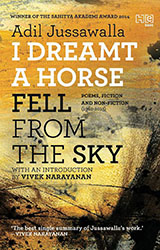
I Dreamt a Horse Fell from the Sky. Poems, Fiction and Non-fiction (1962-2015) by Adil Jussawalla. Published in 2015 by Hachette Book Publishing India Private Limited, 4 th/5th Floors, Corporate Centre, Plot no 94, Sector 44, Gurgaon, 122003. Pp: 347. Price: Rs 599.
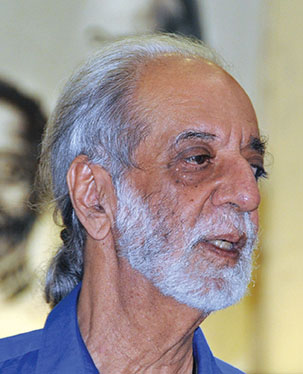 Adil Jussawalla established his reputation as a poet; collections of his poems were published between 1962 and 2013, but one did not realize that he was such a prolific writer of prose as well. This could probably be because these pieces were published in different periodicals over a large span of time and it was only when they were first collected by author Jerry Pinto, to whom we owe a debt of gratitude, in Maps for a Mortal Moon, published by Aleph in 2014, that the reader first became aware of the staggering volume and diversity of Jusawalla’s prose works.
Hachette recently published I Dreamt a Horse Fell from the Sky. Poems, Fiction and Non- fiction (1962-2015). Though selected poems from his previous collections have been included, several new ones have also been published. The introduction, by Vivek Narayanan, poet and co-editor of the literary journal Almost Island, is thorough (46 endnotes) and written with great affection and lucidity. Though he was a former professor at the University of Kwazulu-Natal in Durban, South Africa and has worked at The Sarai Program at the Centre for the Study of Developing Societies in Delhi, Narayanan’s introduction is extremely readable without the literary jargon which generally creeps into academic writing. This may also be a result of the fact that he too is a successful poet.
 Narayanan seems to concentrate more on Jussawalla’s poetry and less on his prose, making a passing reference to his incomplete fiction. He feels that in Jussawalla’s poems, often "a piece of whimsy turns into something darker.” How true this is of a poem like "Reply to a Postcard from Overseas” which starts on an innocuous note, "Do you still have kite-fights?” There follows an evocative verse where Jussawalla describes kites which have been defeated in a ‘kite-fight’ — some hang on trees "like samples of patchwork/from one of our handicraft shops” whereas others balance "like nervous divers on the rims of wells.” But some seem to take off in the air and float away. Only in the last line does one realize that he is writing to a cousin who is compared to a kite which is cut and floats away over the seas "swimming in air, swimming for air.”
Strays is a fragment of a novel started in London in 1967 and Jussawalla wrote about 50 pages before it seems to have been abandoned. The novel starts on August 14, 1947 in a gentle and innocuous manner: "There was a funny smell in the room.” We later learn that Sheroo, the aunt of the protagonist Rumi, has passed away. Jussawalla skillfully keeps the reader in suspense by subsequently revealing that she was mentally unstable. It is only several pages later that we learn that she has burnt herself, which accounts for the funny smell. The focus then moves to Rumi, who is sent to London to search for his brother who had left his parents’ home 12 years earlier. Rumi’s search for his brother is interspersed with bouts of drinking and a strange meeting of the "Moral Crusaders,” a motley collection of individuals who gather together for "soul cleansing” and "soul wash.”
It is no surprise that Jussawalla’s prose is imaginatively poetic. In Strays, Rustom uncle’s nostrils "were permanently hitched up like a ganga’s (maid servant’s) sari” and in Visitors, the narrator’s sister, Faranakh’s teeth "stuck out like tiles on our servant’s bathroom.” Jussawalla captures the rhythms and phrases of Parsi speech translating them into English with hilarious effect: "just like this, just like this.”
In the section "Shadowland” he examines the darker side of human nature. In an article, "Children who Kill,” he questions President Bill Clinton’s view that violence is the result of a society which has "lost its family values, abandoned the church and accepted single parenthood as the norm of the future.” Jussawalla examines several other alternative explanations for this behavior before coming to his conclusion: the problem may lie in the fact that, in America, individual rights are exercised not for family or society but more often for "the sake of personal happiness.”
The section "Finding my Way” comprises largely of articles on writers whom he has met or reviews of their books. In "The Light and Aubrey Menon,” he gently questions Menon’s stand that he can be perfectly objective about India and England (or rather Ireland, from where his mother came). Jussawalla asks him if he was the right person to write about Indira Gandhi when he has "deliberately distanced” himself from India for several years and hints that Menon may have been chosen because very often publishers select authors who are willing to play their tune.
A meeting with writer Angus Wilson is described with great affection. The meeting in Bombay is set against another which had taken place earlier in 1958 in the village of Felsham in Suffolk. The piece is about an interesting discussion centering around Wilson’s latest novel, As if by Magic (which had received unfavorable Press reviews in England), and references to Charles Dickens, Geoffrey Chaucer, Rudyard Kipling, Marquis de Sade and Georges Fedeau. However, Jussawalla discovers that talking about literature is easier than talking about personal matters. Wilson’s confession demanded an openness from Jussawalla, which he finds difficult to respond to.
Jussawalla’s review of Seamus Heaney’s translation of the Old English poem Beowulf is fair and balanced. Though he feels that the translation is a "needless concession to contemporary speech,” he admits that Heaney does do justice to the poem.
"Birdhit” is a sensitively written ode to all the common birds one sees in the metropolis. The language is poetic and evocative: the crow poses on the railing of his balcony "like a newly crowned Miss India, her head high;” the song of the bulbul "makes waking up worthwhile;” pigeons sound like "fingers thrumming on a table.” Jussawalla comes to the conclusion that he can do without birds as an item of food but cannot do without the spectacular sight of birds in flight.
Jussawalla paints a memorable and sympathetic portrait of his father Dr Jehangir in "My Father in the Night Commanding No.” In "I Dreamt a Horse Fell from the Sky,” he discards the theories of Sigmund Freud and Carl Jung and traces his dreams to insignificant everyday events of his life which could have possibly been an impetus to his dreams. This article is an eulogy to the brain which performs the most intricate and magical of tricks to "make us feel alive and sometimes to keep us alive.”
The range and the variety of the articles (and I misuse the word articles to include the essays, reviews, poems and fictional fragments) are so varied and so diverse that it is difficult to condense these into a review. The book is like a kaleidoscope; with every twist of the wrist and every turn of the page we are assaulted by an endless variety of brilliant patterns.
FIRDAUS GANDAVIA