
Rapturous rhapsody - II
Art revival in its entirety was the driving force of Zoroastrian Rhapsody and most of its participants
Just as the exhibitions "Across Oceans and Flowing Silks — From Canton to Bombay 18th to 20th Centuries” and "No Parsi is an Island” were coming to a close on January 28, 2014, the Government of India passed an order extending both by another two weeks until February 13, 2014. Pheroza Godrej, co-curator was delighted that among other things she could prolong the visit of Iqbalbhai, the master weaver for tanchoi saris from Benares, Uttar Pradesh (UP) who was brought back to Bombay for another fornight. His expertise dispelled the notion that tanchoi was uniquely a Gujarat weave. Iqbalbhai is one "of a handful of master weavers” Godrej informed us, UP being the driving force today. "The guild (of tanchoi weavers),” Iqbalbhai says with pride "is almost 25,000 strong,” adding, he had lost count of the number of people he has trained. As he wove a silk dupatta (scarf) in multi-colored panels in a Jacquard pattern, he explained that a maximum of five colors can be used in the loom set up for the occasion. The artisan readily answered questions on the loom and the process, asked by curious watchers at the Zoroastrian Rhapsody (ZR), the cultural events, lectures and dialogs associated with the exhibitions at the National Gallery of Modern Art (NGMA). (see "Rapturous Rhapsody - I,” Parsiana, March 21, 2014).
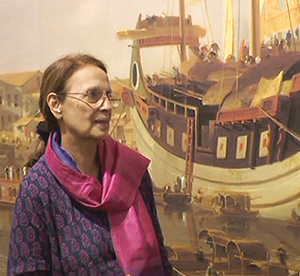
Co-curator Pheroza Godrej before painting of a sailing ship carrying opium
ZR specifically celebrated the Parsi contribution to the city — building its history, shaping its identity through lectures, talks, discussions, concerts, plays, film screenings and poetry readings. This part of the ZR coverage deals with subjects ranging from growing up far from a Bombay-centric Parsi world, how to trace family history, community living as also surviving in a city becoming devoid of its distinctive character and public art.
Calcutta got a fond placing in "Growing up Parsi in Kolkatta” by journalist and columnist Bachi Karkaria with her laconic, distinctive brand of humor. She reiterated how growing up at a distance of 1,700 kilometers from Bombay meant including friends of other persuasions without diluting a sense of belongingness, "rainbow coalition of minorities,” as she put it. The advantage she sees in this is "close but not closed,” close-knit yet liberal with free thought (away from the assumed group-think of baugs). Customs were adhered to but nothing was engraved in stone!
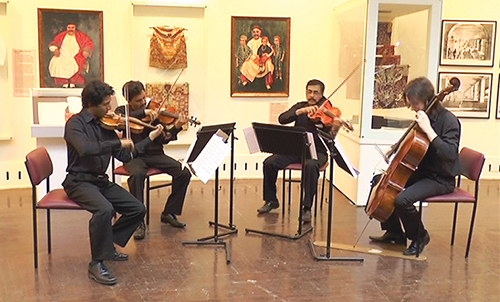
Quartet from the SoI
Yazdi Tantra, founder of the web browser Onlyne and a director of the Zoroastrian Co-operative Bank Limited spoke on "How do you start a family tree?” He advocated an easy technique and demonstrated a systematic method to do so. Having established the Genealogy Project, Tantra recommends this for "your own kids, linkages of the past, how we connect as a community today, as the need to connect is a basic human need.” He also put into perspective the question of identity as we go into the diaspora and more and more Parsis spread out in the world. He talked of Parsi directories theparsidirectory.com, connections established through themissingparsi.com the phone SMS (short message service) for uthamnas his firm launched six months ago called Parsi SMS Seva. Tantra has started Zoroastians.net, and Theparsifamily.com as well. He proudly claims these enable Parsis to obtain news which is not affiliated to any corporation, available to all gratis and free of controversy.
He cautioned that family trees are not only for the rich or for priests (especially from Navsari or Udvada). Anyone can have a genealogical tree. In response to a query, he assured the questioner that even when surnames change, the lineage is traceable. This is also possible through tracing professions. He held a workshop the following week, helping participants to draw up their own family trees, instructing them to bring along any information they held.
Kaiwan Mehta, writer-architect spoke on "Living Together: A User’s Manual,” on people’s way of living, lifestyles in existence for generations and how the old and the young sustain each other. Godrej applauded how Mehta "made it interesting for those who were oblivious of the camaraderie that keeps communities together through thick and thin.” Mehta explored the stories of neighborhoods through their residents.
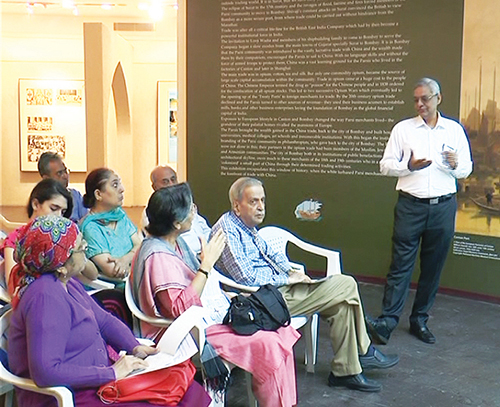
Yazdi Tantra on the Family Tree discourse
He proceeded to dwell on what evokes his characters in the book, how they are influenced by surrounding localities, so that the essence of both the name and the place become inseparable. The book not only bears the faces of characters over six generations, but also several images of buildings connecting the reader to the lives of the characters in it.
Meher Pestonji’s radio play Feeding Crows had Daleep Tahil, Arif Zakaria and other theater personalities reading excerpts about a yuppie Parsi couple in a clash with their maid Savitri who feeds crows because of a superstitious belief.
Architects Kamu Iyer and Vikas Dilawari were on a discussion panel on "Living across the city — community housing in the metropolis” where Mehta was moderator. A practicing architect since 1960, Iyer said he is very happy to work on community housing – chawls, baugs or societies. Home is where "you have a sense of ‘running back home’ — whether a city or a house — you make a home.” Iyer expanded that every migration creates clusters, which are binary in nature — in-out. "It is from nuances that architecture emerges. It is static and has mobility both at the same time. What does it mean to be a trust-patron licensee or a tenant-owner holder? We live in communities and communities share memories.” This is how the fabric of society is formed — through its markets, its residences, the inter-connections. The architect applauded life in koliwadas (colonies of fisher folk), gaothans (village sites) where there is religious or caste affiliation; chawls and baugs had some order in building and style of housing. Most of these were marked by a lack of privacy, as space was limited and common. He distinguished these from wadis where inhabitants were not necessarily of the same community but lived in a walled area with temple and marriage hall being a common social space. He contrasted this with gated communities where grouping is prompted solely on monetary lines.
Iyer reminded us that Cusrow Baug was designed by the English architect Claude Batley (as were The Bombay Gymkhana, The Wankaner Palace, the Bombay Central Station and Jinnah House). He reiterated that baugs are not stratified on money terms; the rich and the not-so-rich occupy the same settlements. Few homes in old Parsi baugs had only one bedroom, whilst most had two defined bedrooms. Hindu colonies usually had one bedroom whilst chawls had no demarcated rooms and common toilets. He also distinguished the colonies by stating that Parsi colonies were built by architects using the latest RCC (reinforced cement concrete) material at the time and in the art deco style whilst Hindu colonies were put up by contractors and engineers. There was a space (sometimes a garden) between the boundary wall and the plinth in the Parsi colonies whilst this was not so in other areas. In Hindu colonies all rooms were inter-connected and spaces undesignated — except for the kitchen.
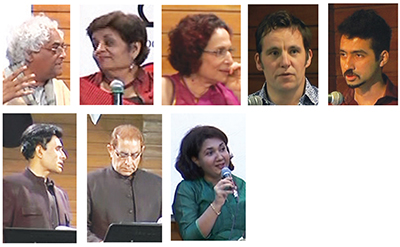
2nd row: Arif Zakaria, Daleep Tahil and Sifra Lentin
"Let’s not romanticize the chawl/baug way of living but let’s also not lose it,” Dilawari cautioned. "Yesterday’s architecture is today’s heritage but is today’s architecture tomorrow’s heritage?” The restorer denigrated "the lack of maintenance,” blamed rent control for making conservation almost impossible in Bombay — "It’s a complex issue.”
"Today we offer linear, vertical alleys,” he jested as we have only upward mobility, which most people aspire to, through high-rises. The heritage conservationist has worked extensively on refurbishing old buildings, which earned him a UNESCO award for restoring the dilapidated Lal Chimney Complex of the Garib Zarthostiona Rehethan Fund Trust and the Royal Bombay Yacht Club Residential Complex. Before this accolade, he had received UNESCO awards for the restoration of the Rajabai Clock Tower and the 140-year old Bhau Daji Lad Museum.
The Lal Chimney project was renovated to its 19th century typology at a modest cost of Rs 850 per square foot. Moreover, all regulations were adhered to. Passionately he explained "that each building was unique… Architects design spaces; it’s the people who make it places (to live in).” Both the architects acclaimed baugs as they had "a human scale… not so high” that inhabitants get dwarfed. "Today you accommodate people inside but what is shared outside gets limited.”
The extension date of the exhibitions led to the ‘farewell evening’ being swapped for a talk — "Spice Trade — the aromas from India” from Jack Turner’s book Spice: The History of a Temptation, first published in 2004. The Australian writer and broadcaster traced spices back through time, history, myth, archeology and literature. Spices were always the prerogative of the rich, whether used in preserving a mummy, a deceased person or meat for the table. European emperors were laid to rest on a bed of cinnamon; when Pharaoh Rameses II’s mummy was x-rayed — black peppercorns were traced up his nostrils as a spice used for preservation; even Christians knew the antibody (bacteria repelling) properties of spices and embalmed bodies. Tracing the history of spices, he mentioned St Thomas Cathedral in Kerala (Turner was unable to name the specific city), which had a cache of hundreds of European coins, presumed to have been traded in exchange for spices. The researcher also referred to the significance of spices as medicine, food, preservative, aphrodisiac and trade. He enlightened the audience how it kept the smell of abattoirs at bay or was burnt in church as incense. Turner cited how rotten spices smelt like gun-powder. And not to forget that the island of Manhattan changed hands between the Dutch and the British, for nutmeg!
The spice investigator educated his audience that cinnamon was native to Sri Lanka, pepper to India, cloves to Indonesia and chilies to the Americas. Making a reference to the oriental belief of "balancing” food types, the gastronome referred to balancing these humors to specific individual needs. He stated how the clergy and other celibates viewed spice as "the viagara of today,” recommending its avoidance.
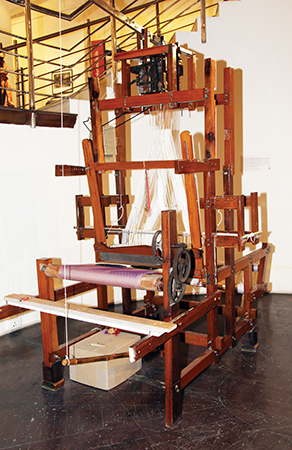
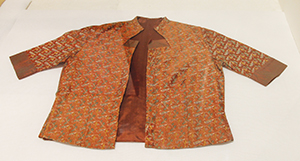
Five color tanchoi loom; tanchoi blouse with Chinese collar Photos: Jasmine D. Driver
As a response to Bombay Electric Supply and Transport commissioning art, renowned sculptor Piloo Pochkhanawala had cast a sculpture "Spark,” at the traffic island at Haji Ali. The 80-foot iron casting disappeared with the traffic island a decade or so after its installation, with no knowledge of where it went. Some citizens persistently urged the authorities to reinstate art in public spaces, and Spark’s dwarf avatar of 20 feet has now re-appeared at the traffic island outside the Sir Cowasji Jehangir Public Hall which houses the NGMA. Godrej is gung-ho about art in public places and she concluded ZR with a discussion centering on it.
Rajeev Sethi, founder trustee of the Asian Heritage Foundation was in conversation with Vishakha Desai, president emeritus of Asia Society in a "Discussion on Art in Public Spaces.” Sethi is currently in the news as the architect of the new T2 (terminal two) at the international airport at Sahar with an art wall of 7,000 creations by 1,500 artists. He calls himself a scenographer — one who designs art spaces, exhibitions, trade fairs and sets. Approached by the Indian Government for this project with a specification that T2 be a "utilitarian space and… transcendental (inspirational),” Sethi conceived The Jaya Hé Art Walk. He kept in mind that airports buzz 24x7 in all weathers with people of every color, race, gender and age group. The Padma Bhushan recipient is a lover of traditional (Indian) art and "did not want T2 to be a Shanghai or Dubai terminal… We have more skills in the subcontinent than anywhere in the world… I don’t see this as a project, I see it as a program.”
The designer-curator has showcased every conceivable medium reflecting the multiplicity of the country — urban and rural art forms from ikkat (tie-dye), chintz (cotton fabric with a glazed finish), embroidery to paintings, charcoal and umpteen other traditional art forms. He asserts there is no distinction between fine art and folk art.
Godrej and Sethi, the planners of the exhibitions and the T2 project respectively, have a similar agenda on art. Both recognize that India is a veritable museum — whether a painting on a hut or under a stairway or monuments or architecture. They are ready to create the platform. It is the public that needs to occupy it.
On January 25, there was a discussion on Parsi poetry at the NGMA auditorium in which Adil Jussawalla, Gieve Patel and Jerry Pinto took part. Jussawalla spoke about two relatively unknown Parsi poets. Fredoon Kabraji (1897-1986) was born in India but spent most of his life in England where he studied at the University of London. He knew several English writers, even corresponded with L. P. Hartley and though his poems were very much praised and his poem "Pianoforte Recital” has been much anthologized, he did not get widely published. The piano player is realistically ushered in:
"Suddenly, /Like the branch of the willow
Lifted on the breath of the wind,/…Her arms lifted in air,/…And the key-board woke,/And ran music/Like a stream!”
Kabraji called himself a Georgian, but some of his poems have a rough and jagged air about them which does not seem surprising as Browning was one of his favorite poets. Many of his poems have an anguished tone as Kabraji was torn between the conflict of writing in English and loving all things English and, at the same time, hating the British Raj.
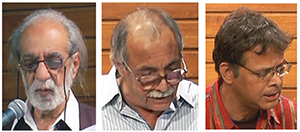
Jussawalla then spoke about Beram Saklatvala (1911-1976), son of the famous Shapurji Saklatvala, member of the Communist party in the British Parliament. Shapurji Saklatvala who is better known as Comrade Sak had quite a checkered life — he was arrested in Britain during the general strike of 1926 and influenced the Meerut conspiracy which led to the imprisonment of S. H. Jhabvala. Though Beram was concerned with adult education and wrote on the subject, for the greater part of his life he worked with the Tata Group where he rose to a position of eminence. Beram did not face the same problems that Kabraji seemed to face with reference to the English language and his poems have a satisfying quality which Kabraji’s work apparently lacks.
Saklatvala’s sonnets are particularly characterized by a strange sense of desolation. He wrote a cycle of poems on the Zodiac signs, of which Jussawalla read the section on "The Crab” which lurks "in treacherous pools” with his low and slow gait:
"I am the Crab whose name is Death,/Maiden, fish and goat must fall/To my power which conquers all.”
Gieve Patel did not read from his poems, but selected an extract from his play Mister Behram. The theme of power is very near to Patel’s heart and runs through all his plays, particularly the use of power within the family. He believes that power is all pervasive in society and in any situation one comes across, it is something one cannot avoid. The scene he chose to read illustrated this. It is an extremely powerful and dramatic one in which the forward looking and emancipated Mister Behram viciously forces his protegé Naval (a tribal Warli whom he has raised and educated) to wear a g-string and a vest, garments he has not worn since he was child. It is quite clear that Patel did not want to imply that there was a physical relationship between the two men but there is definitely a homoerotic background to the relationship. It is also evident that he did not want this to appear as what one might call or consider ‘a problem’ but a strong relationship between two human beings.
Jerry Pinto read, "A Real Life Parsi” from Mustansir Dalvi’s Brouhahas of Cocks. In a few lines, Dalvi creates a very sensitive and appealing portrait of Ardeshir Cursetji Wadia with his "Tall calico headdress,/ and an Oriental long coat” who has been invited for tea. They speak on several subjects as he "sipped his tea/ and ate his bread and butter” and answered them: "in a very low cultivated refined voice,/ Using much better English than we.”
Pinto then read a very pertinent poem by Eunice de Souza where she mentions that her students find it difficult to accept the fact that poems could be written by Daruwallas and de Souzas. Pinto ended with poems by Kersy Katrak, Bikhaiji Manekjee’s "The Aging Lover” and Jussawalla’s "Fire Temple.”
This brings us to the question whether there is anything like a ‘Parsi’ poem or play? Certainly this did not emerge from the poems read. Even Gieve Patel’s play deals with themes which are not solely the prerogative of the Parsi community. Maybe it is a misnomer to speak about Parsi poetry and just restrict ourselves to talking about Parsi poets. Strange that the most "Parsi poem” was not written by a Parsi but by Edna St Vincent Millay. "The Parsi Woman” read by Pinto appropriately concluded the discussion. The poet sensitively portrays the theme of death and sees parallels between the Parsi woman, beautiful and dressed with a pale silk veil with a golden border, and herself. The poet describes the sky, which is:
". . .thick and cloudy with the bold strong wings/ Of the Vulture, that shall tear your breast and thigh,/ On the tall Tower of Silence where you at length must lie.”
Her poem ends on a more positive note with the poet wondering:
"You there with the tranquil and lovely brow,/ What do you see so high, — some beautiful thing/ The sun on the vulture’s wing.”