
Heritage
Collaborating on conservation
A ten-week course on conservation management stressed the importance of preserving the country’s heritage
"How can they not appreciate what they are about to destroy?” queried Mariam Dossal, former head of the University Bombay’s Department of History when delivering the valedictory address on February 13, 2014 to students who had completed the heritage management and conservation certificate course initiated by Wilson College in collaboration with the K. R. Cama Oriental Institute (KRCOI).
She was referring to three historic buildings occupied by the excise department near Victoria Terminus which are to be demolished to make way for multi-storeyed structures. Despite explaining to the government officers the historical significance of the structures, she regretted their "minds are closed.” They claimed the buildings had "no architectural value as they were not pre-Gothic structures,” such as Victoria Terminus, the General Post Office, etc. Dossal explained the three structures were even prior to the pre-Gothic edifices and therefore were of greater historical significance.
Dossal mourned that the officials had "no empathy, no love and no understanding of the architectural style or the history of Bombay… For many people a stone is just a stone, a building is just a building…Such encounters are not rare,” she lamented. "Places that nourish and comfort us are few and getting smaller.” By providing a garden with benches and perhaps swings, the area would become a restful haven for the excise staff. "Today comfort is associated with money. There is a poverty of imagination.” She spoke of the small things that "made a city liveable, such as a child’s smile, caring neighbors.” What was required was "the civilizing process.”
She was referring to three historic buildings occupied by the excise department near Victoria Terminus which are to be demolished to make way for multi-storeyed structures. Despite explaining to the government officers the historical significance of the structures, she regretted their "minds are closed.” They claimed the buildings had "no architectural value as they were not pre-Gothic structures,” such as Victoria Terminus, the General Post Office, etc. Dossal explained the three structures were even prior to the pre-Gothic edifices and therefore were of greater historical significance.
Dossal mourned that the officials had "no empathy, no love and no understanding of the architectural style or the history of Bombay… For many people a stone is just a stone, a building is just a building…Such encounters are not rare,” she lamented. "Places that nourish and comfort us are few and getting smaller.” By providing a garden with benches and perhaps swings, the area would become a restful haven for the excise staff. "Today comfort is associated with money. There is a poverty of imagination.” She spoke of the small things that "made a city liveable, such as a child’s smile, caring neighbors.” What was required was "the civilizing process.”
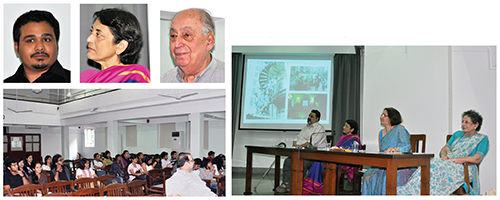
(Clockwise from top, far l): Andre Baptista, Mariam Dossal, Dr Ardeshir Khambata;
Dr Nawaz Mody, Dr Shehernaz Nalwalla, Dosal, Dr Kurush Dalal; audience
Site visits were arranged to the heritage precinct in the Fort area, Khotachiwadi, Buddhist stupas at Nallasopara, the Portuguese fort at Bassein, the Dr Bhau Daji Lad Mumbai City Museum, and the Prince of Wales Museum of Western India. The site visits were conducted to acquaint 25 students with "how not to conserve,” wryly noted Andre Baptista, visiting consultant, lecturer for archeology and course coordinator.
The students spoke about their field trip to the Elephanta Caves on December 15, 2013. They were divided into three groups and a representative from each group spoke about their observations of the site: The enclave was not disabled friendly, there was graffiti on the walls, an excessive use of concrete was visible, original materials were not used for restoration, no proper site map was available, electric points had been accommodated by cutting into the original structure, the barricades were not adequate, garbage was strewn everywhere, adequate dustbins were not provided, hawkers were spread all over the place, water fountains were inadequate and not dispersed, broken pieces of sculpture were lying on the floor, the diesel train was adding to the pollution, salination was seen in many of the caves, tourists washed their feet in the toilet basins, not much shade was available, etc.
Dr Kurush Dalal, assistant professor, archeology, department of extra mural studies, University of Bombay explained that as the Elephanta Caves is a UNESCO World Heritage Site any changes to be made required "intricate steps to be followed.” One government appointed guide was available but not "always visible,” he observed. He explained to the students that "all conservation needs money.” The proceeds from the admission tickets "don’t even come close to the cost of maintaining the site.” Until a year ago there was no electricity on the island and therefore an electric train was not possible. "Graffiti is a part of the history of the monument” explained the archeologist, but not of the Pooja-loves-Ashok type, he clarified.
As to tourists not observing basic norms while at heritage sites, Dalal said, "if we cannot inculcate” the right values in them "then nobody can help them.”
Dr Shehernaz Nalwalla, vice president of Wilson College and the course coordinator noted in a write-up that the 10-week program was "divided into modules such as basic introduction, archeology, local heritage, heritage conservation, object conservation and concluded with a module titled ‘Giving Back.’”
The inaugural session was held at Wilson College on December 5, 2013, noted the write-up. Conservation architect Vikas Dilawari (head of Urban Conservation at the Kamla Raheja Vidyanidhi Institute of Architecture, Mumbai) delivered the keynote address. Chief guest Muncherji Cama, president of KRCOI spoke on how such courses would drum up some bright young prospects that would serve as the future custodians of our cultural heritage, while Nalwalla stressed upon the benefits of initiating such collaborative efforts between institutions. Baptista gave a brief summary of what the course would entail.
The valedictory function was held at the KRCOI where managing trustee Dr Ardeshir (Eddy) Khambata handed out certificates to the students.
KRCOI honorary secretary Dr Nawaz Mody said the Institute would also contemplate holding such courses for the larger public.
◆ ◆ ◆
From the archive