
Books
Colorful compilation
Colorful compilation
Parsi Bol. Insults, Endearments and other Parsi Gujarati Phrases compiled by Sooni Tareporevala and Meher Marfatia. Published in 2013 by Good Books, 19, Kala Niketan, 47C, Bhulabhai Desai Road, 400026 and 49/50 Books, 33, Peacock Palace, 69, Bhulabhai Desai Road, 400026. Pp: 153. Price: Rs 500.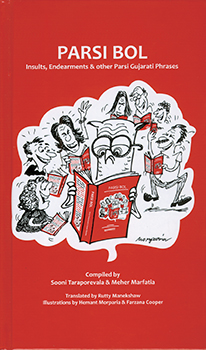
Parsi Bol. Insults, Endearments and other Parsi Gujarati Phrases compiled by Sooni Tareporevala and Meher Marfatia. Published in 2013 by Good Books, 19, Kala Niketan, 47C, Bhulabhai Desai Road, 400026 and 49/50 Books, 33, Peacock Palace, 69, Bhulabhai Desai Road, 400026. Pp: 153. Price: Rs 500.
The little book is a very Parsi endeavor — no purpose other than pure enjoyment. A collation of 716 Parsi Gujarati phrases from 260 contributors have been arranged topicwise (insults, endearments, anatomy, appearances, food, etc). The compilers, Sooni Taraporevala (ace photographer and of Little Zizou fame — a film which lampooned the orthodox) and Meher Marfatia (journalist and author), deserve our gratitude for conceiving this unusual project.
Most of these phrases and sayings originated about a century or more ago in the villages and towns of Gujarat, where most Parsis then resided. The Parsis migrating to Bombay became progressively Anglicized and their future generations could barely understand Gujarati. They were far removed from the cultural ethos which produced these phrases and sayings, and the whole backdrop became gradually alien. Hence, the novelty value of this book, which throws light on a bygone era, an old culture and a different way of thinking.
If you are looking for colorful Parsi abuses, you will be disappointed. The only concession being "Suduntar ghelchodio,” classified wrongly under "Insults.” Most residents of Dadar Parsi Colony would have classified it under "Endearments.” It is undoubtedly an original Parsi abuse. Fellow communities do not use it. This reviewer recalls an incident when, as a child of nine, he was set up by some teenagers to ask of one Keki of Navsari (now deceased) whether he was a "ghelsappo” or a "ghelchodio.” Keki was not sporting enough to make a choice and this reviewer managed to escape after receiving two whacks. Perhaps, the compilers could be inspired to publish a collection of authentic Parsi abuses and alliterations ["Gujarat no ghelsappo governor gaan ghavarta, ghavarta, Grant Road ni gali ma gujri gayo (Gujarat’s idiotic governor died in a lane in Grant Road scratching his bum)”].
Immodestly speaking, this reviewer thought that there would hardly be any new ones in this collection. He was wrong, as there are several nuggets like "Khasra khai ne khurkhur huseh (a person without self-respect),” "Dikro dulnari no, ne naam chhe Darabsha” (a person of humble origin, acting pompous” — this is our translation, which, we believe, is better than the book’s — "to have delusions of grandeur;” "Taddan poniyo chhe, mai baap eh amtho ujagro kidho (a half-wit, whose parents should not have conceived him);” "Navvanoo taap no doctor (a doctor good enough only to treat minor ailments like cold /flu);” and "Jevi dosi, tevoo afargaan (treat the person, as deserved).”
The structure of the compilation is simple but superb. Every phrase is set out in the Gujarati script, followed by an English version of it for those who cannot read Gujarati, then a literal translation in English, the essence of the phrase. There are a few errors in translation as well as typos — "dum bandhi ne” is translated as "harden oneself” — actually, it means "a lot,” as in "lagan ma dum bandhi ne khadhoo.” Similarly, "Patiya gothavvana” is not "to lie,” as mentioned in the book, it is rather "making a series of lame excuses.” Again, it is not "var pur vakhato, but "va” (a Saurashtra Gujarati word for "breeze”).
Similarly, "Het no katko” is not "beloved,” but is sarcastically used to denote a person who utters unflattering words. "Dharak dhujara” does not mean a "very alarming situation,” it means "to cause palpitation.” "Fidgety” is not the meaning of "Akar vakar,” but it is "discomfort.” "Behest ni khushali nahin, ne dojukh ni dulgeree nahin” denotes a stoic person, not "placid,” as given in the book. It is not "aagree chuskee,” it is "Daagree chuski” (decades ago, there was an eccentric caterer-dasturji in Navsari named Nariman Daagree, who would invariably run out of food during his catering service. He was dubbed "Oondhi chamach” — another phrase which may be added in the second edition of the book). The compilation contains several phrases about "gaan” (the Parsi lingo for the posterior, the politer one being "Behram”), but it is not "Gaan no cherro matheh lidho” but "gaam,” meaning village. Hopefully, these errors (and a few others not listed here) will be corrected in future editions.
The compilers may consider adding the following popular ones which are missing. "Nachva nai gamé, tau aangnoo vankoo (if you don”t like to dance, you blame the dancing floor — making excuses);” "Navi gilli, navo daav (a new innings);” "Colgate nu nalloo packet (someone who blows your brains by constant chatter);” "Gadhera né bhi taap aavé (talking nonsense).” In the "Abuse” section, one can add the favourite Surati phrase of a certain famous solicitor and former Bombay Parsi Punchayet trustee — "Tamari mai né, kutra lai jai” — does not require translation, does it? And, "Gho (a large lizard) marvani thai, thaaré kolivadé jai” — meaning "asking for trouble.”
Most of these phrases and sayings originated about a century or more ago in the villages and towns of Gujarat, where most Parsis then resided. The Parsis migrating to Bombay became progressively Anglicized and their future generations could barely understand Gujarati. They were far removed from the cultural ethos which produced these phrases and sayings, and the whole backdrop became gradually alien. Hence, the novelty value of this book, which throws light on a bygone era, an old culture and a different way of thinking.
If you are looking for colorful Parsi abuses, you will be disappointed. The only concession being "Suduntar ghelchodio,” classified wrongly under "Insults.” Most residents of Dadar Parsi Colony would have classified it under "Endearments.” It is undoubtedly an original Parsi abuse. Fellow communities do not use it. This reviewer recalls an incident when, as a child of nine, he was set up by some teenagers to ask of one Keki of Navsari (now deceased) whether he was a "ghelsappo” or a "ghelchodio.” Keki was not sporting enough to make a choice and this reviewer managed to escape after receiving two whacks. Perhaps, the compilers could be inspired to publish a collection of authentic Parsi abuses and alliterations ["Gujarat no ghelsappo governor gaan ghavarta, ghavarta, Grant Road ni gali ma gujri gayo (Gujarat’s idiotic governor died in a lane in Grant Road scratching his bum)”].
Immodestly speaking, this reviewer thought that there would hardly be any new ones in this collection. He was wrong, as there are several nuggets like "Khasra khai ne khurkhur huseh (a person without self-respect),” "Dikro dulnari no, ne naam chhe Darabsha” (a person of humble origin, acting pompous” — this is our translation, which, we believe, is better than the book’s — "to have delusions of grandeur;” "Taddan poniyo chhe, mai baap eh amtho ujagro kidho (a half-wit, whose parents should not have conceived him);” "Navvanoo taap no doctor (a doctor good enough only to treat minor ailments like cold /flu);” and "Jevi dosi, tevoo afargaan (treat the person, as deserved).”
The structure of the compilation is simple but superb. Every phrase is set out in the Gujarati script, followed by an English version of it for those who cannot read Gujarati, then a literal translation in English, the essence of the phrase. There are a few errors in translation as well as typos — "dum bandhi ne” is translated as "harden oneself” — actually, it means "a lot,” as in "lagan ma dum bandhi ne khadhoo.” Similarly, "Patiya gothavvana” is not "to lie,” as mentioned in the book, it is rather "making a series of lame excuses.” Again, it is not "var pur vakhato, but "va” (a Saurashtra Gujarati word for "breeze”).
Similarly, "Het no katko” is not "beloved,” but is sarcastically used to denote a person who utters unflattering words. "Dharak dhujara” does not mean a "very alarming situation,” it means "to cause palpitation.” "Fidgety” is not the meaning of "Akar vakar,” but it is "discomfort.” "Behest ni khushali nahin, ne dojukh ni dulgeree nahin” denotes a stoic person, not "placid,” as given in the book. It is not "aagree chuskee,” it is "Daagree chuski” (decades ago, there was an eccentric caterer-dasturji in Navsari named Nariman Daagree, who would invariably run out of food during his catering service. He was dubbed "Oondhi chamach” — another phrase which may be added in the second edition of the book). The compilation contains several phrases about "gaan” (the Parsi lingo for the posterior, the politer one being "Behram”), but it is not "Gaan no cherro matheh lidho” but "gaam,” meaning village. Hopefully, these errors (and a few others not listed here) will be corrected in future editions.
The compilers may consider adding the following popular ones which are missing. "Nachva nai gamé, tau aangnoo vankoo (if you don”t like to dance, you blame the dancing floor — making excuses);” "Navi gilli, navo daav (a new innings);” "Colgate nu nalloo packet (someone who blows your brains by constant chatter);” "Gadhera né bhi taap aavé (talking nonsense).” In the "Abuse” section, one can add the favourite Surati phrase of a certain famous solicitor and former Bombay Parsi Punchayet trustee — "Tamari mai né, kutra lai jai” — does not require translation, does it? And, "Gho (a large lizard) marvani thai, thaaré kolivadé jai” — meaning "asking for trouble.”

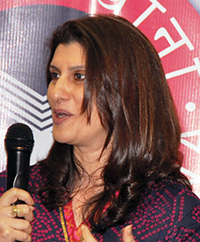
Sooni Taraporevala and Meher Marfatia — co-authors of the Parsi Bol
Another popular one is "Nak no baal” (literally, nose hair) — denoting a critically important person, like, "Jehangir to Khushroo no nak no baal chhé.”
While the phrase "Luhoova (bumpkin)” finds a place in the book, the untranslatable "Aando (lout, crude, rustic streetfighter)” (applies to many currently in Parsi politics), is missing. Similarly, while "Chaoon master” has been included to mean a conman, the colorful phrase for corrupt practices, "Apaamch, Jammamch, Urvanamch” is missing. The compliers may be urged to include "Tamboo ma ghabraat” meaning panic in one’s camp. And considering the compilers’ obsession with "gaan,” "Gaan phaati né godown thai gai (got screwed badly)” would be a worthy inclusion.
Under "Anatomy,” the editors have included "Kan fatyo” for sticking out ears, a better one is "bakkar kan” — goat-like ears. We have other suggestions on "Anatomy,” which may not find favor with the coy readership of this magazine.
Under the list of "Advice,” quite a few nuggets find place. A favorite of the late Navroji Gamadia is worthy of inclusion: "Konhyoon tanh thi kaapi nakho (sever the gangrenous portion),” meaning "cut your losses”; and another one, decrying cry babies, by the same gentleman: "Hansta ramta daaro jai, pun ruri téni ben (expletive deleted);” "Paisawallah na mahel joi né, aapru jhupru nai toriyé” (literally, do not demolish your hut after seeing the palace of the rich; meaning "no need to mimic the rich”). Another common community lament about the circle of life: "Jhaaré daat uta taré gorpapri khava nai mali; né jhaaré gorpapri mali, taré daat pari gaya;” and in similar vein: "Chakli chhé taah charo nathi, né charo chhé, taah chakli nathi (poor have many kids but nothing to feed and the rich have no kids).”
The compilers have boldly hesitated to include the bawdy and the ribald. Parsis use a lot of badam daraakh (expletives). The old Parsi sense of humor was similar to that of Elizabethan England (that is Elizabeth I, not II). Under "Appearances,” a few politically incorrect ones are also bravely included, like "Nahi agasee, nahi otlo” (a woman without any figure) and "Nulla amba pur mottee keree” (a petite but big busted woman). They could have as well added the popular phrase: "Aakhi daar na eeda (tiny breasts).”
A lot of Parsi Gujarati phrases originate from Saurashtra and Kathiavad in a bastardized form. "Dholio” for bed; "dilnoonsnoo” (actually, Dil loochhnoo) for towel are examples. The compilers may be encouraged to seek out some nuggets from these sources. The book already contains a few Saurashtra phrases: "Churyo nahin, tetla ma to ootree gayo (premature ejaculation);” "Baap khai neh dikro hugwa jai” (literally, father eats, son shits — "stingy with food”) — the word for defecation, "hugwa,” being an original Saurashtra phrase.
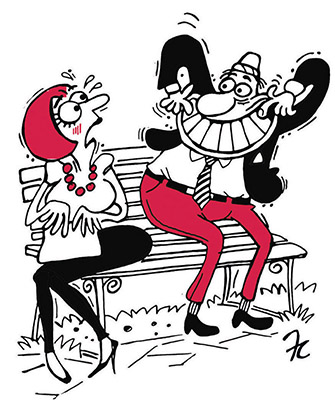
Ghela Ganda (pranks)
Illustration: Farzana Cooper
The compilers have not been squeamish in including several politically incorrect sayings (like the Parsi preference for the fair-skinned or rude comments on anatomical distortions). A sterilised version would have been insipid. Each nugget in this book can be relished like a slow melting gor-papri in the mouth.
(The reviewer, though presently a lawyer, has been a Gujarati journalist and alumnus of the Bharda New High School, where he learnt most of the gems in this book, and many other unprintable ones in the back streets of Navsari.)
◆ ◆ ◆
From the archive