
Cover Story
Renaissance at Elphinstone
UNESCO honors Elphinstone College with an award for “setting the standard” for conservation work on its Grade I heritage building
Sir Cowasji Jehangir’s marble bust over the front porch and the plaque which reads "The Cowasjee Jehanghier Building for the Elphinstone College” had been almost blackened, by the ravages of time and indifference, into anony-mity. Few passers-by cared to admire its magnificent Victorian Grade I heritage facade, which dominates the Kala Ghoda streetscape.
The institution of higher learning which had shaped mighty minds — Dadabhai Naoroji, Pherozeshah Mehta, Jamsetji Tata, Gopal Krishna Gokhale, Bal Gan-gadhar Tilak, Babasaheb Ambedkar, Sir Jivanji Modi, Dinshaw Wacha, K. R. Cama, Dr Homi Bhabha, Justice Y. V. Chandrachud, Homi Seervai... — was fast fading into mediocrity.
But in the last few years, a "mammoth restoration,” in the words of recently retired principal Nergish Charna, has seen the Government of Maharashtra-run Elphinstone College witness a renaissance. Combining action with aesthetics, chipping away at stone and attitudes, in a vindication of teamwork and people’s capacity to care, the Elphinstone College restoration won in September 2004 an "Honorable Mention” in the Asia-Pacific Heritage Awards 2004 for Culture Heritage Conservation from UNESCO (United Nations Educational, Scientific and Cultural Organization).
"Setting the standard for conservation work on the Victorian buildings of (Bombay), the project’s cautious and methodical conservation approach and, in particular, its use of non-invasive techniques have ensured the preservation of the building’s fragile, historic fabric... this project has contributed to consolidating the (Fort) district as a showcase for (Bombay’s) wealth of Victorian heritage,” states the UNESCO website. The restoration was the result of a community-led campaign and "demonstrates best practice in collaborative private-public conservation,” UNESCO notes.
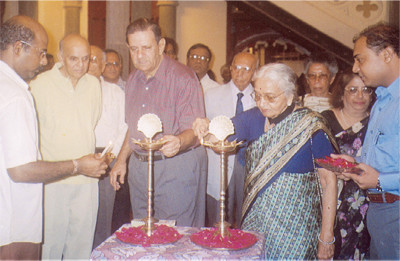
Kanga (third from left) lighting the lamp alongside octogenarian Indubehn Mehta, the oldest living alumni, at the inauguration of the renovated lobby Photo: Hilla P. Guzder
Coincidentally enough, in further vindication of Bombay citizens’ and NGOs’ (non governmental organization) efforts, the Dadabhai Naoroji Road Heritage Streetscape Project, the first of its kind in India, won an Award of Merit from UNESCO for its "restoration of shop fronts, signage and street furniture... (which) has succeeded in gaining commitment from the municipal government to adopt urban design guidelines for the entire historic precinct, setting an important precedent,” states the announcement to the Awards.
A third recipient of UNESCO recog- nition with an Award of Merit was the venerable 286-year-old St Thomas Cathedral, situated within the Fort area too, all three awardees being located within walking distance of each other.
With facades cleaned and the structure strengthened, the morning sun glows on Elphinstone College’s golden yellow basalt, interplaying with the lighter color of Porbander limestone. Its lofty, tiled, pyramidical central roof, flanked by smaller, sibling roofs, soars above the surrounding structures of British Bom-bay. The cleaning has highlighted once again the dexterity of design of its towers and turrets, arches and alcoves, balconies and balustrades...
"The restoration of the building was an absolute necessity. It was not just a case of cosmetics,” states Charna whose association with the College has spanned four decades — as student, lecturer, head of the department of political science and finally a two-year tenure as principal which ended with retirement in September 2004, as per government rules. "Restoration has been on my mind for years. It was very painful to see the College’s deteriorating condition,” asserts the petite lady, elegant in dress, crisp in speech and resolute in manner.
A query regarding restoration casually posed in 1996 to ex-student Rahul Mehrotra, who is a noted conservation architect and executive director of the Urban Design Research Institute, elicited an enthusiastic response. When the Kala Ghoda Association (KGA) embarked on its plan to rejuvenate the Kala Ghoda precinct, Elphinstone College became one of its prime objectives, declares Jamsheed Kanga, one of KGA’s founding members and a former municipal commissioner of Bombay. Shahrookh Sabavala (grandson of Sir Cowasji Jehangir and also one of KGA’s founding members) also mentioned how sad he was to see the structure built by his grandfather and inaugurated in 1888 in such an appalling condition, asserts prominent conservation architect Abha Narain Lambah who prepared the initial Conservation Report in 1999, which was sponsored by the KGA, and saw the project through. "We then approached the Government of Maharashtra for permission to restore the front and side facades,” explains Kanga, also an Elphinstonian. An MOU (Memorandum of Understanding) was signed by the Government and the KGA, so that obligations and financial commitments on both sides were well delineated, he explains. "This established a trend for future restoration work (in other buildings) as well,” Kanga adds. The rear of the College is yet to be done.
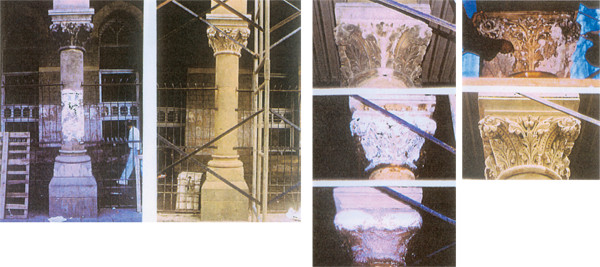
Restoring the carved columns
The project was undertaken in a tripartite partnership of work between the KGA, the Government of Maha-rashtra and its Public Works Department (PWD), and the College authorities. "Prof Charna was strongly involved from the inception. She kept asking when we were going to do the measured drawings. I was in touch with her even when she was not the principal,” asserts Lambah.
To severe structural distress of the front porch, leaning of turrets, cracks and corrosion were added rampant stone staining caused by pollutants and Bombay’s lashing rain, compounded by leakages, insensitive service piping and electrical wiring, as well as an incongruous and visually jarring terrace shed built on the second floor! "We wanted a skilled job. We did not want anyone botching things up,” elaborates Kanga. A senior structural engineer, Sudhir Deshpande, was appointed; the British Council flew down Dr Michael O’Connor, reputed stone conservator. "The right methodology was put in place,” says Lambah. "It’s about time we stopped slapping cement where lime is to be used!”

Kanga and Lambah: committed to conservation
"I have always maintained that the difference in the conservation movement between Delhi and Bombay is that in Delhi people expect just the government to come through, but in Bombay we don’t. We (citizens) take part as funders or activists. We look to setting high standards. And I totally, absolutely adore working with the Parsis,” smiles Lambah.
A plaque in the completely renovated front lobby lists the donors — Piem Hotels (of the Tata group), the Dorabji Tata Trust, Tata Sons, Tata Power, Tata Steel, the Davar Foundation, HDFC (Housing Development Finance Corporation), Yahoo Web Services India and contributions from ex-students are mentioned. Charna points out the beautiful wood panelled ceiling, the ‘pearly’ old lamps refixed. "The wood was covered thick with layers of paint! It had to be painstakingly scraped off!” she sighs. The external facade is illuminated by HSBC (The Hongkong and Shanghai Banking Corporation), as part of its program for the preservation of heritage and beautification of precincts during its 150th year celebrations, states The Elphinstonian, 2002 — 2004.
The restoration also had the full support of the Mantralaya (executive seat of the Government of Maharashtra in Bombay), declares Charna. Their chief architect was the convener of the building restoration committee, the principal secretary of the Department of Higher and Technical Education has taken personal interest. "This is a government college and you are answerable to many masters — the minister, secretary, deputy secretary, director of education, deputy director... All correspondence is in Marathi. You can’t survive in state service if you don’t know the state language. I know my administrative Marathi perfectly,” she laughs, adding that state government employees have to take exams in Hindi and Marathi, with papers in grammar, a literature text in chaste Marathi and a viva as well!
"It is a fallacy, however, to believe that government colleges are neglected. The government is very anxious to see that government colleges perform well. They are very supportive,” she asserts. But to achieve, in India, one has to lead dynamically from the front and push from behind as well, she laughingly adds.
Restoring the interiors of the 3,000-strong College with its cavernous classrooms, high ceilings and arts, science and commerce streams spread across three buildings [the Elphinstone College building, the east wing of the adjoining Institute of Science where the physics department is located and the biotechnology, biology, botany, zoology and microbiology departments on the fifth floor of the NCC (National Cadet Corps) building next door, linked by an interconnecting corridor] was also a mammoth task, Charna explains. She points with pride to the spanking new, modern conference room, the new and upgraded laboratories, the gymnasium with the latest equipment providing a healthy relief from the pressures of present day academics.
"The PWD engineers and staff have been very cooperative,” she commends, all renovations having been executed by the PWD. Charna personally looked into even small details, like selection of tiles or fixing feminine, flowery curtains to bring on a cheery air.
"The PWD will put the same standard color (yellow) they use in all government buildings. I would insist on their getting the shade I thought was right, but the workers couldn’t quite understand the ‘pursuit of perfection,’” she chuckles. Beautiful old furniture, unthinkingly tossed into the storeroom as ‘rubbish,’ has been salvaged and put to good use. Taking pride of place in the principal’s office are the lustrous black carved tables, a portrait of Dadabhai Naoroji adorning one wall, Pherozeshah Mehta the other while Mountstuart Elphinstone (a former governor of Bombay after whom the College is named) presides benignly over it all. Near the door stands a painting donated by noted artist Jehangir Sabavala, also a grandson of Sir Cowasji Jehangir and an alumnus of the College.
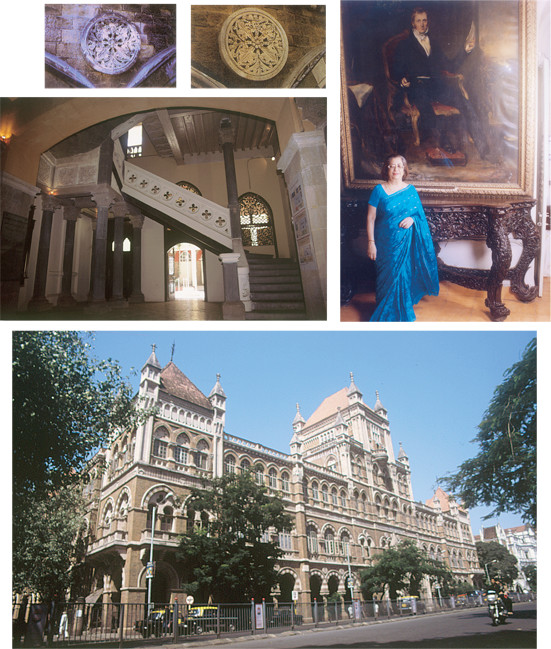
Clockwise from top left: Dexterity of design before and after stone cleaning; Charna and portrait of Mountstuart Elphinstone; magnificent facade of Elphinstone College* and venerable stone stairway and ornamental window*
*Photos: Cherag Mevawala
Whilst the nuts and bolts of the job of restoration were still ongoing, a further challenge for principal and staff arose as the College accelerated preparations for the visit of the NAAC (National Assessment and Accreditation Council) team in July this year. "There is a huge set of parameters and presentations to be made for NAAC,” Charna explains. "The NAAC team visits every department, speaks to each staff member, to students and alumni... looks at all aspects of the institution to award a grading. I used to be working with my team in college for NAAC presentation till midnight when my husband Phiroze would come and pick me up.” Barely a fortnight after the announcement of the UNESCO award came the Accreditation, with the College graded at the ‘A’ level which denotes an institutional score of 85-90 percent. India Today in its issue of May 17, 2004 had placed Elphinstone at number two in the arts and science streams (behind St Xavier’s) in the city-wise ranking and the College has featured in the top 10 in India in its survey over the last five years for all the three streams.
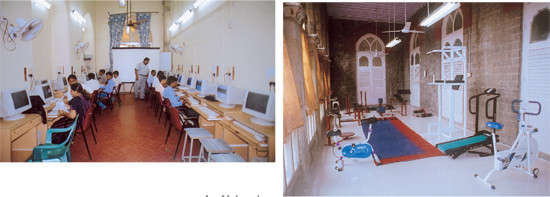
New computer laboratory for I-T students; fine fettle at the College gym
The beginnings of Elphinstone can be traced back to 1827 when the citizens of Bombay collected a sum of Rs 2,29,636 at a public meeting for the purpose of instituting professorships for teaching the English language, the arts and literature of Europe — a suitable testimonial to departing governor Elphinstone regarded as ‘father and friend.’ The Elphinstone Institution was formally constituted in 1835, classes commenced in 1836 with two English professors. In 1855, the Institution promoted Dadabhai Naoroji as the first Indian professor, in fulfillment of the hope entertained when the Elphinstone professorships were founded. The College became a separate institution in 1856, distinct from the high schools run at that time by the Board of Education. In 1860, the College was affiliated to the University of Bombay.
From 1855, Elphinstone saw several changes of location — from a room in the Town Hall, to premises opposite the Grant Medical College, to the Cowasji Jehangir Readymoney Building on Parel Road, to a bungalow near Gowalia Tank. In 1860, Sir Cowasji Jehangir (Readymoney) presented the government with a sum of one lakh rupees, adding a further sum of one lakh four years later, on account of the rise in the prices of building materials, states the College’s history. Designed by Trubshaw (the design was originally for a government printing press!) and built under the supervision of Khan Bahadur Muncherjee Murzban, the College also claims the distinction of having produced Bombay University’s first woman graduate — Cornelia Sorabjee. Its library of over one lakh books has rare classics, as well as books in Farsi, Pali and Gujarati.
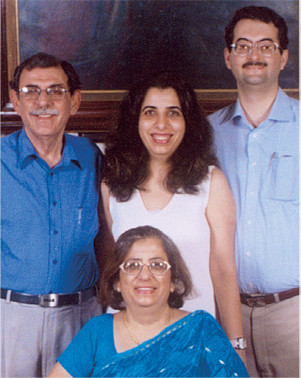
The Charna family: Nergish (seated) with Phiroze (left) and daughter and son-in-law Nilufer and Mehernosh Khajotia
With an abundance of intellectual riches among faculty and alumni through the years, the College has been a premier sounding board for ideas, debate, discussion, dissent and agility of mind. "My family, both on my father’s and mother’s side were Elphinstonians and very proud Elphinstonians...I did not even apply (in 1974) to any other college,” writes eminent advocate Navroz Seervai in The Elphin-stonian, 1999-2002, recalling and commending Prof Dr Homai Shroff — "an institution in herself within this great institution. She took over as principal at a point of time when the College was going through a crisis, and as can be expected of one as masterful as she was, she soon restored the equilibrium of the College and brought it back on its high pedestal of academic excellence,” notes Seervai.
Principal Kamal Wood "was a brilliant teacher. She could relate to her students with ease, and was quick to spot talent,” observes Dr Suma Chitnis, an ex student who went on to become Vice Chancellor of S. N. D. T. University. Principal Dhun Banker was "a gem of a man, a lovable human being,” writes Dr Sunanda Karnad, retired head of the sociology department. Often buffeted by the pulls and pressures of being in government service, the threats of transfer were sometimes used as a means to an end: "When a principal (Banker) was targetted by the government authorities from Mantralaya, the Elphinstone alumni, many of whom were leading legal luminaries of the likes of Setalvad... supported him to the hilt,” writes Dr Shakuntala Bharvani, who taught at the College for 23 years, in The Elphinstonian, 2002-2004. "The transfer of Prof Banker from Elphinstone College during the last year of his teaching career had the students up in arms. They were prompt in organizing a strike, processions and petitions made their way...” writes Dr Soonu Kapadia, ex-Elphinstonian and head of the English department who was also in-charge principal in 1996 and who devoted almost her entire life in the service of the College.
Prof S. R. Mehta, referred to in the magazine as a "distinguished and dedicated teacher,” was head of the statistics department for 28 years and principal before his retirement. Dr Jehangir Chubb is remembered for being a "stimulating” and "gifted” communicator during his philosophy and logic classes, as well as for his "tremendous humor and wit and his delightful limericks, popularly known as Chubbits,” observes Kapadia.
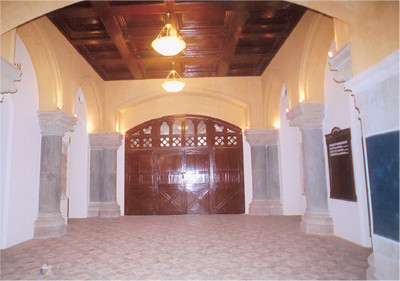
The aristocracy of old wood and stone in the front lobby
Dr Mehroo Jussawalla’s "edition of Spenser’s Faerie Queene Book I was even recommended for study at Cambridge (‘A’ level Cambridge examination),” writes Bharvani, while ex-student Jerry Pinto recalls, almost a quarter century later, the pleasures of listening to Jussawalla "rhythmically reciting Shakespeare, a 400-year-old tradition making its presence felt in every syllable.”
Zarin Minocher-Homji Pinto of the English department was associated with the College as student and teacher from 1961- 2003. "Popularly admired as a disciplinarian, (Pinto) retired in May 2003 after a lifetime of service to the College... She conducted the College examinations with an efficiency few could live up to,” writes Dr Jyothi Nanjundiah in her editorial in the 2002-2004 issue. Dr Shireen Vakil was with the English department till she moved to Sophia College.
Dr Zenobia (Shroff) Dumasia, author of The Contribution of Parsis to Education in Bombay City (1820-1920), is with the history department of the College. "We have a very strong arts department,” states Charna, whose paper "Sir Phe-rozeshah Mehta and the Elphinstone College” has been published in the book Pherozeshah Mehta — Maker of Modern India edited by Dr Nawaz Mody, herself an Elphinstonian. Charna’s Textbook on Political Science was recognized by the Maharashtra State Board of Secondary and Higher Secondary Education as a prescribed textbook for Standard XII.
Elphinstone is the only college in south Bombay offering German and Geography as majors for the three-year degree course. Ancient Indian Culture and French, available at the College, are no longer commonly taught in colleges affiliated to Bombay University, she observes.
Keeping up with 21st century requirements, the College commenced its BSc - Information Technology course from the very first year (2001-02) of its launch at Bombay University. In tune with the declaration of the Biotech Policy 2001 by the Government of Maha-rashtra, the College introduced BSc — Biotechnology in 2002-03. Both these are unaided courses, states Charna, adding that the College gets students not only from Bombay but from as far afield as Nepal, Manipur and Mauritius as well. The College actively encourages several outdoor and indoor sports.
"Elphinstone is the place where I came in (the year 2001) as a shy, unsure and impressionable young girl... This is where I actually grew up — on the hoods of cars outside college, in the quadrangle, in the crowded canteen room chatting over a masala dosa and chai... where I learnt about life,” writes Behrooz Avari. "Elphinstone is an exciting place to be in, there is lots to be learnt. How much and in what measure is your decision to make.”
◆ ◆ ◆
From the archive