
Books
Colorful compilation
Sooni Taraporevala and Meher Marfatia have done the Parsi community (and anyone interested in the Parsi community) a great service. They have cooked up a delectable dish of Parsi "culture” hitherto unknown outside the Parsi fold and to many in the Parsi community as well.
And yet, delectable as the dish is, there is something tantalizingly missing. The Parsis took the Gujarati language and made it their own. It is, perhaps, the most colorful of all the Indian languages and it is that color, that amazing lexicon of words that say one thing and mean something else that makes Parsi Gujarati so delicious. To give an example — Dhila nara no Parsi; literally it means a man with loose pyjama strings. In Parsi Gujarati it means a man who sleeps around.
The ladies have given us some truly delicious ones. Like Maran nu karan dhakhara (cause of death, delusions of grandeur). In case you didn’t know, the expression maran nu karan (cause of death) is straight out of the Jam-e-Jamshed obituary column.
Parsi Bol, interesting as it is, is not something one can read from cover to cover. And I don’t think the "authors” meant it to be. It is something to dip into every now and then and savor.
And yet, delectable as the dish is, there is something tantalizingly missing. The Parsis took the Gujarati language and made it their own. It is, perhaps, the most colorful of all the Indian languages and it is that color, that amazing lexicon of words that say one thing and mean something else that makes Parsi Gujarati so delicious. To give an example — Dhila nara no Parsi; literally it means a man with loose pyjama strings. In Parsi Gujarati it means a man who sleeps around.
The ladies have given us some truly delicious ones. Like Maran nu karan dhakhara (cause of death, delusions of grandeur). In case you didn’t know, the expression maran nu karan (cause of death) is straight out of the Jam-e-Jamshed obituary column.
Parsi Bol, interesting as it is, is not something one can read from cover to cover. And I don’t think the "authors” meant it to be. It is something to dip into every now and then and savor.
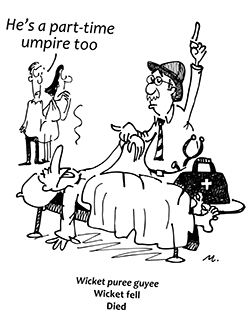
Wicket puree guyee (Wicket fell)
Illustration: Hemant Morparia
Let’s face it, Parsi Gujarati is, to use a phrase from the book, ‘Ell fell’ thi bharéli chhé (is filled with choicest expletives). (And anyone who says it isn’t so, doesn’t know Parsi Gujarati.) In fact, mummo-chachcho is practically used as punctuation.
Perhaps Taraporevala and Marfatia felt a little embarrassed at some of the words that make the language so unique. (Though why they should, I don’t know. They are, after all, Parsis.) But, to their credit, I must say, they have tried. They have told us of the phrase Gaan fatee gai, the literal translation of which has been politely given as bum split meaning terrified, but it also means "screwed” or "buggered.” The more colorful version of this is Gaan faree né godown. The literal translation is pretty easy to figure out, but what it really means in Parsi Gujarati is "buggered out of shape.”
There is, however, a small suggestion I have for the "authors.” Instead of giving the literal and "other” meanings of the phrases, give the readers an example of each phrase used in a sentence. This will make for easier and more interesting reading.
This book is like a starter. With 716 phrases from 260 contributors, the compilation whets one’s appetite to know more about what this tiny community says and what it really means. Each phrase is written in the Gujarati and Roman script, followed by the literal meaning and lastly the idiomatic one. The Gujarati phrases have been translated by Rutty Manekshaw, while the illustrations are by cartoonist Hemant Morparia and freelance illustrator Farzana Cooper. We hope the starter will be followed up by the main course and then the dessert.
Kudos to the two ladies for compiling this badly needed volume, and to Cyrus Guzder for sponsoring their effort through the Jimmy and Shirin Guzder Trust and the J. C. D. Adenwalla Trust.
As it is, the book is fun to read or rather to dip into. Go, grab a copy. It is well worth the price. And the next time you hear two Parsis talking you might be able to make some sense of what they are saying.
◆ ◆ ◆
From the archive