
Comment
Merit in maanthra
Why the Zoroastrian prayers should be chanted only in the original language, whether we understand it or not
An acquaintance recently requested me to expand upon what I have often said in the past regarding translation/interpretation of sacred texts. Among other things he wrote in his email: "In many of your write-ups in the Parsi Press you have maintained that religion and religious matters should be discussed in public only by scholars and not by any Tom, Dick and Harry. My two grandsons (aged 17 and 15) and I are very eager to read an amplification of this theme. If you don’t mind, please add a few lines about saying one’s prayers with or without understanding the sacred text.”
In view of the germane suggestion, the theme may be amplified as: the Zoroastrian religion is based on certain canons which are explicitly or implicitly mentioned in the scripture or its commentary. Avesta and Pahlavi are the languages in which the same are to be found. Unlike Sanskrit, Hebrew, Greek and Arabic, Avesta and Pahlavi are not spoken languages. In the extant Avestan literature there are no words for "reading” or "writing.” The bedrock of our scriptures lies in preliterary oral tradition, to use a German technical term Sitz im Leben, having an outstanding "place in life.”
In view of the germane suggestion, the theme may be amplified as: the Zoroastrian religion is based on certain canons which are explicitly or implicitly mentioned in the scripture or its commentary. Avesta and Pahlavi are the languages in which the same are to be found. Unlike Sanskrit, Hebrew, Greek and Arabic, Avesta and Pahlavi are not spoken languages. In the extant Avestan literature there are no words for "reading” or "writing.” The bedrock of our scriptures lies in preliterary oral tradition, to use a German technical term Sitz im Leben, having an outstanding "place in life.”
.JPG)
Priests studying religious texts at the First Dastoor Meherjirana Library Conference
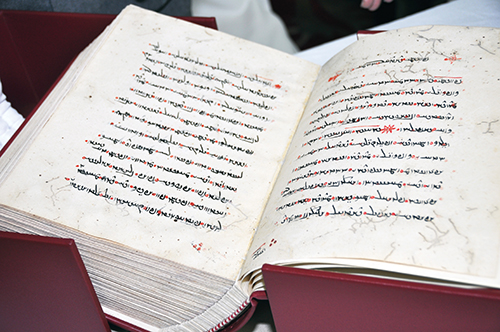
Manuscript recently restored for Meherjirana Library
Whatever was available to us in the last two centuries came in the form of manuscripts which have been admirably collated by occidental as well as oriental scholars before being published. Different manuscripts of the same text are at variance with each other. Scholarly translations of various texts rely on one variant or the other. Besides, there can be diverse views/explanations of one and the same word/phrase and many vivid and arresting flashes of meaning of a phenomenon. Just as there are various versions of the Bible like the Geneve Bible, The Rheims Douai (or Douai) Version, the King James (or Authorised) Version, The American Revised Version, The New English Bible, etc, there are many translations of our scriptures in Gujarati, Marathi, English, French, German, etc.
There is a popular notion that anyone who is well read in any subject can peruse one or more of these translations and can criticize the same, perhaps by giving his own version! A more fallacious notion would be hard to find. Scholarly translations contain copious footnotes including grammatical, philological, historical, mythological and metaphysical arguments. Thus, even if one can read a translated passage, to read and comprehend the footnotes is beyond the scope of such a person. It is evident that a translator/interpreter of scriptures must have sound judgment in exegesis (analytic and critical analysis of text) which, in turn, requires long training and much experience. Without accurate knowledge and sound judgment it is not possible for one to comprehend a scripture.
A person may show proficiency in law, medicine, journalism, economics, engineering, etc, he may be a polished speaker, but that does not mean that he is qualified to deal with the translation/interpretation of a scripture, much less criticize it. This is so because the person lacks the groundwork required. However, we have men who, while admitting their utter lack of scholarship, indulge in questioning and criticizing scholar-priests and scholars. Some such men are muckrakers; others may be trying to gain a social foothold. Also, there are those who are over enthusiastic to exercise their "democratic right of freedom of expression.” All such persons resemble the man who thinks of playing polo — a Persian sport (originally a fertility rite) — without being a horseman! However, one need not deduce that all scholarly translations are gratifying. No, the observations clearly mean that only scholars can judge the merit or demerit of the translation/interpretation of a sacred text and not any Henry or Conrad. In such matters it would be futile to bring in "democratic right” because neither the Iranian nor the Indian ideal has anything to do with any type of democracy, whether ancient Greek or Roman, modern English or American. The Iranians and the Indians of earlier times were always for governance by the king and the priest, the raja and the purohita, the sacerdotium and the regnum. Both looked up to the raiyyat nawaaz (benevolent ruler), in Platonic terms the philosopher-king.
The "holy word” (Avestan maanthra, Sanskrit mantra) was always venerated by the Iranians and the Indians of yore. And though a vast majority would never be in a position to grasp, in totality, the import of "holy word,” for one who recites it with reverence while comprehending its import, merit may increase manifold. Today any devout man, priest or layman, literate or illiterate can read or arrange to memorize a piece of our sacred text and recite the same. Whether he belongs to the first or the second category, correct pronunciation would be a sine qua non (essential requirement).
Parsis of the last 100 years or so may be divided into two categories: Commoners’ Category (CC) and Scholars’ Category (SC). For the sake of accuracy, the two categories may be sub-divided into CC1 and CC2 and SC1 and SC2 respectively. In Commoners’ Category 1 (CC1), numerically the largest among the four, we have many lower middle class and poor humdins facing the problem of survival. Many of them are wedded to simple living. By and large, in religious and socioreligious matters they make an attempt to be guided by our scholar-priests and orthodox scholars. Their weak point is that they are prone to fall prey to devious propaganda of some members of Commoners’ Category 2 (CC2), propaganda which lacks theological justification. CC2 consists of moneyed businessmen, peevish pamphleteers, nonconformists, etc. They are pro abolition of rituals, favor interfaith marriages, burial/crematorium even where a dakhma exists, and believers in free love. Many of them are out to gain street credibility and some of them do not hesitate to concede that they are not scholars while in the same breath they keep on lecturing/writing about our doctrine, ritual and dogma! To inflict their views on those in CC1, they come out with statements like "Parsi is a race while Zoroastrianism is a religion.” Either they don’t know, or even if they know they wish to forget that our forefathers frequently used terms like "Parsi dharam (religion)” as well as "Jarthosti dharam.” Again, these controversy seekers often find fault with our scholar-priests of international repute. Now and then they take our religious and socioreligious matters to courts of law! Such exercises are performed in order to bask in the approval of the cosmopolitan heterodox. A movement like this has upset the equilibrium of our joint family system and altered the Parsi way of life. According to such people, there can be no greater hindrance to progress than orthodoxy and tradition. It is rather comical that such strangers to orthodoxy should, at times, talk about "unity” in the community while trying to generate discord!
Scholars’ Category 1 (SC1), numerically the smallest of the four, consists of scholar-priests and four or five orthodox scholars who recognize the scriptures as the main authority while realizing that these should be interpreted in the light of tradition. Their singularity is their fullness of thought and flawless exactitude of statements. They use their sagacity to hit out at heretics and the heretical announcements of Scholars’ Category 2 (SC2). The myths generated by the latter become hazardous for those who can be whipped into a frenzy. Strangely enough, among them are some madressa-trained mobeds, but they, together with some behdin scholars in SC2, are inclined towards theosophy and the un-Zoroastrian doctrine of reincarnation. Lavish use of tortured reasoning impels them to be too obtuse to detect the kernel of genuine religious expression and transforms them into a snake-pit of meanness, spite and selfishness. Even ecclesiastical censure means next to nothing for such persons.
Having walked through the present communal scenario, let us revert to the main point. In the late 1930s and early ’40, there were some who had raised an issue of samjaati bhaashaama bandagi (praying in a language one understands). Also, some high-society persons, well-meaning but ignorant about the worth of maanthra, found "logic and cogency” in this canard which was hotly debated at that time but, thanks to some orthodox stalwarts, could not be transmuted into a movement. After so many decades we still find somebody here and there expressing his sympathy with this distressing idea.
Our communal style largely depends upon the said four categories and their functioning. The authority to translate/interpret the scripture rests with the scholars and our prayers should be recited only in the original with or without understanding.
 Faribourz Nariman is an Iranist and a scholar of comparative religion who has attended several international congresses and seminars on oriental studies, art and archeology, etc, and presided over the Iranian section of the All-India Oriental Conference on six occasions. He has collaborated with the German Archeological Institute in establishing a Zoroastrian Museum at Hamburg. He has delivered lectures on Zoroastrianism, Iranian and Indian art, architecture, etc under the auspices of various organizations in India and abroad.
◆ ◆ ◆
From the archive