
Books
Colorful compilation II
Parsi Bol 2 — Insults, Endearments & other Parsi Gujarati Phrases compiled by Sooni Taraporevala and Meher Marfatia. Published in 2016 by Good Books, Jasawalla Court, 47/B, B. Desai Road, Bombay 400026 and 49/50 Books, 33, Peacock Palace, 69, B. Desai Road, Bombay 400026. Pp: 212. Price: Rs 500.
What we had stated in our earlier review "Colorful compilation,” Books, Parsiana, March 7, 2014 holds good for the enlarged version too: "Most of these phrases and sayings originated about a century or more ago in the villages and towns of Gujarat, where most Parsis then resided. The Parsis migrating to Bombay were progressively Anglicized and their future generations could barely understand Gujarati and were far removed from the cultural ethos which produced these phrases and sayings. The whole backdrop became gradually alien. Hence, the novelty value of this book, which throws light on a bygone era, an old culture and a different way of thinking.
"The structure of the compilation is simple but superb. Every phrase is set out in Gujarati script, followed by an English version of it for those who cannot read Gujarati, then a literal English translation, and lastly, the essence of the phrase.”
Some of the original nuggets first: Sahrah chhuh noh kato (hands of the clock at 6:30; Impotent) accompanied by a rather risqué cartoon. Parsis treat death with humor too (Kemps Corner ver avee gaya (Doongerwadi) – near death). A smooth operator is described by the phrase Aankh ma thee kajal kahreh evo loochho (such a cheat that he even steals kohl from the eyes); and the rather irreverent expression for "how a gift is used is not your concern” – Pundit neh loto apyo, puchhee te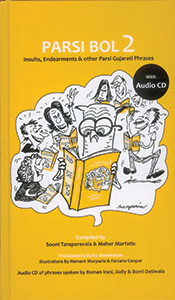 jup kare ke gaan dhoyeh, shun farak pareh? (give a Pundit a mug, then whether he uses for prayers or to wash his bum, what difference does it make?)
We had pointed out some significant errors in translation and typos in the first edition; unfortunately, none have been corrected. Considering that this is a hugely collaborative effort of hundreds of Parsis the compilers will hopefully rectify this in a future reprint. There are a few more errors in the second edition – Jhooftoo jhaftoo is wrongly translated as ‘In disrepair’; it actually means ‘sleepy and sluggish.’ Omtoo gomtoo is a messy mixture, normally a reference to bad cooking, and not a jumble as the book says. Chiao miao is not a baby; it means to eat or gulp quietly; and Tukora Bundh is not ‘on the dot’; it means perfectly splendid.
Parsi Bol 2 captures some real old fashioned expressions. Jher khavani fursood nuthee (no time to swallow even poison — very busy) reminded us of a noted Parsi solicitor (and once upon a time Punchayet trustee) given to great melodrama, in his heydays ("Bawa, jaldi bolo, mane ghadiyal né chaavi aapvano bhi time nathi; arré, nakh kaapvano bhi time nathi” I am so busy that I have no time to wind my wristwatch or trim my nails).
Despite our considerable repertoire of colorful idioms, we never knew that a man fiddling with his private parts is called "furniture gothvech” or that a very large family deserves the expression Vahan bhuree neh kaka, neh galla bhuree neh maasi (steamer full of uncles and cartloads of aunts).
"The structure of the compilation is simple but superb. Every phrase is set out in Gujarati script, followed by an English version of it for those who cannot read Gujarati, then a literal English translation, and lastly, the essence of the phrase.”
Some of the original nuggets first: Sahrah chhuh noh kato (hands of the clock at 6:30; Impotent) accompanied by a rather risqué cartoon. Parsis treat death with humor too (Kemps Corner ver avee gaya (Doongerwadi) – near death). A smooth operator is described by the phrase Aankh ma thee kajal kahreh evo loochho (such a cheat that he even steals kohl from the eyes); and the rather irreverent expression for "how a gift is used is not your concern” – Pundit neh loto apyo, puchhee te
jup kare ke gaan dhoyeh, shun farak pareh? (give a Pundit a mug, then whether he uses for prayers or to wash his bum, what difference does it make?)We had pointed out some significant errors in translation and typos in the first edition; unfortunately, none have been corrected. Considering that this is a hugely collaborative effort of hundreds of Parsis the compilers will hopefully rectify this in a future reprint. There are a few more errors in the second edition – Jhooftoo jhaftoo is wrongly translated as ‘In disrepair’; it actually means ‘sleepy and sluggish.’ Omtoo gomtoo is a messy mixture, normally a reference to bad cooking, and not a jumble as the book says. Chiao miao is not a baby; it means to eat or gulp quietly; and Tukora Bundh is not ‘on the dot’; it means perfectly splendid.
Parsi Bol 2 captures some real old fashioned expressions. Jher khavani fursood nuthee (no time to swallow even poison — very busy) reminded us of a noted Parsi solicitor (and once upon a time Punchayet trustee) given to great melodrama, in his heydays ("Bawa, jaldi bolo, mane ghadiyal né chaavi aapvano bhi time nathi; arré, nakh kaapvano bhi time nathi” I am so busy that I have no time to wind my wristwatch or trim my nails).
Despite our considerable repertoire of colorful idioms, we never knew that a man fiddling with his private parts is called "furniture gothvech” or that a very large family deserves the expression Vahan bhuree neh kaka, neh galla bhuree neh maasi (steamer full of uncles and cartloads of aunts).
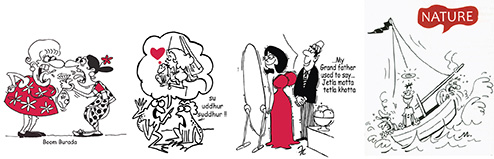
Above: A sample of illustrations from Parsi Bol 2
Some of the food metaphors are exquisite. If dhansak ni dal is too watery, you say "Ava Ardavisur Banoo meherban laagech” — referring to the boon granting goddess who presides over the waters of the world. A faux pas is described as "Chhas ma mooro dovhyo” – stirred a radish in buttermilk. And the virtues of pure Porbandari ghee are extolled by the idiom "Chokha ghee ma toh murelo kootro bhi saaro lageh” — literally, even a dead dog will taste great if cooked in pure ghee. They would love this one in Seoul.
Translating these phrases from Parsi idiomed Gujarati is not easy. One has to appreciate the peculiar nuance and the backdrop of a society, some 100 years ago. Considering that, Parsi Bol is a remarkable endeavor. Any nitpicking reviewer who does not appreciate this will be classified by the Parsi Bol, as Sadantar Ghelchodio (untranslatable).
◆ ◆ ◆
From the archive