
Books
So they say
Should the authors of the Parsi Bol book have included some "non-vegetarian” sayings in their 156-page book? "No,” insisted filmmaker, director and photographer Sooni Tareporevala, and author and columnist Meher Marfatia who compiled the 716 phrases in the Rs 500 book published by Good Books & 49/50 Books.
When this topic was broached at the book launch at the hands of Farok Guzder, son of late Bombay Parsi Punchayet chairman emeritus Jamshed Guzder, at Bombay’s Kitab Khana book shop on December 20, 2013, the authors declared they didn’t want to "offend.” Taraporevala conceded that some felt the sayings were "too tame.” Asked whether the phrases were more from Parsi Gujarati or Gujarati, Tareporevala replied "most are very Parsi.” The Gujarati sayings veer more towards positive attributes.
"Everyone takes offence very easily,” said Dr Hemant Morparia who along with Farzana Cooper drew the illustrations that accompany some of the phrases. Morparia, a radiologist who draws political and social cartoons for the Mumbai Mirror daily, said that people took pains to be "politically correct” but that should not negate bona fide humor. People should "take it in the right spirit,” he advised. The book was designed by Priya Pereira and printed by JAK Printers.
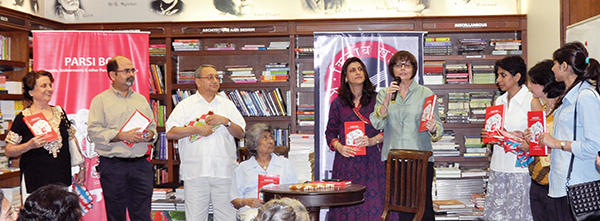
(L-R): Dolly Mistry, Hemant Morparia, Farok Guzder, Rutty Manekshaw, Meher Marfatia, Sooni Taraporevala,
Priya Pereira, Farzana Cooper and Sejal Purohit at launch of Parsi Bol
The sayings are printed in Gujarati with an English transliteration, the literal meaning and a colloquial rendition. Rutty Manekshaw who translated the sayings stated the work was "good fun and a pleasure.” Taraporevala noted that Manekshaw "spoke Italian as well.”
The authors thanked the Jamshed and Shirin Guzder Trust and the J. C. D. Adenwalla Trust for sponsoring the book. "I have never seen such generosity,” said Taraporevala who met Cyrus Guzder at the Bombay Gymkhana to acquaint him with the concept. His brother Farok noted the trust founded by his father had "helped a lot of people.”
The brief launch was preceded by a short skit authored by thespian Sam Kerawalla, replete with various phrases that appear in the book. The script readers were Danesh Irani and Huzan Wadia.
In case one does not find their favorite phrases in the book, the authors urge readers to email their contributions to parsibol@gmail.com "Our lines are open for the sequel,” note Taraporevala and Marfatia. Thanking all the contributors they observe, "Without all of you Parsi Bol would have been boltee bundh (mouth shut).”
In an article in Mid Day of December 20 when asked how the project took shape, Taraporevala referred to "an e-mail I wrote to my friend (producer/director) Mira Nair using one of the phrases coupled with an entirely unconnected e-mail from Zarir Cama [executive director of three of Hong Kong and Shanghai Banking Corporation’s banks — HSBC bank Bermuda Limited, The Saudi British Bank and HSBC Private Banking Holdings (Suisse) SA] saying how somebody should compile these phrases was the dual trigger that made me message Meher and suggest we embark on a book as co-publishers using the internet and crowd sourcing to make it a collective effort. As a writer I marvelled at the… inventiveness of the Parsi imagination and wanted to put it down on paper before it was too late. Meher, unbeknownst, to me was undertaking the same journey — so it was destiny that brought this about.”
Marfatia told the daily, "We started in February 2012, so that’s almost two years. Sooni sent me a message as I was putting finishing touches to another fun book, on Parsi theater: Laughter in the House, which she encouraged and guided me to self-publish in 2011. ‘Let’s do a quirky Parsi Gujarati phrase book,’ she said. Both of us by then with our own publishing labels, went ahead as collaborators on the project. Before that, my friend Pervin Dadachanji had got me going, suggesting that it’d be a shame not to pin down our community’s priceless phrases in book form, and so we’d started jotting down some in alphabetical order.”
As the authors note in the Introduction, their goal was "to archive the gems we grew up hearing, before the generation that knows them dies out…
"In much the same way that every family has its own dhansak recipe, the meanings of these phrases are variations on a theme, with their interpretation changing from person to person. As there are no definitive ‘right’ criteria, we request any perceived differences to be viewed in this light.”
◆ ◆ ◆
From the archive