
Religion
Promoting prayers
A reliable prayer book standardized from the various Khordeh Avesta texts, in roman script, would meet modern day needs
Acutely concerned at the manner of promoting our prayers, readers have anguished over the lack of accurately printed materials and their careless, slipshod oral transmission by disinterested priests. Such concerns highlighted defects in published texts, their worrying divergences and absence of informed commentary.
Whilst there is no confusion in privately performed, purely personal ritual of the nirang-i kushti bastan, kushti/kasti tying is on the wane among the youth who, sadly, find it irrelevant for today’s material preoccupations.
Sad because of the unawareness of the quiet power and inherent purpose of these painstakingly compiled formulations by caring, discerning scholar-priests who realized their potential for easing careworn minds through their reflective, inspirational and purposeful empowering recitation. For too long has the absence of prayers been condoned on the grounds that "they are in a dead language.” The language is "dead” only to those who are not alive to their timeless teachings. When such recitations are required to be exact and flawless, there arises an imbalance between utterance and understanding.
The understanding of prayer is particular to each devotee; exactitude, however construed, would raise pointlessly contentious issues. "Precise” translations are best avoided and instead favored through their general sense responsibly presented by learned prelates.
Whilst there is no confusion in privately performed, purely personal ritual of the nirang-i kushti bastan, kushti/kasti tying is on the wane among the youth who, sadly, find it irrelevant for today’s material preoccupations.
Sad because of the unawareness of the quiet power and inherent purpose of these painstakingly compiled formulations by caring, discerning scholar-priests who realized their potential for easing careworn minds through their reflective, inspirational and purposeful empowering recitation. For too long has the absence of prayers been condoned on the grounds that "they are in a dead language.” The language is "dead” only to those who are not alive to their timeless teachings. When such recitations are required to be exact and flawless, there arises an imbalance between utterance and understanding.
The understanding of prayer is particular to each devotee; exactitude, however construed, would raise pointlessly contentious issues. "Precise” translations are best avoided and instead favored through their general sense responsibly presented by learned prelates.
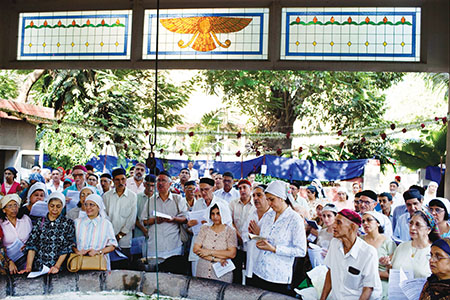
Prayers recited at Bhikha Behram well Photo: Kainaz Amaria
Also, what is the best script in which these compilations are published? Should it remain in Gujarati for the Jarthostis of India and in Perso-Arabic for the Zardushtis? How will those in the diaspora cope with scripts which increasingly seem outmoded and incomprehensible? A commonsense via media format would appear to be a correctly accented romanized text.
Earlier "native” productions still exist in their homelands. Among the first Gujarati-scripted Khorde Avastas is the extraordinary late 19th century volume produced by Ervad Kavasji Edalji Kanga, a prolific and hugely learned scholar priest. A stout volume of some 550 pages, it went through several re-edited printings from its first in 1880 to its 10th in 1926 (as in this writer’s fiercely guarded possession) and doubtless others well beyond. In careful transliteration, translation and richly extensive commentarial notes, its contents abundantly satisfy the most fastidious of Gujaratophone devotees.
The Zardushtis have the Perso-Arabic scripted version by Ebrahim Pour-Daoud, yet another brilliant, widely admired scholar who painstakingly transcribed and translated several texts he considered suited to Iranian requirements. This writer’s copy was "lifted;” it is hoped that it still benefits the unauthorized borrower and his descendants somewhere in North America.
To address the point of exact/correct pronunciation: both transcribed versions have minor but noticeable blemishes; in Kanga’s work it is the persistently irritating use of the -e- as in bet, get, etc, in lieu of the muted vowel, here shown as -a- as in the -u- sound in bun, fun, etc, and its long form -ā- to sense in burn, fern, etc. The Persian re-editions often missed the crucial pointing of vowels.
Kanga had, nevertheless, taken trouble to extend the normal range of his Gujarati alphabet with additional, properly devised characters. That these were not always adhered to must be the fault of bored proofreaders and negligent editors.
The real joy in using his Khorde Avasta lies in his astonishingly good notes and explanations-cum-glosses.
The prayers themselves require comment and gentle rebuke for those who deal with them in cavalier fashion. The kushti nirang has been sectioned off between its Gathic Avestan, (Standard) Avestan and the Pazand. Its two verses recited prior to the actual tying on are the Kamnā Mazdā (Ys.46.7) and the Kā varathram.jā (Ys.44.16). The first takes the form of an entreaty to Mazda for protection from harmful deceit through His spiritual fire and His mind by which truth nourishing deeds are sustained and proclaimed to the devotee’s spiritual vision (the daēna).
The second Gatha verse whose first line is omitted out of respect to Ahura, "Lordly One,” not to be seen addressed in any disrespectful way -- it reads "I ask you this, Lordly One, answer me aright.” The rest may be understood as "Who will victoriously protect through your manthras (divinely inspired pronouncements) those living ones? Appoint therefore a healer of life, and may Hearkening (Sraosha) come to whomsoever you wish it.” In the original Gathic these are the very words of Zarathushtra who alone is Mazda’s spokesman. This is presumably why the nirang had emphasized in the "Profession of the Faith,” the Jasa.mē avanhē Mazda, that we are Mazdayasno ahmi; mazdayasno Zarathushtrish (Mazda worshippers of Zarathushtra’s persuasion.)
Of all short invocations, it is the very concentrated Yathā ahū vairyō with its 21 words which is considered the prime prayer of the four: the others are Asham vohū (Ys.27.14; 12 words); Yenhē hātam (Ys.27.15; 15 words); Airyāmā ishyō (Ys.54.1; 24 words).
The sacrality of the Yathā ahū vairyō must be proclaimed with every emphasis. For as long as anyone can recall, this crucial piece had the highest prestige: "The sacred gift of the Ahuna-vairya intoned with sanctity... with that of the correctly uttered words... May they be to us the more saving in their wise significance” as Lawrence Heyworth Mills had well prefaced in his translation.
As per the Yatha: Ys.27.13: "Just as one chooses a spiritual guide (ahu), so too does he/she choose a truth allied earthly guide (ratu). Given to actions through good mind, (and) dedicated to a life of wisdom (Mazda), spiritual authority (khshathra) comes to him/her who attends to the underprivileged (drigu).”
In Yasna 19, a commentary on the Ahuna-vairya, Ahura Mazda revealed to Zarathushtra its spiritual preexistence and preeminence in the material world: its threefold parts are peculiarly His own, each of which is to be recited aloud. Its perfect rendition is worth a hundred of other ritual stanzas (from the Yasna?); even when imperfectly sounded it is worth 10 such stanzas! Better to be perfect!
The recommended pattern of recitation follows — the worshipper firstly recalls it mentally; then worded in an undertone; thereafter it is to be chanted aloud in its threefold entirety. Thus will the devotee be safely escorted by Mazda Himself over his particular Chinvat crossing to his foremost existence.
Setting this passage alongside the Gathic Ys. 46.10 where it is Zarathushtra who assists with the crossing, it is evident that this bridge represents the progress of the worshipper from ignorance to illumination, from brutishness to norms of civilized behavior. This indeed is the foremost existence of Yss 28.2, 43.3 and 46.10 — right here in the Mazda created material world. Such is the power and purpose of this awesome prayer where the Gathic "heaven” and "hell” are earthly mental states, and whose expressions are found in the Ahunavaiti Gatha. (Note that in place of full Gathic invocations, each Gatha requires 1,200 Yathā recitations!)
The best of scholarship has been devoted to the Yathā ahū vairyō or Ahuna-vairya, with inevitable differences. The "desired” of vairya seeks an earthly spiritual guide allied to truth, just as the divine guide. Three agencies of this divine entity (Mazda) are invoked: Asha (as noted), Vohu mana (good mind); and His Khshathra (governance) for the deeds of a Mazdaic existence in succoring the deprived, the indigent, the disfranchised. However simplistic this brief sketch, it expounds the duties of the Mazdaic Zarathushtrian.
The Asham vohū (laudation of truth) cyclically defines the boon and blessing of truth which is one’s best acquisition (Ys.27.14). It signifies "Truth is good; it is the best — a blessing (ushta) it is; a blessing for whom truth is the best order.”
Of the four sacred prayers, the Yenhē with its archaized Avestic is a later insertion, and has its own part story. Here is seen the introduction of male and female entities through knowledge of Ahura Mazda; Zarathushtra would have been not a little miffed! He foresaw how great would be this danger of infringing the worship due solely to Mazda, his Ahura: prayer to Him alone is the final test of Zarathushtra’s forthrightly preached monotheism. Hence his Gathas.
The last of the four praises is enshrined in the Airyāmā ishyō from the opening words of Ys. 54.1. It is a convocation prayer for the early Zarathushtrian clans — both men and women. Couched as a reminder of the purpose and power of the daēna or spiritual envisionment, it is thought to be by Jamaspa, Zarathushtra’s son-in-law: its prestigious 24 words complete the Gathic Avestan corpus.
An offbeat sidelight is shed on the purifying activity of Saoshyant — the final savior who, in the Zurvanite scheme of religious history, makes his appearance in its 12th millennium to complete the work of his two predecessors in 57 years. Why 57? A plausible solution is an arithmetical one: the 21 words of the Yathā + the Ashām’s 12 + the 24 of the Airyāmā — bean-counters’ delight! One has to refer to Zarathushtra’s unwavering perspective on the real saviors — they are all those who, through good mind and truth teach the life enhancing Mazdaic unison of mind and body to all humankind.
Reliable prayer books must accordingly select from the varied Khordeh Avesta texts, and then carefully edit and publish in an augmented romanized alphabet. Some dozen extra accents and diacritics to satisfy the 16 vowels and 37 consonants of the purposefully devised sixth century CE Avestan alphabet should pose no problem to those determined to preserve, protect and project our rich spiritual culture and ancient heritage. Will scholar priests together exercise their hearts and minds to agree to such a worthy project? The religio cultural well being of future generations depends on its lastingly successful outcome. May it so happen!
Born in Bombay into a Navsari high-priest clan, Farrokh Vajifdar developed a deep and abiding interest in Indo-Iranian civilizations, with strong bias towards Zoroastrianism, when settled in London. Occasional radio and TV broadcaster, lecturer and independent researcher, he has translated books and articles from French, German and Italian.
◆ ◆ ◆
From the archive