
“Hear… the great truths”
The principle of truth and freedom of choice are meant to guide Zoroastrians to the right path
Parsiana carries excerpts of the thoughts expressed by Maharashtra advocate general Darius J. Khambata in his keynote address on "Zoroastrianism: The Way Forward” at the 10th World Zoroastrian Congress (10WZC).
The first half was devoted to an analysis of historical facts which indicate that:
Zarathushtra himself was not a Parsi — he is reputed to have been born in ancient Bactria (now southern Uzbekistan);
The Parsis (people from Pars in southwest Iran) themselves accepted Zoroastrianism almost a thousand years after Zarathushtra and after other Avestan peoples had become Zoroastrians;
Zoroastrianism was a revelatory new religion — the first monotheistic one and was not a mere continuation of an existing religion (which was polytheistic). Thus those who accepted Zoroastrianism were necessarily converts;
In ancient times, the religion spread far and wide and this is inconsistent with it being a monopoly of the Parsis (e.g. upto Turkey in the west and Parthia in the northeast);
Parsis and Zoroastrians have through the centuries displayed great qualities of tolerance, mercy, kindness and generosity, several of which are absent in the current debate within the community.
When sharing his speech, Khambata clarified, "I was deeply touched by the genuine appreciation of the audience. I sincerely cherish my religion and am proud of my ethnicity. I want both to survive. The object of saying what I did was to encourage a free, fair and dignified dialog bereft of acrimony. If this speech makes more Parsis read and think about our great religion and exercise ‘urvan,’ I will have achieved my objective. I have no other interest.
"I welcome informed criticism and do not claim infallibility in my views. I only hope that those who take a different line or are critical of what I have said, do so on the basis of disclosed historical, legal or religious sources. Nothing that I have said is either new or radical. It is in fact a rational option that should not hurt any true Zoroastrian.”
Parsiana is reprinting the second part of his paper:
We have in India freely practiced Zoroastrianism. The two great tenets of our religion are Urvan which signifies freedom of choice and Asha which means walk the path of righteousness.
Urvan literally means the chooser but refers to the soul. For each individual has complete freedom to choose his path, only guided by Zarathushtra. Linked to that is the idea of "man;” a word that in the Gathas combines the concept of both mind and spirit.
What was "man” if not what Zarathushtra proclaimed in the 30th Yasna: "Hear with your ears the Great Truths, consider them with clear thought, deciding between the two and choosing — man by man, each one for himself.”
Yet today our community is being haunted by the specter of intolerance. The democracy of thought and freedom of choice of our religion is being engulfed by the tyranny of reprisal and recrimination. The freedom, indeed the duty, to exercise choice is rapidly being stifled within our community.
The other great tenet is Asha and our basic prayer Ashem Vohu tells us that the path to happiness is by righteous living and by truth alone. In its secondary sense Asha is the path to Ahura Mazda and fire is the outward symbol of purity, being the purest of Ahura Mazda’s creations.
Herodotus, a Greek historian (often inaccurate) said that between the ages of five and 20, Persian boys were taught only three things: how to ride a horse, how to use the bow and to speak the truth.
On a lighter note, Herodotus also records how the ancient Persians resolved disputes. When important decisions were to be made the question was discussed when they were drunk and the following day submitted for reconsideration when they were sober. If it was still approved it was adopted; if not, abandoned. The reverse order was also sometimes followed. If we continue on our current path this may soon be the only way we will be able to resolve anything!
.JPG)
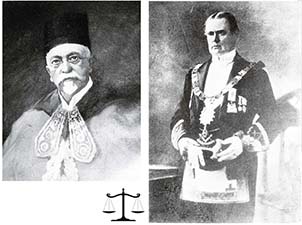
The true test of our commitment to Asha came several centuries after our arrival in India, in 1910 in the case of Sir Dinshaw Manockji Petit v. Sir Jamsetji Jejeebhoy ("the Parsi Punchayet Case”). The case concerned J. R. D. Tata’s mother Sooni who was French and had converted to Zoroastrianism after marrying R. D. Tata. She was denied entry to an agiary. The Bombay High Court (Justice Dinshaw Davar and Justice Frank Beaman) came to several seminal findings after hearing extensive evidence (including of high priests such as the great Dastur Jamasp Asa):
Both judges held that the Zoroastrian religion not only permitted but actually enjoined conversion of a person born in another religion and of non-Zoroastrian parents;
However both the judges also held that since the advent into India, there was not a single proven instance in India of conversion of a person born of both non-Zoroastrian parents to Zoroastrianism;
Davar held that there were certain elaborate ceremonies necessary and conditions to be fulfilled before accepting a person into the Zoroastrian faith, and it was required that the desire to proselytize was actuated by pure intentions and convictions and not based on other considerations;
Davar also held that once such a conversion had taken place, the persons were entitled to the full rights and privileges of a Zoroastrian;
Both judges held that when the settlors made trust deeds (200 or 300 years ago), it would not have been within the contemplation of the settlors that an individual who was not a Parsi but converted to Zoroastrianism would be entitled to the benefits and use of the trust property. They applied a doctrine of interpretation based on the contemporaneous usage and understanding of terms;
Hence Davar also held that the Parsi community entitled to trust properties fell in three classes: Parsi descendants from the original emigrants and who were born of both Zoroastrian parents and who professed the Zoroastrian religion; the Iranis from Persia who professed Zoroastrianism; and the children of Parsi fathers by "alien” mothers (as he put it) who had been duly and properly admitted into the religion; The last category is odd. It is not from the trust deeds. It is not in our religion. The rationale for the third comes in Justice Beaman’s judgment;
Justice Beaman held that the Indian Zoroastrians had adopted the caste system from other Indians and that whilst theoretically they adhered to their religion, whose principal tenets included the merit of conversion as a theological dogma, they erected about themselves real caste barriers and therefore the term Parsi had acquired a caste connotation. He attributed our refusal to allow non-Parsis into fire temples or to participate in death ceremonies, to caste and I quote him: "This is not religion, it has nothing to do with religion: it is essentially distinctly irreligious: but it is pure unadulterated oriental caste.”
I believe Beaman’s judgment to be a very awkward and an un-comfortable wake up call. A wake up call to which sadly, after a 100 years we have still not responded. "Parsi” and "Zoroastrian” had become synonymous in India not because of religion but because of caste. That is why whilst caste made the Zoroastrian religion hereditary in India, the great Persian priests in the Rivayats or answers sent to theological queries from India maintained conversion of non-Zoroastrian servants to Zoroastrianism was permissible albeit if ritual was strictly followed. It is a caste that is inherited through the father and that is why we bar worship in an agiary to children of non-Zoroastrian fathers. This was the unspoken rationale underling Justice Davar’s inclusion of children of Parsi fathers from "alien” mothers. It has nothing to do with our religion. It is a manifestation of caste, pure and simple.
A 100 years have passed since then.
We are now proud citizens of the world’s greatest democratic experiment and citizens under a visionary and great Constitution. Part of a vision that our founding fathers, including Dadabhai Naoroji, Sir Phirozeshah Mehta, Sir Jamsetji Jejeebhoy and Jamsetji Tata dreamt of. For which nation in the world has a national motto which resonates with the message of Zarathustra. "Satyameva jayate” or "Let truth prevail” is nothing but an invocation to Asha. The three lions that grace our national emblem are the great symbol of that philosopher King Ashoka the Great — but they have their origin in the pageantry of the Achaemanians and were first found at Persepolis.
The Constitution of India abolishes discrimination based on amongst other things, caste. An exclusion from a place of worship based on caste would be illegal and unconstitutional. No doubt Article 25 protects the right to freely profess, practice and propagate religion and Article 26 reserves the right of every religious denomination to establish religious and charitable institutions and to manage their own affairs in matters of religion. But Articles 25 and 26 are "subject to public order, morality and health …” To my mind an exclusion based on caste would be immoral and un-Zoroastrian.
Mahatma Gandhi had famously said about Parsis: "In numbers beneath contempt but in contribution beyond compare.” (There is no documented evidence of Gandhi having made the statement according to scholar Dinyar Patel, a Harvard PhD student — editors) The question before us today and in this (10WZ) Congress is whether we allow those numbers to fall beneath the line of extinction and become fossilized as was predicted by that great historian Arnold Toynbee or we somehow save our religion for future generations.
I know that this is a controversial debate and it has genuine votaries on both sides. I believe that the strong views expressed on either side are supported by genuine convictions and to say otherwise would be to devalue the debate. The debate must be dignified and without rancor.
Consider the extreme nature of what is happening today, in the guise of subserving the assumed intention of the settlors of trust properties. Freedom to worship is being actively denied to many true and good Zoroastrians who are not of Parsi origin or whose fathers are not Parsi Zoroastrian or indeed even to Parsi Zoroastrians married outside the community.
Do we let dogma and caste triumph over good thoughts, good words and good deeds? One of the greatest Zoroastrian Parsis who strode this earth was Sir Jamshedji Kanga acknowledged by many to have been India’s greatest lawyer and a wonderful human being. He was a mobed and wore his mobed’s cap to court for every year of his almost 70-year practice. Yet each evening on his return from court he would light one cigarette, carefully removing his priests’ cap before he committed that one daily act of "heresy!” Did that make him any less a devout Zoroastrian and Parsi? Not in the least. He never allowed dogma to triumph over Asha and Urvan.
The descendants of those who sought refuge here from the scourge of religious intolerance and bigotry cannot now appropriate the fire to themselves. Was that the dream of (those) who fled Iran sacrificing their worldly possessions? The time has come to free Zoroastrianism from the shackles of property law. To monopolise Zoroastrianism is to kill it.
We do not need to sacrifice our identity to reclaim our religion. That is a myth that is being propagated.
It is a sobering thought that today a Zoroastrian from Uzbekistan (the birth place of Zarathustra) or a re-converted Zoroastrian descendant of any of those valiant kings Cyrus, Darius, Xerxes, Shapour, Khushrav Noshirwan or Yazdegard, would not be able to assert the right to enter an agiary since he or she would not fit within the strict confines of the Parsi Punchayet judgment.
This is a matter of shame. Nothing less than that. It does not behoove us as Zoroastrians or as Parsis.
Yesterday, walking in the leafy forests of Mahabaleshwar, I wondered whether Zarathushtra himself — born of parents who were neither Parsi nor Zoroastrian — would be able to get admittance today to an agiary as a matter of right. Perhaps not. That is, at once, both farcical and tragic.
Does the future of Zoroastrianism lie with Bombay Parsis or must we now pin our hopes and destiny on the Zoroastrian diaspora abroad? I hope that we Bombay Parsis rise to the challenge. We are the descendants of those pioneering exiles and it is in that spirit that I salute those true and valiant Zoroastrians who wage a sometimes lonely battle for their right to worship. To them I say do not despair for you partake of the struggle for Asha or truth and Ahura Mazda walks beside you.
The Rangoon Case
Some years after the Parsi Punchayet case, there arose an interesting matter in which to apply and perhaps extend the principles laid down by the Bombay High Court. It came to the Privy Council from Burma, in Saklat v. Bella. Bella (reportedly) was the 14-year-old daughter of a Goan Christian and a Parsi Zoroastrian mother. She had had her navjote and entered an agiary. Some worthy members of the Parsi community objected and filed proceedings to bar her entry.
The Privy Council (in a judgment delivered by Lord Phillimore) followed the Parsi Punchayet case that required the dual qualification of being both a Zoroastrian and a racial Parsi before one could assert the right to enter an agiary. It held that maternity was of no importance in matters of race.
The Privy Council however also evolved a doctrine which is very important and apposite:
It held that although when property was set apart for public or charitable uses it would be a malversation to apply the funds for persons who were not objects of the trust. This principle did not prevent the rendering of some convenience or service of such a nature as would not hurt the lawful recipients;
The Privy Council consequently held that the trustees were not bound to exclude others who were also Zoroastrians but who did not strictly meet such dual qualification (and hence had no title to share), provided their admission would not hurt the beneficiaries. So it was only if the numbers admitted were too large or the persons were disorderly or unpleasant in their habits or they substantially interfered with the convenience or benefit of those for whom the endowment was created that the trustees would be required in law to exclude them.
The Privy Council held that the suggestion that Bella’s conversion was impossible or had not been completed by due initiation, was not established. It was also held there was nothing to show that allowing entry to a Zoroastrian (Bella) would cause desecration within the fire temple and that accordingly such entry would not be a case of substantial interference with the devotion of worshippers.
In these years of controversy I have not seen anything that establishes that the presence of a Zoroastrian born of a non-Parsi father and Parsi mother in an agiary desecrates our holy and powerful fires. There is no basis for this in law or in religion. Let no one tell you that permitting entry into an agiary, of a Zoroastrian who is not born of a Parsi father is either against the law or against our religion.
Possible solutions
I therefore offer two solutions:
Firstly if it causes such great anguish to Parsi Zoroastrians to have a true and pure Zoroastrian, who is not born of a Parsi father, stand next to them in an agiary to worship Ahura Mazda, then let new agiaries be consecrated. Let our great soul fires seed the fire in such new agiaries. For that there has to be a spirit of sharing and magnanimity. There is clearly no breach of trust if trustees of existing agiaries permit a flame to be lit from the fire burning within and hence permit a new agiary to be consecrated. The rights of beneficiaries of the existing agiary are not thereby affected. The trust deeds for the new agiaries may permit entry to all Zoroastrians including those with a non-Parsi father.
Alternatively, our agiaries and atash behrams can and must throw open their doors to all Zoroastrians. This is the preferred alternative. This is the nobler alternative. It will behoove us as Zoroastrians and as Parsis. This will be completely within the duties of trustees and the bounds of the law of trusts. The rights of beneficiaries will not be diluted. There is nothing in our religion that suggests that the presence of a Zoroastrian, whose father is non-Zoroastrian or is not a Parsi, in an agiary will desecrate or dilute the holy fire —no such evidence was led in the Parsi Punchayet case or in the Rangoon case and I believe that there is no theological basis for such apprehension.
I think that every true Zoroastrian will agree that the fire of Zarathustra and the right to worship is inexhaustible, so it can and must be shared. It will be like the fish and loaves of bread that Christ shared amongst his congregation. It is infinite.
As regards other rights such as housing, education and health, a more doctrinaire approach can be adopted based on a strict construction of the trust deed. Until the Parsi Punchayet case is reconsidered by a higher court, rights of enjoyment of other properties that are by their nature exhaustible will have to be allowed only strictly in accordance with the inferred desire of the settlor, i.e. only for Zoroastrians born of a Parsi father.
Do not, I beg of you, make our soul fires and our great religion a hostage to fortune! The choice is clear we must either allow the fire to spread or risk its extinction. The keepers of the flame must not lock it in their embrace and extinguish it!
As Davar held, conversion to Zoroastrianism is a matter of elaborate ritual and purity of conviction. It is neither routine nor easy. I do not advocate active proselytization; I advocate acceptance, humanity and tolerance. I advocate inclusion, not exclusion.
The expression "Parsi Zoroastrian” is completely alien to our religion. It is a term from trust deeds and we demean Zoroastrianism by introducing that term into religious discourse.
I appeal to our worthy and respected high priests to eschew legal controversies and follow the examples of the great priests that have preceded them: Dasturs Naryosang Dhawal, Kirder, the second great prelate of the Sasanians, Meherji Rana, Kukadaru, Dhalla, Jamasp Asa. Propound and spread Zoroastrian philosophy. I implore you to revitalize our religion and evangelize our youth. You enjoy great respect but with that respect comes responsibility. It is a far greater trust that you are charged with.
Today’s speech is not a legal opinion nor even a legal analysis. It is but the suggestion of an approach for debate and consideration. An approach of tolerance and magnanimity. An approach that is within our religion and that will be within the Parsi Punchayet case and that will subserve the great constitutional values laid down in the Constitution of India. It will reflect the tolerance and libertarianism of Cyrus, the generosity of Darius, the magnanimity of Xerxes, the sacrifice of Yazdegard, the magnificence of Khusrav Noshirwan the Just, and the valor shown by Parsi Zoroastrians through the ages. It would combine the concepts of Urvan and Asha.
Conclusion: the Chinvad Bridge
We must all cross the Chinvad bridge one day. As a community and as a religion we stand today at the same crossroads that the Mughal empire stood at in the 17th century. The warring sons of Shah Jahan battled for his succession. Finally Aurangzeb triumphed sending the decapitated head of Dara Shukoh, the eldest son, to his ailing father. Do we go the way of Dara Shukoh and look to a libertarian renaissance or do we go the way of Aurangzeb and fall into the abyss of bigotry and intolerance that marked the decline of the Mughal empire? Let us not make the same mistake, for the price we will have to pay will be far too high.
Zarathushtra himself exhorts us in these magnificent words of the 30th Yasna:
"May we be the ones who will make this world splendid,
Mindful One and Ye Lords, bringers of change, and Right, as our minds come together where insight is fluctuating.”
It will not be easy but we must remember those stirring words of Lord Wavell: "Without courage there cannot be truth, and without truth there can be no other virtue.”
"We desire your fire” was Zarathushtra’s plea to Ahura Mazda in the 34th Yasna. It is also a clarion call to all to receive the truth of the divine revelation from Ahura Mazda. It is an exhortation not to the physical element of fire, but to faith.
It is in the spirit therefore of tolerance, respect for Asha or truth, Urvan or freedom of choice and the great Zoroastrian dream, that I beseech every Zoroastrian to walk the path of the righteous, to reaffirm the timeless truth of our faith and to give his or her fire to Zarathushtra.
Light that fire and it shall be everlasting, the cause is just and will endure, the flame shall never wane or flicker and the dream shall never die.