
Comment
Thwarting tradition
Some people are working to shun tradition and create an entirely new Zoroastrian persona with the brush of modernism
"Religion and tradition are inseparable; they are two closely related aspects of the same thing,” observed Lord Northbourne. The word religion has been variously defined by different authorities. Sociologists, philologists, philosophers and psychologists have tried to study the origin of religion in different ways. However, it would be safe to maintain that, at the level of the body politic, religion is a body of truths to be believed, a body of principles to be obeyed and heretical proclivities to be shunned, while bearing in mind its three important components — doctrine, ritual and dogma. Thus, a Zoroastrian is one who will assume responsibility for the implementation of these three components, to the extent that the implementation is deemed feasible by orthodox scholar-priests at a given time. It need hardly be added that no stratagem can succeed in combining this responsibility with the likes and dislikes of individuals. Broadly speaking, this has been the case with our community from the days of the Sasanians. But of late, some men and women have come forward to do some scene-shifting!
The following would help identify the scene-shifters. They are ill-fitted for understanding, quoting, translating or interpreting a sacred text. Nothing pleases them more than to talk about their rights while forgetting to talk about their duties. Everything connected with tradition is gall and wormwood to them. For them, a fire temple, far from being the heart of a settlement, is a structure to exhibit their religiosity on certain days. It appears that their goal is to create an entirely new Zoroastrian persona, which, in reality, would be a cavern of profligacy and indecorum tarred with the brush of modernism. Their pie in the sky is "secularized Zoroastrianism.” To jack up this sort of secular osmosis they enlist, for a price, the services of certain newspapers and journals disseminating anti-orthodox information. On the one hand they glare defiance at the expositions of traditional themes, and on the other, they fabricate falsehoods about orthodoxy and orthodox scholars. Some may be tempted to ask: what instigates them to adopt such an attitude? The answer is their notion of ‘freedom’ or ‘freedom of choice’ for one and all. Their lack of respect for what is venerable spurs them to ignore the guidance of highly knowledgeable and experienced scholar-priests. Now, the achievement of freedom in any sphere means to be free from something for something else; and freedom for what is more important than from what.
As per the scene-shifters’ phraseology, ‘freedom’ means ‘freedom to choose’:
one’s spouse without any reference to the latter’s community,
any un-Zoroastrian system of disposal of the dead where the traditional system is available,
conversion/acceptance for any non-Zoroastrian,
atrocious words and phrases to denigrate orthodox scholar-priests and scholars,
a tendentious interpretation of a sacred text and to glorify both the interpretation and the interpreter,
a mixture of Avesta/Pazand and theosophy to dish out reincarnation etc. It is interesting to note that this sort of ‘freedom’ is for being footloose for free love and for everything that leads to free-for-alls! More often than not anarchism ensues from this sort of ‘freedom’ and agnosticism or atheism does not take long to follow.
Mikhail Bakunin, for whom freedom meant ‘complete independence of man from man,’ had the arrogance to assert: "If God exists, I am not free. But I am free, therefore God does not exist!” Otherwise stated, the pie in the sky turns out to be nothing short of satanic freedom. From the traditional point of view bondage is hundred times better than such ‘freedom.’ Nevertheless it must be said that Bakunin, and Jean Paul Sartre who followed him, at least had the backbone to announce: no God, no religion. Our high flying scene-shifters do not have the guts to proclaim their agnosticism/atheism. They want to have their cake and eat it! Outwardly they pretend to be devoted Parsis while inwardly they are sworn gravediggers of tradition. In a word, they are dealers in hypocritical cant.
And as if to add insult to injury, they attempt to do our scholar-priests down! Here, it is imperative to underline that it is not for our scholar-priests to enter into debate with ignoramuses, especially with those who revel in utterances/acts of profanity. Suffice it for the scholar-priests to declare what is right and to denounce what is wrong. Besides, profane professionals and men of big business cannot discuss religious problems with representatives of the spiritual power on equal terms. Deeper ideas in the sacred text of any genuine tradition just cannot be grasped by every Henry or Conrad.
All the more so because, unlike Sanskrit, Hebrew, Greek, Latin and Arabic, Avesta-Pahlavi are not spoken languages. Of course, translations of a number of texts are available, but for one who is au fait with both the texts and with religious studies as such, the exegetical, historical, philological and philosophical hurdles in the way of understanding the scripture would prove to be insurmountable. A person, however successful he may be as a lawyer, physician, government officer, columnist, etc would be at sea to single out a good, scholarly translation. But let us say a solid work is recommended by a scholar or a scholarly review in some journal, even then, will the inherent ineptitude of such a person allow him to grasp the contents in the translation? Again, certain translations published in the late 19th or early 20th century have been improved on in parts during the last 50 years or so.
That our scene-shifters would be ignorant about the strides made by Iranian studies during the last few decades is beyond question. But this shortcoming will not deter the dilettante from coming out with snatches from the Gathas or the Yasht literature, thereby causing confusion among the laity and, simultaneously, putting the Zoroastrian Church in jeopardy. During Sasanian times such a person would have been unchurched, but today we have some columnists who are eager to idolize the recreants/Bohemians and their disingenuous analyses.
As long as the recreants/Bohemians, in their search for something new, sever traditional ties of family and race and choose to live their lives away from their motherland while keeping to themselves, they do not constitute any grave danger for the community. Whether they choose to live in Latin Quarter (Paris)/Soho (London)/Greenwich Village (New York) or some similar place is inconsequential. But the moment they adopt an anti-traditional posture and pretend to educate our community in religious matters, they deserve to be reprimanded.
Initially the dogmas of the Zoroastrian Church were handed down viva voce and, later, in writing. This tradition is the foundation of the Church’s article of belief. In Yasna 71.5, among other things, the Zoroastrians worship "all the laws against the demons” (vispem datem vidoyum) and "all the long traditions” (vispemcha daregham upayanam). Moreover, a Zoroastrian is one who respects the self-same dogmas set forth as truths of divine revelation; this is something on which our socioreligious structure is based. It is thus that tradition lends sanctity, just as orthodoxy confers propriety.
Keeping this in mind, a cut-and-dried formula to prevent our socioreligious fabric from being fouled up may be hinted at: unquestioned obedience to tradition by all upstanding ones while censuring the upstarts. An amoral disregard for tradition begins by shattering ethical and social values and ends up in total destruction of the community. A note of caution is imperative in connection with some columnists and pamphleteers who, to quote a master of tradition like Guenon, only have a tendency or aspiration towards tradition, without really knowing anything about it. It would be in the interest of the community if no attention is paid to such columnists and pamphleteers because, as the saying goes, such people go further (progress?) and fare worse.
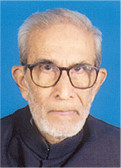
Faribourz Nariman is an Iranist and a scholar of comparative religion who has attended several international congresses and seminars on oriental studies, art and archeology, etc, and presided over the Iranian section of the All-India Oriental Conference on six occasions. A visiting professor at the Bombay University, he has delivered lectures on Zoroastrianism, Iranian and Indian art, architecture, etc under the auspices of various organizations in India and abroad.
◆ ◆ ◆
From the archive