
50TH ANNIVERSARY
“All is not lost”
The demographic decline is not so alarming and can be stemmed by inculcating religious fervor through suitable education
The population trend of a nation or community is a marker of its health and vitality. A growing population is a general indicator of prosperity, but an alarming increase suggests poverty and ignorance. A stable population suggests planned growth. A mildly decreasing population suggests a growing, lifestyle conscious middle class, but an alarmingly declining population suggests that something is wrong with the nation or the community.
In the case of Zoroastrians, it is not possible to determine exactly whether the decline in numbers is mild or alarming. Different papers in the community media project different pictures. According to one paper the global Parsi Irani population in the world in 2001 was pegged at around 1,40,000. ("What the Diaspora can do for India and what India can do for the Diaspora,” Khojeste P. Mistree, 2009). Another paper shows the global population at about 1,20,000 in the same year ("Decline of the Parsee community in India,” Dinshaw K. Tamboly, 2012). Still another paper puts the global Parsi Irani population in 2001 at 1,12,000-1,20,000 ("Rescuing Our Community from a Demographic Crisis,” Dinyar Patel, 2012). The real answer, it seems, lies somewhere in between, but tilts more towards a mild rather than an alarming decrease.
In the case of Zoroastrians, it is not possible to determine exactly whether the decline in numbers is mild or alarming. Different papers in the community media project different pictures. According to one paper the global Parsi Irani population in the world in 2001 was pegged at around 1,40,000. ("What the Diaspora can do for India and what India can do for the Diaspora,” Khojeste P. Mistree, 2009). Another paper shows the global population at about 1,20,000 in the same year ("Decline of the Parsee community in India,” Dinshaw K. Tamboly, 2012). Still another paper puts the global Parsi Irani population in 2001 at 1,12,000-1,20,000 ("Rescuing Our Community from a Demographic Crisis,” Dinyar Patel, 2012). The real answer, it seems, lies somewhere in between, but tilts more towards a mild rather than an alarming decrease.
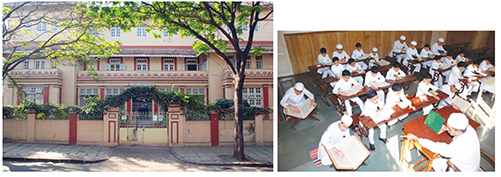
Dadar Athornan Institute (left) and its students learning from the scriptures
Population statistics suggest about 20% decline in the Indian Parsi Irani population since 1971 (1971 Government of India census figures for Parsis: 76,382; 2001 figures: 69,601; 2011: estimated 61,000 — official figures still awaited — editors) , but at a global level, considering the increase in the population, especially in North America and Australia-New Zealand, the decline comes to around just five percent. (Here it should be noted that the estimates of population of North America, in the first half of 2000, differ in different papers. Mistree puts it at 33,000, Tamboly at 18,000 and Patel at 15,500.) So though there is a decrease, if one considers the global Parsi-Irani population, it does not seem to be so alarming. I do not entirely concur with people who are pessimistic about the community’s future and feel that the end is round the corner. However, the marginal yet steady decline is not a healthy trend and all possible measures need to be taken to stem and finally reverse it.
Efforts should be made to motivate youths to marry, marry early and marry within the fold and propagate two to three children per marriage, which requires determination and commitment, generally associated with religious fervor, pride and a sense of responsibility towards one’s religion and community. The fact that marriage and procreation are cardinal Zoroastrian duties has often been overlooked and rarely emphasized. I know of at least two couples where one of the spouses in the marriage insisted on having a second child as a religious responsibility when the other spouse was not willing for it. Finally, the former succeeded. This is the direct result of religious fervor evolving into a community centric mindset.
One of the surest ways to decrease, halt and subsequently reverse the trend of declining population among Zoroastrians is to increase the religious fervor of the community starting with children and the youth. The best way to achieve this is to start systematic, organized, specialized, authentic religious education which will inject positive traits like motivation and determination in them.
Efforts should be made to motivate youths to marry, marry early and marry within the fold and propagate two to three children per marriage, which requires determination and commitment, generally associated with religious fervor, pride and a sense of responsibility towards one’s religion and community. The fact that marriage and procreation are cardinal Zoroastrian duties has often been overlooked and rarely emphasized. I know of at least two couples where one of the spouses in the marriage insisted on having a second child as a religious responsibility when the other spouse was not willing for it. Finally, the former succeeded. This is the direct result of religious fervor evolving into a community centric mindset.
One of the surest ways to decrease, halt and subsequently reverse the trend of declining population among Zoroastrians is to increase the religious fervor of the community starting with children and the youth. The best way to achieve this is to start systematic, organized, specialized, authentic religious education which will inject positive traits like motivation and determination in them.

The M. F. Cama Athornan Institute in Andheri
Organized religious education is sorely missing in our community. In the past, attempts had been made to suggest a common syllabus and infrastructure for religious education, but it did not pick up enough steam. One of the reasons for this sad state of affairs is that it has never been taken seriously. Religious teachers are expected to work voluntarily or in an honorary capacity. Serious attempts need to be made for central, professionalized religious education at the institutional level. One of the only organized attempts at multiple level religious education that comes to mind is (Mistree’s) Zoroastrian Studies which revolves round a small band of dedicated religious teachers hand-picked and personally trained by an academically qualified religious scholar.
Considering the way monies are being generously expended for different projects, the infrastructure and ongoing expenses for establishing and running organized religious education is not much. But most important would be to have a professional administrator who can work independently without any strings attached.
It is no doubt important and necessary to provide housing and fertility programs to stem the declining population, but the issue of religious fervor should not be overlooked. In most national and international youth seminars and community conferences, most problems boiled down to lack of religious education. Religious scholarship and organized religious education needs to be given the rightful place it deserves as it affects almost every aspect of community life.
In the last 20 years, the number of students in the Dadar Athornan Institute has come down by about 25%. (In 1994 there were 29 students; in 2014, 23 students.) But this, according to me, has nothing to do with the declining Zoroastrian population. It is on account of the relocation of priests from rural areas to cities in Gujarat, from Gujarat to Bombay and from India to overseas. Since they now have access to good educational institutes they do not perceive the ‘academic’ need for our Institute. Further, they too, like the other members of our community have only one or two children and are able to look after them well with educational aid now more freely available.
Yet another reason is that those who have become priests by learning just a couple of chapters of the Yasna are treated at par with those who have memorized all the 72 chapters at our Institute. This is very demoralizing for the full-fledged priests. Parents don’t want their children to undergo the grind and exertion of rigorous studies for a (full-fledged, trained) priest when an easy alternative is available.
The future of the priesthood is not as depressing as it seemed about three decades back. The community has woken up to the fact that priests need to be paid well, at par with a decent income from other sources. With this, the tide will turn. Much will also depend on the priests, on how they rise to the challenge and how they present themselves to the community. The priests will have to widen their ambit of expertise and become religious educators and expounders, over and above specialists in rituals. Priests will come if we offer them good remuneration and so will the support staff. The big gap between the demand and supply of priests may soon be filled if proper motivation is offered to them. It is just that they are not willing to work as full-time priests in the current circumstances.
In Bombay where there are around 50 agiaries catering to a community numbering around 40,000, it means we have one agiary for about 800 Parsis which is not a bad figure. All is not lost, as is generally made out to be. No doubt there are a handful of agiaries that are not being patronized as they are located away from places of residence. Otherwise all agiaries are very well looked after. If the priests are offered a good package, getting about 200 full-time priests to tend the agiaries will not be a very difficult proposition.
After some communication with a responsible member of the priestly fraternity in Iran, I feel that all the duties of a lady mobedyar in Iran are within the ambit of what a lay Zoroastrian lady in a state of ritual purity can do as per the religious traditions, except for the performance of sudreh-pushi (the Iranian equivalent of the navjote). The idea of priesthood in Iran and in India is very different.
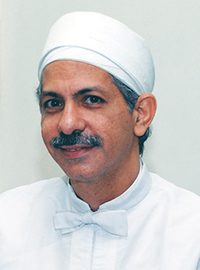 Ervad (Dr) Ramiyar Parvez Karanjia is the principal of Dadar Athornan Institute, and Sir J. J. Z. Institute for Indo-Iranian Studies. He has obtained his Masters and Doctorate in Avesta-Pahlavi from Bombay University. He was a post-doctoral research scholar at the Universities of Uppsala (Sweden), Heidelberg (Germany) and Zurich (Switzerland). An author of various books, he regularly conducts courses and seminars, and gives presentations and talks on the Zoroastrian religion, spirituality, Iranian languages and history. He has a website www.ramiyarkaranjia.in where he offers everything connected with Iranian religion, history and languages for all age groups.
 ◆ ◆ ◆
From the archive