
50TH ANNIVERSARY
“Neither here nor there”
Many of the young claim to lack space and time to nurse the old or find a spouse
The decline in population of Parsi Zoroastrians is a disturbing and worrisome factor that is being discussed at various fora.
For the past 27 years I have been working with the senior members of our community mainly at J. J. Hospital’s Parsi Ward. I also render service at the F. S. Parukh Dharamshalla, Gamadia Clinic, Masina Hospital and B. D. Petit Parsee General Hospital.
Whereas other communities in India have a negligible five percentage of their population that is 65+, and a huge 32 percentage under the age of 15 years, amongst Parsis we have a reverse pyramid with the elder members accounting for more than 25 percent and under-15 population less than 13 percent. As a result of the ageing population, the old age homes with which I am connected are always full, with a long waiting list for admission to these institutions.
For the past 27 years I have been working with the senior members of our community mainly at J. J. Hospital’s Parsi Ward. I also render service at the F. S. Parukh Dharamshalla, Gamadia Clinic, Masina Hospital and B. D. Petit Parsee General Hospital.
Whereas other communities in India have a negligible five percentage of their population that is 65+, and a huge 32 percentage under the age of 15 years, amongst Parsis we have a reverse pyramid with the elder members accounting for more than 25 percent and under-15 population less than 13 percent. As a result of the ageing population, the old age homes with which I am connected are always full, with a long waiting list for admission to these institutions.
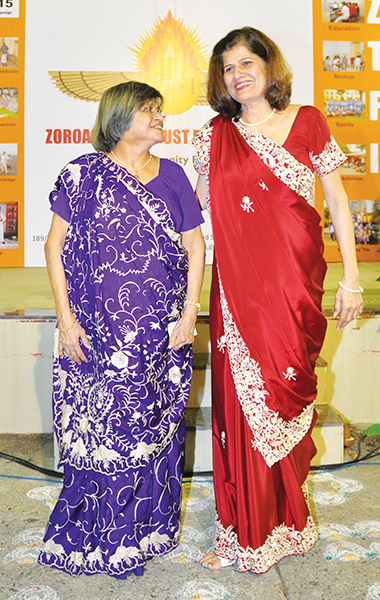
Arnavaz Mistry (right) with winner of best gara sari at a Zoroastrian Trust Funds of India function
The decline in Parsi population has had a huge impact on the old. Many of the persons admitted are not married, and hence in their old age there is nobody to take care of them. Their nieces, nephews and other relatives are too busy to look after them. Then there are widows or widowers without children. Their predicament is the same as the unmarried ones.
The saddest cases are of those who have children but for various reasons have been put in old age homes by their offspring. In some cases the children have migrated abroad, some have a small accommodation which makes it inconvenient for them to keep their old at home, and some influenced by the western ideology, feel that it is their birthright to put their old away in old age homes. But the basic fact remains that most of them are childless or have just one child who is unable to take care of them. Would this scenario be witnessed amongst other communities in India?
Another area of work that I am closely connected with is matrimony. According to a 2009 study conducted by Sayeeda Unisa, professor of demography and statistics at the Indian Institute of Population Sciences, one out of every five Indian Parsi men and one out of every 10 women is still unmarried by the age of 50.
The Matrimonial Bureau of the Bombay Parsi Punchayet was revived in February 2010. It has met with limited success. In over three years there have been just 11 marriages that have taken place due to our efforts. A number of problems are faced by us due to the decline in population. In each age group, the choice is very limited. The vast choice that other communities in India would have is not available to our youngsters. And till they find every aspect suitable, our youngsters are not willing to marry. They would rather remain single than compromise on the criteria they are looking for in their match.
The tradition amongst other Indians, that by the time the children reach a marriageable age they are to be married off, is non-existent amongst us. Their society looks down upon parents who do not marry off their offspring by a certain age, irrespective of whether they are self supporting, or whether they have independent accommodation. Further, the practice of marrying a partner selected by your parents, still observed in other communities of India, is just non-existent amongst us. If at all, parents start looking for a suitable match, it is much after their progeny have crossed the age of 30. By that time other Indian youngsters are already parents of school-going children. Till the age of 30 or so our youngsters are busy studying and building up their careers. The highly educated girls start earning a high salary and develop a firm mindset in terms of matrimonial expectations. They are neither ready to compromise on the prospective partner’s level of education nor the salary. The high level of comfort and luxury experienced by them makes them think that unless they can improve their standards by marrying, they need not tie the knot. On the other hand the highly educated and well placed boys are grabbed for matrimony at an early age by girls from other communities.
The saddest cases are of those who have children but for various reasons have been put in old age homes by their offspring. In some cases the children have migrated abroad, some have a small accommodation which makes it inconvenient for them to keep their old at home, and some influenced by the western ideology, feel that it is their birthright to put their old away in old age homes. But the basic fact remains that most of them are childless or have just one child who is unable to take care of them. Would this scenario be witnessed amongst other communities in India?
Another area of work that I am closely connected with is matrimony. According to a 2009 study conducted by Sayeeda Unisa, professor of demography and statistics at the Indian Institute of Population Sciences, one out of every five Indian Parsi men and one out of every 10 women is still unmarried by the age of 50.
The Matrimonial Bureau of the Bombay Parsi Punchayet was revived in February 2010. It has met with limited success. In over three years there have been just 11 marriages that have taken place due to our efforts. A number of problems are faced by us due to the decline in population. In each age group, the choice is very limited. The vast choice that other communities in India would have is not available to our youngsters. And till they find every aspect suitable, our youngsters are not willing to marry. They would rather remain single than compromise on the criteria they are looking for in their match.
The tradition amongst other Indians, that by the time the children reach a marriageable age they are to be married off, is non-existent amongst us. Their society looks down upon parents who do not marry off their offspring by a certain age, irrespective of whether they are self supporting, or whether they have independent accommodation. Further, the practice of marrying a partner selected by your parents, still observed in other communities of India, is just non-existent amongst us. If at all, parents start looking for a suitable match, it is much after their progeny have crossed the age of 30. By that time other Indian youngsters are already parents of school-going children. Till the age of 30 or so our youngsters are busy studying and building up their careers. The highly educated girls start earning a high salary and develop a firm mindset in terms of matrimonial expectations. They are neither ready to compromise on the prospective partner’s level of education nor the salary. The high level of comfort and luxury experienced by them makes them think that unless they can improve their standards by marrying, they need not tie the knot. On the other hand the highly educated and well placed boys are grabbed for matrimony at an early age by girls from other communities.
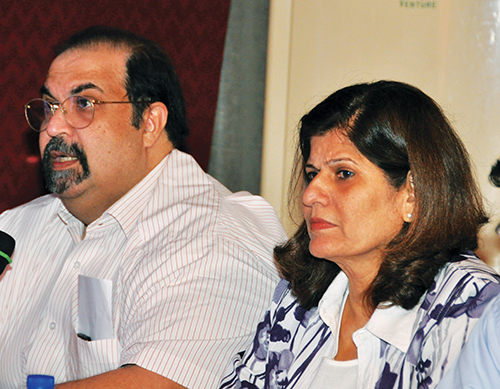
Arnavaz Mistry, with BPP trustee Muncherji Cama at a Federation of
the Parsi Zoroastrian Anjumans of India meet in 2013
We are caught between two worlds: our youngsters neither want to settle down the way other Indians do, by having matches arranged by their parents; nor are we liberal enough like our western counterparts, where the youngsters leave their parents’ home by the time they are 18 years of age and pursue their independent lives and relationships. As a result, we are neither here nor there, and our children are not able to settle down at the right time.
We have to work very hard to ensure that our youngsters marry at the right age, within the community, and have at least three children so that our population can increase.
Arnavaz Mistry took her first step in the service of the community by working in the Parsi Ward of J. J. Hospital in 1987 and has over the years transformed this facility for senior members. She is a trustee of the Bombay Parsi Punchayet (BPP) as also the Jal Minocher Mistry Memorial Foundation (established in the name of her late husband), the J. N. Petit Library and the Gustadji Menty and Homi Chinoy Charitable Trust. She is the chief organizer of the BPP matrimonial bureau.
◆ ◆ ◆
From the archive