
50TH ANNIVERSARY
“Not reform but restoration”
The urge to be exclusionist and live in a fantasy past is blinding Indian Parsis to current complex realities
Ever since realization dawned that the term "Parsi” was attested but once in our much-vaunted "foundation charter,” the Qisse-ye Sanjan, there have been ingenious and ingenuous attempts to project it as meaning only those who had become self-exiled from Khorasan, North Eastern Iran, 1,300 years ago. It is vaguely asserted that they spent 100 years in "Kohistan” (mountain region); a span of some four generations. If so, it is strange that they never encountered their settled fellow Zardushtis anywhere other than "Kohistan” during their slow migration southward.
But whence came the obsessive urge among the Parsis of India to carve out a very particular, separatist identity? They had never fitted into, nor had conformed within, the prevailing caste systems: they were, and remain, "out-castes.” Dozens of congresses and seminars, with reams of demographical papers after, strove to pinpoint the nature, significance and values of "Parsi identity” — everything from identity crises (!) to exclusivist ethnicity — all culminating in endless and fruitless debate.
Thus began the introverted, exclusionist process — easier to convince oneself and others through hazy mirror images from a gilded fantasy past than the current complex realities. All Parsis suddenly became "born Zoroastrians” who rigorously excluded all those of varying darker shades of skin. The reality behind such fantasizing is that the Parsis themselves remained ignorant; yet, on the principle of ignotum per ignotius (explaining the unknown by the even more unknown) all manner of frivolous assertions were concocted. The only certainty is our worldwide diminishing numbers despite initial denials through wishful number juggling.
The "Parsi Zoroastrian” tag bears comment. Each term was made to mutually depend on the other: a hazardous and highly discreditable procedure. Misspelled signs at fire temple entrances suggested that there was no entity as Irani Zoroastrian — until recently, that is! Slowly and inexorably it occurred to the chauvinistic Parsi that the several hundreds of thousands left guarding the true flame of Mazdayasna in their Iranian Fatherland had diminished at an alarmingly exponential rate: some had desperately ventured into India where they were subsumed into the overwhelming Parsi milieu. They retained little more than the surname "Irani” and, occasionally, other purely Persian cognomina (distinguishing nicknames). The levelling process ensured their absorption so much so that former traces of Iranianness had vanished, to be unreclaimed for decades.
Then arose the knotty problem of Parsi women’s education in India. The intransigence of 19th century Parsi males expressed itself with bans on everything to do with colonial, social and cultural influences regarded as corrosive for Parsi sociocultural cohesion or Parsipanu. Keenly aware of women’s potential other than being cloistered and deprived of a basic education which would have eased their entry into the wider, progressive world, some enterprising Parsi college students, unselfishly motivated, determined upon a course of action which would introduce their womenfolk to "western” ideas on female emancipation. It was channelled through education.
Their audacious plans were met with outrage. The persuasive efforts of the well-intentioned young activists bore fruit, nevertheless. By 1870 some 1,000 young Parsi girls, often with their seniors, had graduated from primary to a secondary education with all its benefits. It remained a delicate task for many to emerge from their house bound, sheltered upbringing into the light of an increasingly cosmopolitan society, and marked a progress from indifference to non-differentiation. Aushti (from priestly families) ladies, however, lagged behind.
The case of the feisty lady who defied the closed-in norms of her contemporary Parsi society bears retelling. A certain Meheribai Jasavala (née Shroff) determined upon sending her daughter Dosibai to a school run by English governesses. The inevitable torrent of abusive, threatening letters followed; yet neither mother nor daughter would be deterred. Where the two had led, others were preparing to seize the advantage and follow in Dosibai’s tracks. Almost all had retained Hinduized customs and beliefs; for them the remarkable turnaround came at this time (1870s) when the highest Parsi values reasserted themselves, largely thanks to a steady acquisition of ethical and moral teachings on which their newly rediscovered Zoroastrianism was based.
Another example is the religious cover which obtained well after the assault on Parsiism in the 1830s by the Scottish missionary John Wilson. His efforts had crumbled in the face of the outraged Parsi onslaught. With the advent of Dadabhai Naoroji and Kharshedji Rustamji Cama, the general awareness of the lack of knowledge of the teachings of the Sage Zarathushtra and his enlightened disciples had grown. Priestly learning on a broader basis other than the mouthing of prayers and mimed ritual gestures was seen as essential, and a new wave of highly competent, concerned and caring clerics emerged.
Several of these priests took up the austere, unremitting study of Old Iranian languages and literature. The truths of our religion were enshrined there; the random accretion of hearsay legends and myths were revaluated, some being retained, others rejected as sub-standard, purposeless productions. Gatha studies were still in their pioneering stage, conducted chiefly through the extensive Pahlavi zand [translations with glosses (misleading interpretations) and commentaries].
It is a curious fact that whenever Parsis are called upon to cite the names of their great and good, the ones which readily spring from their lips are those of leaders of industry, entrepreneurs, lawyers, doctors, and to list noteworthy politicos and parliamentarians. It is in rare instances that the names of worthy priests, High Priests and educationists are knowledgeably proffered.
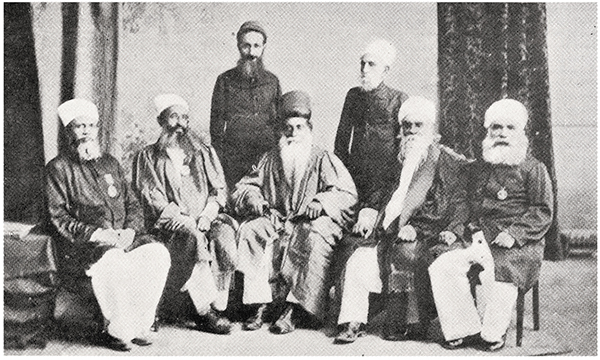
Seated left to right: Ervads Tahmuras Anklesaria, Sheriarji Bharucha, Kharshedji Cama, Kavasji Kanga,
Edulji Antia. Standing from left to right): Ervads Jamsetji Nadirshaw, Khurshedji Kateli
Outstanding among the learned minds within this noble priestly calling must surely be Sardar Dastur Hoshang Jamasp who in 1870 prepared, edited and commented on the notorious Arda Wiraz Namag text in collaboration with Martin Haug and Edward West. The story of its reception among Parsi ladies was summarized in Dastur Hoshang’s words: "When the book used to be read before them, overpowered by consciousness of guilt, the punishment for which was so terrifically described, they (the Parsis), but especially the gentler sex, used to weep. It was a most affecting spectacle to witness the awakening conscience exhibiting itself in trickling tears” (!) That slowly "awakening conscience” was the rejection of disinformation, and the embracing of sound religious education from those best qualified to impart it. It has always been one’s daena which powerfully embellishes the Gathic teachings of the Sage Zarathushtra.
Against the offence sensed by the Parsis of circa 1775 through their own ignorance, this erudite High Priest had countered: ".... had they been told that the Arda-Viraf namak was nothing else but a mythological work. In our days of progress, not only a professor of another creed and religion, but even a Parsi Destour is permitted to say so.” He was referring to the winds of change sweeping through orthodoxist mind sets in the 1870s for the benefit of priestly seminaries and devotees everywhere!
Western respect for that nascent priestly scholarship, enriched by the European-educated Cama, was evidenced during the visit to Bombay of the prolific French savant James Darmesteter in 1886. There, over a year and more, he became acquainted with the modern-minded Dastur Tahmuras Anklesaria and Ervad Jivanji Modi with whom he read priceless manuscripts and discussed points of ritual. It was Darmesteter who called Cama the "lay Dastur,” so highly did he rate the true worth of the Parsi scholarship of his time. His 1893 translations and commentaries reflect the enormous value and trust placed on that fruitful Parsi collaboration in India. Thenceforth the mindless accusations of "liberal” and "reformist” were rendered meaningless — by open-minded priests. It was not reform but restoration!
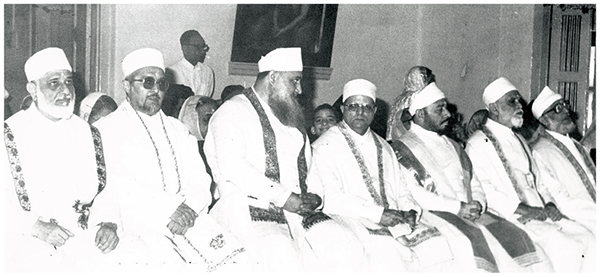
Dasturs (from left): Kaikobad Dastoor, Noshirwan Dastur, (Drs) Firoze Kotwal, Kaikhusroo JamaspAsa,
Meherji Meherjirana, Hormazdyar Mirza, Navrooz Minochehr Homji
Dastur Tahmuras’ son Behramgore Anklesaria had added immeasurably to the rich store of Pahlavi literature with his esteemed editions, with translations, of the Iranian or Greater Bundahishn, the Pahlavi Vandidad, and Zadspram’s Anthology. It is good to know that there exists the Meherbanoo Behramgore Anklesaria Publication Trust to ensure that this prolific scholar’s works are not forever lost to serious students and instructors from the current crop of herbadhs and mobadhs.
Other Parsi priests in India were neither slacking nor lacking in their drive for the religious education of the laity. Here are some names among the many: the father-and-son Dasturs Sanjana, editors and translators of the extant seven books of the Denkard, our "Mazdaean Encyclopaedia;” Ervad Kavasji Edalji Kanga for his Gujarati scripted Khordeh Avasta with reliable translations and extensive commentaries; Ervad Sheriarji Dadabhai Bharucha, famed for his Sanskrit renditions of Avestan and Pahlavi texts, as also for his forthright comments on wayward Parsi perceptions, with their remedies. Those scholar-priests had decorously conducted themselves as trustworthy spiritual guides, unlike today’s divisive meddlers in Parsi sociopolitics!
A name in danger of being forgotten is that of Ervad Bomanji Dhabhar, rightly lauded by the Swedish Pahlavisant Nyberg for "his very solid and reliable investigations on Book Pahlavi.” Those investigations had led to his formidable production of the Pahlavi Yasna and the Visparad. Few today seem to profitably consult his publications. Another excellent Pahlavisant was the late lamented Ervad Maneck Kanga who had contributed greatly to Pahlavi literature with his brilliant studies of chapters from the ninth century orthodoxist Epistles of Manushchihr, published as separate Festschrift articles in hard-to-obtain, expensively produced European volumes.
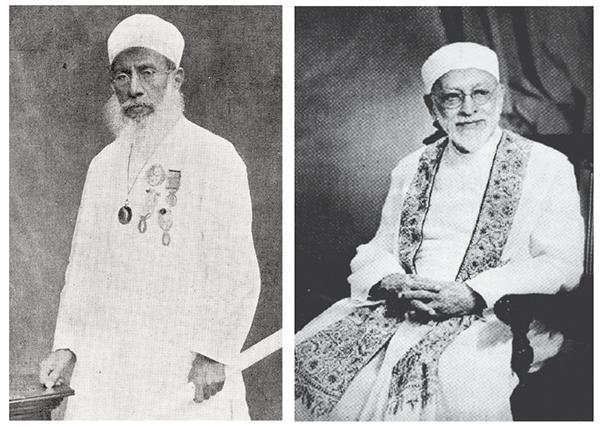
From left: Drs Sir Jivanji Modi and Dastur Maneckji Dhalla: prolific scholars
In North America two of our early best known Dasturs, Maneckji Dhalla and Jal Cursetji Pavri who studied with A. V. Williams Jackson had published substantial tomes dealing with Ancient Iranian history and civilization, as on the Zoroastrian hereafter with textual evidence and copious references. Stoutly bound reprints of their works were readily available in the 1970s; their fate in this electronic age is not known.
Remaining with North America, we meet with Ervads Kersey Antia and Jehan Bagli who, in their respectively pious ways, have legitimately performed navjotes of non-Parsis and outmarrieds’ children. It is impossible to disagree that these were not religiously sanctioned; they are increasingly seen as priestly duties properly performed in full conformity with socioreligious precepts.
In India three of the six High Priests had received their doctorates from Europe: Dastur Hormazdyar Mirza from Vienna and London; Dastur Kaikhusroo JamaspAsa from Bombay and Mainz; and Dastur Firoze Kotwal, Bombay and London. Each had produced commendable Pahlavi text editions: Pahlavi seemingly more tractable than the Avestic! No bad thing in itself, one has to be constantly reminded that those Middle Persian treatises reflect the state of religious knowledge in late and post-Sasanian periods, and not the beliefs and customs of either Parthian or even Achemenian times.
With the worldwide dispersals of Parsi and Iranian Zoroastrians, it appears more pressing than ever that serious note be taken and acted upon of the various issues seen flagged up in Parsiana, Hamazor, and the North American FEZANA (Federation of Zoroastrian Associations of North America) periodicals. For the poorly tackled range of crucial, contentious items, from calendar to conversion, sedreh-pushi to sexism, priesthoods to purity laws, it is sincerely hoped that good sense in confronting such matters will prevail over the ever ready blanket bans with excuses of "tradition” and "time-honored customs” — neither of which bear on real live issues that will impact on our future generations the world over.
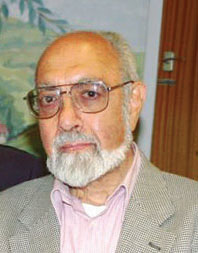 Born in Bombay into a Navsari high-priest clan, Farrokh Vajifdar enjoyed his primary and secondary education there and acquired his tertiary nurture in London, where he remained to settle, out-marry and procreate. He developed a deep and abiding interest in Indo-Iranian civilizations, with strong bias towards Zoroastrianism, its languages, literature, history and philosophy, and is a fellow of the Royal Asiatic Society. Occasional radio and TV broadcaster, lecturer, and midwife to aspiring and published authors, he, as independent researcher, continues as full-time writer and, as international consultant, has translated books and articles from French, German and Italian. He taught physical sciences at the National Association for Gifted Children.
 ◆ ◆ ◆
From the archive