
“Demographics determines destiny”
Whilst in India and Iran the Zoroastrian community may get decimated, in the West it may get assimilated
The tale of Zoroastrian demographics in the three ‘regions’ of the world — Iran, India and the diaspora — tears our emotions asunder, one of despair and the other of hope. Despair and indignation at the precipitous decline in our numbers in Iran and India, and hope that our community may prosper and renew itself in the diaspora.
"Demographics determines destiny.” Demographics is the life blood of a community; without sufficient numbers the community ceases to exist. The death knell has sounded. The questions are, "Will India and Iran heed these warnings?” and "Will the diaspora learn these lessons?” The spiralling decline continues relentlessly year after year, both in Iran and in India; in Iran possibly on account of an exodus, and in India on account of our own doing, a list of missteps and defaults, that in retrospect, just sicken us more. "Where did we go wrong?” we ask ourselves. The pet answer is that decline in population comes with modernization, westernization, industrialization — everything except our own doing. In order to sustain a culture/community the fertility rate must be at least 2.1, we are told, that is to say a couple must procreate their replacement. Ours in India is 0.89!
If the western diaspora does not pay heed, their fate will be the same, if not worse. What happens in India and Iran could very well happen in the diaspora. We are inter-linked, one with the other. We are one, a worldwide ‘community without borders,’ despite the artificial separation the pundits have imposed upon us. Is this not a defining moment, for us to join hands and work together, support each other so that we may all be winners?
For any issue, first there needs to be recognition, followed by willingness and commitment to resolve the issue followed by joint action. Recognition seems to be springing up here, there and everywhere lately, but let us be sure we understand the issue.
At first there was denial, now there is a tacit acceptance and some action. Interest in our population figures has been quite recent, and yet there are some amongst us who would dismiss it as unimportant and rest in their cocoon. But, for the majority, our declining demographics is a major calamity.
We have now preserved our culture for 4,000 years. Were it not for the sacrifices of our forebearers we would have long perished. The first time was when they fled from Iran and landed on the shores of India, following the advent of Islam. And then again, when the Parsis of India sent Maneckji Limji Hateria to rescue the few Zoroastrians that were left in Iran in the 1850s when, as the French Ambassador wrote: "Only 7,000 are left, and only a miracle may save them from extinction … glory is not everlasting, because these are descendants of the people who once ruled the world.”
The natural alacrity of our community, coupled with self preservation defenses made our communities both in Iran and in India rebound and prosper until the mid 20th century.
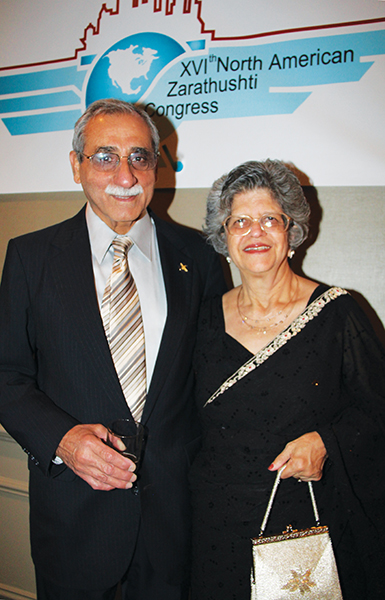
Rohinton and Roshan Rivetna: "A defining moment" Photo: Jasmine D. Driver
Little by little, with the erosion of our identity, sartorial, linguistic, cultural and the dilution of our defenses, our numbers started to decline quite imperceptibly until now when it has become a free fall, all too obvious even to a casual observer, evidenced by the growing numbers of the aged, a steeply upward death-to-birth ratio, a low fertility rate, and a large cadre of the happily unmarrieds — the latter, not only in India but also beginning to rear its head in the diaspora.
Much has been written about our community, its achievements, its contributions to human society, and the loss it will be to all humankind were it to disappear. So this is what we are trying to preserve. This recognition has to dawn upon our people, in India, Iran and in the western diaspora.
Commitment
Willingness on the part of our community, particularly our next generation, to preserve the community, needs to follow. Without this "will to survive,” to stem the tide and even grow, all else is futile. Taking things for granted is a weakness that all of us suffer, particularly the young, but that is the nature of things. Two important things are to be indelibly impressed upon our young; first, that the community is their responsibility and it has to be prioritized, and secondly if they do not work and make sacrifices to preserve it, it will be gone and can never be recreated.
Action
One solution that has caught the attention of the Zoroastrian leadership is for our young to marry, marry early, marry within our community and at a minimum generate a couple’s replacement plus one. Lame excuses of not finding suitable partners and incompatibility are to be set aside. After all, just two generations ago, our grandparents and great-grandparents had no issue with ‘suitability’ and ‘compatibility’ and they were the greatest generation that brought fame and prosperity to our people.
In the diaspora communities, while the population appears to be increasing in numbers, one needs to be wary, and look for solutions to combat the ogre of hastened assimilation, exacerbated by our small numbers, dispersed populations and alarming number of inter-marriages. There is, in the diaspora, a glaring lack of infrastructure which diminishes a sense of community. There are schemes under way to enhance and improve infrastructure with commensurate increase in pride of belonging.
Another aspect of any community that promotes growth is prosperity. The world around us has changed but there is one change in the make-up of our community that is so glaring that it may have had an impact on our declining numbers -- and that is the ‘prosperity factor.’ In the early to mid 1900s our community was chiefly entrepreneurial, business oriented and prosperous. That changed in the 1940s and 50s, when the community gradually started turning purely professional, with a commensurate communal loss of prosperity. That has been recognized by many, and efforts are under way to bring about a good balance of professionals and businesses that will hopefully bring back the prosperity we once enjoyed. What we need, then, is an entrepreneurial renaissance. The less fortunate among us need to be provided skills and made self-sufficient. A resident industrial park with small scale and cottage industries outside of urban areas is not out of the realm of possibility. The dignity of the human being must never be impaired. The physically impaired should likewise be sheltered, accorded due care and respect. Such good works will no doubt instil a sense of belonging and pride. This is not just applicable to India but also to the western diaspora where similar situations are beginning to surface.
An important factor that is sadly, all too often forgotten is community harmony (hamazori). Happiness to the one who gives happiness to others. At the same time happiness promotes harmony and respect and care for each other. A growing child is influenced most by its environment. If we bring back order, if we bring back harmony and respect for each other and if we bring back prosperity, we bring back our community.
While the demographic data on Zoroastrians is dispiriting, it is heartening to see the respect and recognition given to Zarathushtra and his religion in the interfaith arena. As a Zoroastrian whose community numbers barely 15,000 in the USA, a country of 312 million people, it is humbling to stand side by side and be recognized and respected as one of the major world religions alongside Christians (who comprise 78 percent of the population) and other religions — Jews, Muslims, Hindus, Buddhists, Jains and Native Americans. One almost feels that even if our community may be on the path towards extinction, after 4,000 years Zarathushtra’s place in the context of world religions is secured.
We may pray to Ahura Mazda to illumine our minds to see the light and fill our hearts with zeal and determination to succeed, and to survive, nay grow! Knowing the value our community has brought to humanity over centuries past, and the potential it holds for the future, should give us the vigor and strength to redouble our efforts. It is never too late. Let us begin with renewed fervor, here and now.
Rohinton Rivetna spearheaded the formation of the Zoroastrian Association of Chicago in 1976 and served as its president and trustee. The prime architect of the Federation of Zoroastrian Associations of North America, in 2000, he initiated the founding of the World Zarathushti Chamber of Commerce. He served as president of both organizations. He was founding vice president and is trustee emeritus of the Council for a Parliament of the World’s Religions. A professional engineer, he retired in 1997 as director of environmental engineering at American National Can Company, Chicago.