
50TH ANNIVERSARY
Rumblers along the road
Our propensity to litigate should be curbed with compromise and counsel
The total number of Parsis in India has fallen to less than what they were two generations ago. This undoubtedly is a matter of serious concern for the community. It is very heartening that the efforts made by PARZOR, the Bombay Parsi Punchayet (BPP) and other community organizations with the Government of India have fructified and substantial financial assistance has been granted to stabilize the population under the program "Jiyo Parsi (JP).” We must fully avail this opportunity and implement the project with vigor.
Recent demographic studies reveal that the decline in fertility is a national phenomenon and is most welcome for an overpopulated nation like ours. Globally also this trend has manifested itself even in predominantly Catholic countries in Europe where family planning is taboo by the Church. Amongst developed societies Japan is experiencing the lowest fertility rate. I do not want to sound cynical, having been one of the prime movers of the fertility scheme in Bombay a decade ago, but let us face the reality and not get too exuberant about JP. The gap between deaths and births is currently around 500 per annum. According to a recent press report, since the start of the BPP initiative clinically assisted pregnancy occurred in 222 cases over nine years i.e. about 25 per year. Hence it will be impossible to bridge this wide gap. JP will at best arrest the rate of decline. The ageing of our population and increase in the dependency ratio will, in turn pose serious challenges in the years ahead.
Recent demographic studies reveal that the decline in fertility is a national phenomenon and is most welcome for an overpopulated nation like ours. Globally also this trend has manifested itself even in predominantly Catholic countries in Europe where family planning is taboo by the Church. Amongst developed societies Japan is experiencing the lowest fertility rate. I do not want to sound cynical, having been one of the prime movers of the fertility scheme in Bombay a decade ago, but let us face the reality and not get too exuberant about JP. The gap between deaths and births is currently around 500 per annum. According to a recent press report, since the start of the BPP initiative clinically assisted pregnancy occurred in 222 cases over nine years i.e. about 25 per year. Hence it will be impossible to bridge this wide gap. JP will at best arrest the rate of decline. The ageing of our population and increase in the dependency ratio will, in turn pose serious challenges in the years ahead.
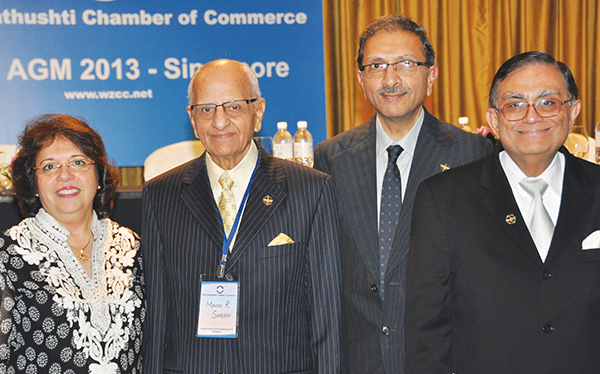
From left: Behroze Daruwala, Minoo Shroff, Farrokh Rustomji and Rusi Gandhi at
World Zarathushti Chamber of Commerce annual general meeting in Singapore 2013
There are equally formidable and urgent tasks which need to be tackled with imagination and courage to revitalize the community. In the current universally competitive globalized environment it must be the community’s endeavor to improve the level of skills among the youth and instill in them the ardor to forge ahead to retain the competitive edge which we as a community have always had in various businesses and professions. This alone can equip the new generation to support the growing numbers of the aged, particularly among women, who outlive men by about five years.
To the best of my knowledge two organized efforts were made over a decade ago to achieve this objective. The first was given institutional shape by the BPP with the incorporation of the Zoroastrian Investment Corporation Private Limited to provide financial and managerial assistance to budding and existing small and medium sized entrepreneurs. The World Zarathushti Chamber of Commerce was launched in Chicago as a global effort to enthuse and invigorate the younger members of our community to become self-reliant and venture out on their own. It is now a worldwide organization with the main activities being focused in Bombay and Poona, where the largest numbers reside. These initiatives have helped only to a limited extent for two reasons. First, general apathy among Parsi youth to take the plunge. Second, lack of active involvement of seniors in the community to come forward to support the effort.
The current economic climate is propitious for activising these institutions as the global trend is increasingly moving towards self-employment in view of the shrinking opportunities for jobs in the organized sector in almost all countries, including India. Further fresh avenues have opened up for self-employment in myriad businesses and professions and which our youth are capable of taking advantage of, provided they are properly counseled, trained and mentored. Above all we must create an enabling environment for the youth to become more daring and not live in cozy comfort zones of secured jobs.
There is lack of leadership in the community. We elders have failed the youth by not setting inspiring examples by our own conduct and demeanor. As the old saying goes "the Bottleneck is at the top of the Bottle and this Bottleneck must be broken.”
How do we break this Bottleneck? Our community known for its unique sense of comradeship, tolerance, conviviality and a sense of bonhomie over the years has lost its sheen. We have lived a lot on our past glory oblivious of the responsibility for the future. The creed of tolerance and unity has started weakening in recent decades and must be resurrected through farsighted leadership and adjustment to contemporary realities. Acute fundamental, doctrinal and social differences have emerged, tearing at the very fabric of our community. The differences have splintered the community into diverse groups having different perceptions of the path the community must follow and adopt. Unfortunately the differences amongst divergent groups have greatly increased with none agreeing to appreciate the other’s viewpoint or dialog to accept reconciliation.
There is growing acrimony leading to proliferation of litigation between trusts and stakeholders. Several of these disputes arise out of clash of egos between contending parties and can well be settled through discussions in a calmer atmosphere. Many land in courts, leaving behind bitterness instead of drawing community members closer. We should instead constitute Dispute Redressal Forums at various levels. Half of the members of these Forums should be with legal background and the other half drawn from among community leaders and social activists. The decision of the Forums must be accepted as final, except in very rare cases where the issues are irreconcilable.
There is lack of clarity as to where the community is heading. In the absence of a clear sense of direction merely presenting alluring prospects of a better tomorrow, based on past accomplishments, is not inspiring enough faith in the younger generation.
The youth has to be led by example. No community in India epitomizes better the title of Dr Amartya Sen’s book The Argumentative Indian. We as a community derive great fun and pleasure in generating controversies where none exist. When differences come to the fore they are highly magnified and given undue prominence even in the national Press. Hence issues which could be compromised and resolved through sober discourse are unduly magnified and lead to squabbles. The impact this generates on young fertile minds is most damaging. One has just to read the proceedings of the Federation of Parsi Zoroastrian Anjumans of India meetings during the last several years to realize that these are mere slugfests. Hardly any positive suggestions have emanated therefrom for the betterment of the community. What purpose then does the purported apex body serve?
We must seriously introspect and accept the fact that none of us has the monopoly of wisdom and can be wholly right or can be wholly wrong. Let us recall the old Persian saying:
"He who knows, and knows not that he knows, is asleep: wake him./ He who knows not, and knows that he knows not is humble: help him.
He who knows not, and knows not that he knows not is a fool: shun him./He who knows, and knows that he knows, is wise, follow him.”
To chart our way forward I strongly recommend that we set up a Council of Advisors for the community. The Council should comprise at least two-thirds of relatively young leaders (under 45 years), individuals who have a vision for the future and do not carry any past baggage of differences and acrimony. They could be assisted and counseled by a few elders (not more than one-third) — individuals with great credibility. These individuals should be open-minded and without prejudice or dogma with a fine track record of community service. They should be selected in a very transparent manner through informed public discussions. The Council should be entrusted with the task of evolving a plan for the future course of action preferably within one year. The Council should be provided with full secretarial assistance by the apex body.
This is a truly testing time for our community and our leadership faces a challenge. We have abundant maturity and statesmanship amongst us to resolve our differences, most of which by any means are reconcilable. As our numbers are miniscule our differences appear more strident and are manifested in varying degrees. Hence for our survival, judicious and pragmatic compromises are a must in a small community like ours. Our survival and future prosperity lies in our own hands. As Gandhiji observed: "Be the change you want to see…”
Minoo Shroff is president of the World Zarathushti Chamber of Commerce and former president of the Federation of Parsi Zoroastrian Anjumans of India and chairman of the Bombay Parsi Punchayet, is a respected economist and qualified chartered accountant. He has been on the board of several leading companies and consultant to leading industrial houses. A recipient of the Government of Japan, Rising Sun award, Shroff is president of the Forum of Free Enterprise and chairs several other social organizations.
◆ ◆ ◆
From the archive