
10WZC
Hooked on heritage
Unless the community is familiar with its past, it will be adrift, fears Firoza Punthakey Mistree
Her priority that morning was to urgently send across some documents to London. Co-curator of "The Everlasting Flame: Zoroastrianism in History and Imagination” exhibition in London that was to continue until December 14, 2013 as also of the upcoming one in Bombay "Across Oceans and Flowing Silk — From Canton to Bombay 18th-20th Centuries” that opens at the National Gallery of Modern Art (NGMA) within a fortnight on December 26, Firoza Punthakey Mistree’s time and loyalties remain divided between the two.
"These are two very different exhibitions, both requiring intense and high energy work,” says Mistree. Whilst "The Everlasting Flame” at the School of Oriental and African Studies (SOAS) "spanned 3,000 years of Zoroastrianism” and had to overcome considerable bureaucracy in getting the exhibits, the one in Bombay that covers Parsi maritime trade with China and its impact over 200 years will be "very micro-focused so there will be greater depth and detail,” she explains. "There is an enormous amount of work to be done” within a limited time span.
"These are two very different exhibitions, both requiring intense and high energy work,” says Mistree. Whilst "The Everlasting Flame” at the School of Oriental and African Studies (SOAS) "spanned 3,000 years of Zoroastrianism” and had to overcome considerable bureaucracy in getting the exhibits, the one in Bombay that covers Parsi maritime trade with China and its impact over 200 years will be "very micro-focused so there will be greater depth and detail,” she explains. "There is an enormous amount of work to be done” within a limited time span.
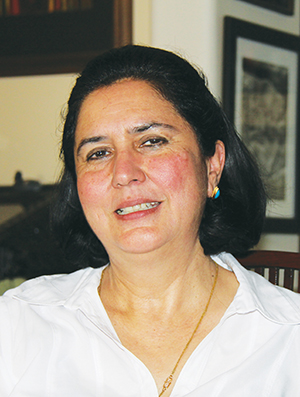
Firoza Punthakey Mistree
A considerable number of captions have to be readied for the nearly 300 exhibits that will be on display plus legends have also to be written for the catalog that will accompany the exhibition. One hundred and thirty-eight porcelain objects have been taken from the Alpaiwalla Museum, reveals Mistree who has been working piecemeal on this exhibition since August of this year and in full earnest since her return from London in October after the inauguration of "The Everlasting Flame.” The SOAS exhibition being in its final week at the time of the Parsiana interview on December 9, Mistree referred to the pending logistics of returning the antiques and non-antiques to their rightful owners whilst incurring the lowest customs duty.
Just as Mistree had created a "Parsi salon” with befitting furniture, costumes and even Minton tea service that was found in affluent homes for the SOAS exhibition, she was keen to create "a diorama of a street in Canton as also a Parsi vad in Surat” for the next one. She is doing intense research to evoke a natural setting, reminiscent of the days of yore. "Amitav Ghosh’s book (River of Smoke) opened a whole new vista of this fascinating period when Parsis made their most money and did philanthropy.” To present this "in a visual context” is a challenge before the curators.
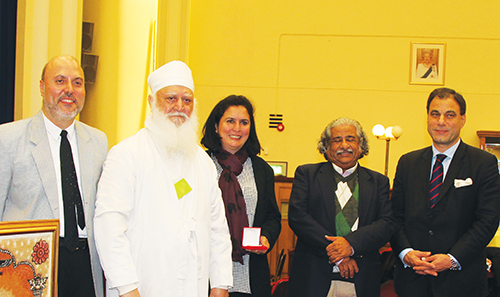
Malcolm Deboo, Dastur (Dr) Firoze Kotwal, Dinshaw Mehta and Lord Karan Bilimoria
Some of the other exhibits for the SOAS exhibition which had been crafted under her supervision were the replica of the exterior and interior of a fire temple as also the glass panel depicting the western stairway of Darius’ palace that Mistree describes as "magnificent in size and workmanship.” According to Mistree, "The fire temple has been the focal point of interest” for the over 17,000 visitors from London, Manchester, Sweden, other parts of Europe and even Canada, who have come to the Brunei Gallery to learn about Zoroastrianism. Besides 18 schools that sent its students to the exhibition, groups even came from the Cambridge Society, Bloomsbury Association, Art History Society of London, all of whom were fascinated by the exhibits.
How did she get involved in co-curating these major exhibitions? "I am the general faltoo (with spare time),” jests Mistree before speaking of her "love for history, love for dealing with the community’s past. As a community we know very little of our history, legacy, heritage… It is important to recognize and understand our history. Unless we are rooted we will find ourselves floating with no idea as to who we are…”
Once she decides to "plunge into the pool,” Mistree says she makes sure she goes the extra length to emerge a stronger swimmer each time. Having put together the NGMA exhibition in less than a year with the cooperation of her co-curator Pheroza Godrej, Mistree refers to their team work ever since they jointly authored A Zoroastrian Tapestry: Art, Religion and Culture. Thereafter, when either of them is summoned for any project concerning the community, they invariably turn to the other for help. Declares Mistree, "We work well together. It is a mutually rewarding experience. Pheroza has a critical eye for color, design, art and is meticulous with details.” Being a member of the industrial house of Godrej "she extends their infrastructure for our convenience.”
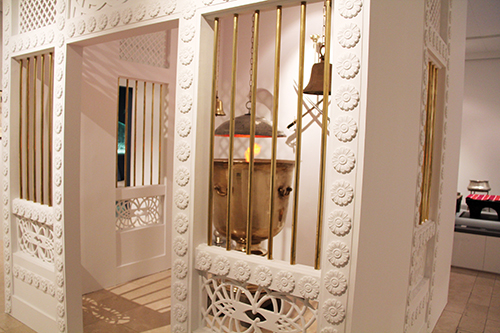
Exhibit at "The Everlasting Flame" Photos: Parinaz Gandhi
The co-curator also acknowledges "the incredible help from a number of people” who responded to their appeal for artefacts for the NGMA exhibition. She refers to treasures like carved chests loaned by Serena Khambatta whose family had connections with China. Yet another lady, Zenobia Davar graciously shared her collection of garas.
For their "impressive” catalog, they will be featuring essays from authorities like Ghosh; Dr Tirthankar Roy, professor of Economic History, London School of Economics and Political Science; Dr Jesse Palsetia, associate professor in the History Department at the University of Guelph in Ontario; Dr Ghulam Nadri, who having been conferred the two-year Newton International Fellowship at the Economic History Department of the London School of Economics and Political Science, is pursuing his new research project on "The Political Economy of the Indigo Production and Trade in India, 1500-1900;” Rusheed Wadia, an economic historian who specializes in the study of 19th century Bombay; and Dr Mariam Dossal, PhD and MPhil research guide whose forte lies in the urban and maritime history of modern India. The two curators have also penned an article that will explain how the exhibition evolved. They are hoping that Dr Homi Bhabha, Anne F. Rothenberg Professor of English and American Literature and Language and the director of the Humanities Center at Harvard University will write the introduction, synthesizing all the contributions.
"It is time the community invests in its intellectual well-being appertaining to its history and religion,” urges Mistree. "We all have opinions; that is fine. But we need to do something together to lift ourselves intellectually.” Referring to her rapport with Godrej, Mistree concedes, "We don’t always see eye-to-eye (on religious issues) but we have the ability to deal with things and work together. That is important.”
After completing her Masters in International Relations in Pakistan, Mistree says she had "every intention of joining the Pakistan Foreign Service until I met Khojeste and got totally diverted.” Although she came from a traditional family (Punthakey) and had nurtured a curiosity in religion since her early days, her interest in the history of the religion developed subsequent to her marriage to Khojeste, "someone who breathes and lives” this subject. "It would be impossible to be married to him without learning… At heart he is a teacher,” she appreciates.
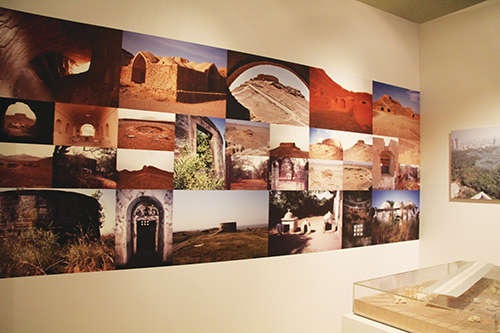
Collage of traditional funerary practices in Iran and India
Her views on the future of the Parsi community Mistree was reluctant to share on the rationale, "If the readers know the truth, it will be quite devastating.” In favor of "a think tank of young professionals who can draw up a charter on where we as a community want to be in the next 10 years,” Mistree regrets, "We are controlled by those aged over 70 who do not allow the community to open up and progress in a manner in which it will make a difference to this community…” The Parsis are in the eye of the international media for only three reasons: funerary practices, interfaith marriage, dwindling numbers, she observes.
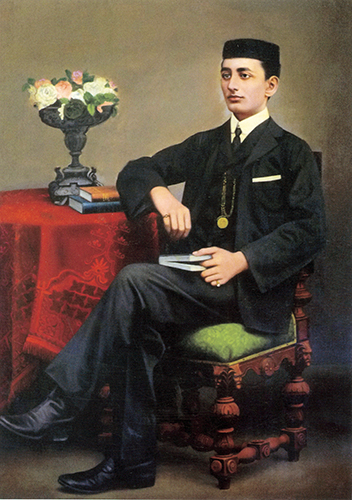
Unidentified Parsi with fob watch painted by Chinese artist
Sunqua (Collection: Hameed Haroon)
Whether a person is married within or outside the community does not bother her as much as "There is no one to direct the community; no icon; no one left without being attacked or slandered… Parents don’t think religion is important. They don’t know who to believe and candidly state that ‘faafaa maa nathi parvu (don’t want to be unnecessarily caught in the cross-currents).’
"The community must do something about the education of its kids,” recommends Mistree who has been teaching religion at four Parsi founded schools in Bombay and also conducts a religion class for children at Khareghat Colony. On the one hand are children who are not able to afford a good education and are struggling to converse in English, and on the other are children from affluent homes "with very good education but no anchoring in the community or religion. That is where the ‘Roots’ program is very important,” she stresses. Initiated by Parzor it has a role to play in helping youngsters from India and overseas understand their origins and background.
Also involved in the renovation of the Alpaiwalla Museum, Mistree says that although there will be a "soft opening on January 1, 2014 we should be ready around Navroz.” By then the new exhibits too would have arrived from London. Planned as "a state of the art Museum,” currently they are moving slowly due to shortage of funds. This Museum plus exhibitions like the ones at SOAS and NGMA, hopes Mistree, will create an awareness of "what we were as a community and what we can be.”
◆ ◆ ◆
From the archive