
10WZC
Goodwill at the Gallery
The exhibition at the National Gallery of Modern Art, co-curated by Pheroza Godrej, will reflect on how the Parsi community derived and donated its wealth
Teams of researchers were engrossed in different aspects of the month long exhibition "Across Oceans and Flowing Silk — From Canton to Bombay 18th-20th Centuries” that will succinctly showcase the Zoroastrian community’s entrepreneurial spirit, wealth of talent and largesse. Some framed photographs and maps that will be displayed at the exhibition covered floor space on the sixth floor at Godrej Bhavan. Planned as one of the prestigious events to coincide with the 10th World Zoroastrian Congress in end 2013, this exhibition at the National Gallery of Modern Art (NGMA, former Cowasji Jehangir Public Hall) from December 26, 2013 to January 28, 2014 is a testimony to the goodwill extended and earned by the community, believes co-curator Pheroza Godrej.
Even during the interim period when the fate of the Congress remained undecided, Godrej was determined that the exhibition should continue as per schedule for she firmly believes, "You can’t let your partner down.” As she further explained, "These things don’t happen at the last minute… The Bombay Parsi Punchayet had signed an agreement with the Ministry of Culture. This was vetted by the Ministry of Law.” For six weeks the NGMA premises were made available for this exhibition, one week for mounting, four weeks for viewing, and another week for dismounting. "That too at prime time, in winter, when tourists to the city want to visit museums and galleries. These are the concerns I had… What do I tell the Ministry of Culture?...When you have made a commitment for an international event, you have to honor it.” She believes it was "very gracious of both,” Dr Cyrus Poonawalla and Nadir Godrej, to take on the responsibility as chairman and vice chairman to lift the Congress from the quagmire.
Even during the interim period when the fate of the Congress remained undecided, Godrej was determined that the exhibition should continue as per schedule for she firmly believes, "You can’t let your partner down.” As she further explained, "These things don’t happen at the last minute… The Bombay Parsi Punchayet had signed an agreement with the Ministry of Culture. This was vetted by the Ministry of Law.” For six weeks the NGMA premises were made available for this exhibition, one week for mounting, four weeks for viewing, and another week for dismounting. "That too at prime time, in winter, when tourists to the city want to visit museums and galleries. These are the concerns I had… What do I tell the Ministry of Culture?...When you have made a commitment for an international event, you have to honor it.” She believes it was "very gracious of both,” Dr Cyrus Poonawalla and Nadir Godrej, to take on the responsibility as chairman and vice chairman to lift the Congress from the quagmire.
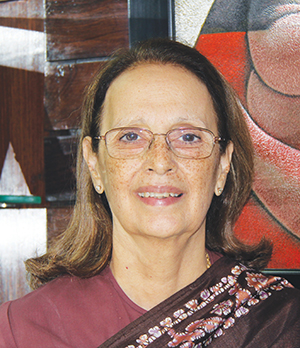
Pheroza Godrej
"You cannot jeopardize the mutual trust, goodwill and respect the community enjoys,” reiterates Pheroza Godrej who is also the chairperson of the NGMA’s advisory committee and appreciates the efforts and contributions of her peers and protégés in the art fraternity who have labored on this exhibition. Besides being the honorary secretary of the Museum Society of Bombay, she is on the advisory committee of the National Committee of Modern Art, New Delhi, is an advisory member of the Parsi Heritage Cell of the Indian National Trust for Art and Cultural Heritage (INTACH) and is a trustee of the newly restored Bhau Daji Lad Museum. Although Godrej and her co-curator Firoza Punthakey Mistree will be rendering honorary service for the NGMA exhibition, and some other Parsi establishments like the Pundole Auction House helped with the valuation for insurance of the artefacts taken on loan, working within a budget of Rs 35 lakhs can be restrictive, she realized, mentioning that she would have been able to do better justice if the budget had been double the amount.
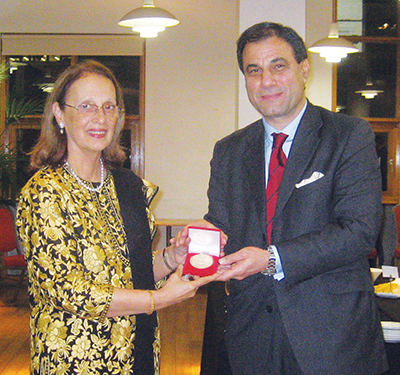
Pheroza Godrej being felicitated by Lord Karan Bilimoria
For the inauguration of the exhibition on the evening of December 26, eminent physician Dr Farokh Udwadia and senior counsel Soli Sorabjee will light two lamps. Just as in earlier times it was the philanthropic businessmen and industrialists who earned a name for the community, currently it is the professionals who have brought it prestige, believes Godrej. Homai Modi will serve as master of ceremonies.
"I want people to come for the exhibition,” says Godrej who has planned "a series of programs involving the citizenry of Bombay.” Having co-authored or co-edited 11 works connected with history, travel, painting and lithography, being an executive committee member of the Mehli Mehta Music Foundation, serving on the Women Empowerment Committee of the Confederation of Indian Industries, being a board member for the Department of Ancient Indian Culture at St Xavier’s College, Godrej has roped in "people whom I could bully” to take charge of different outreach programs. Reading from a tentative schedule of events she enthusiastically referred to the sessions on textiles that will be conducted by Ashdeen Lilaowala and Tulsi Vatsal, on literature by Dr Homi Bhabha and Bachi Karkaria, on poetry by Adil Jussawalla and Jerry Pinto, Parsis on stage with readings by Dr Gieve Patel, art by Ranjit Hoskote, on architecture by Kaiwan Mehta, screening of films like Gangoobai and Café Irani Chai, music in the form of a program from Mozart to Mercury to get the youth involved, "not cheap and bawdy music” but a Parsi quartet/quintet/octet and a children’s concert, the making of family trees, a talk on Baghdadi Jews whose presence in Canton has also been recognized. The last day "will be a fun evening with lots of camaraderie.” And since there cannot be a community event without food, arrangements have been made with Indigo to take care of the catering. There will be no charge for these evening programs, although Rs 10 is the admission fee at NGMA.
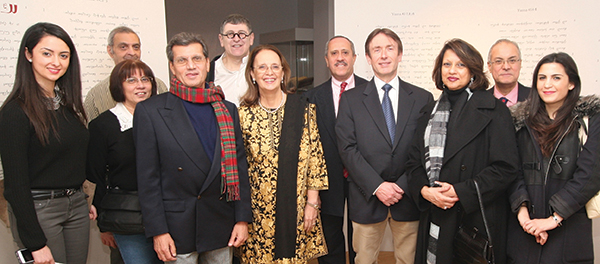
Pheroza Godrej at the SOAS exhibition, Godrej (center) flanked by Byram Jeejeebhoy (left),
Zarir Cama and Colin Morris Photos at SOAS by Paresh Solanki
Besides these programs that will project the community, Godrej was equally determined to publish a catalog that remains a legacy of the exhibition. To stress on the importance of a catalog, she regrets that unfortunately "no record remains of ‘Parsika,’ the exhibition held at the Prince of Wales Museum nearly 25 years ago. Despite her long-standing interest in art, having founded Cymroza Art Gallery 42 years earlier, Godrej says the only thing she can remember about the "Parsika” exhibition was the small printing press loaned by Muncherji Cama, and in fact was surprised when she was shown a photograph of herself in the audience at one of their events.
In contrast, the exhibition, "Portrait of a Community,” around 10 years ago, "identified, displayed and created awareness of old Parsi portraits through the accompanying catalog,” sensitizing community members to "restore portraits hitherto neglected in private homes, fire temples and trust offices,” she points out. At the current exhibition, neither did the curators want to repeat the theme of portraits, nor did they feel that the community’s favorite heirloom, the gara, could singly do justice to the considerable space available to them at NGMA because after a display of 50-60 garas of different hues and embroidery motifs they can get repetitive.
Godrej recalls a meeting with the full board of Punchayet trustees to deliberate on what the exhibition could commemorate and what it could leave behind. Whilst pondering on the different possibilities she remembered a discussion on the emerging BRIC (Brazil, Russia, India, China) economies with husband Jamshyd (chairman and managing director of Godrej and Boyce) and felt the exhibition could perhaps reflect on how the Parsi community derived its wealth from its maritime trade links with China and where it stands today.
Thus the story conceptualized and related across seven levels refers to the community’s base in Surat with agriculture being their mainstay, their trade associations with the British, Dutch, French and Portuguese companies, their expertise as craftsmen in carpentry, boat building, textile weaving, jewelry making, their coming to Bombay and setting up a post there, their willingness to take risks as middle men, to travel to uncharted territories, their adaptability to work and winning the confidence of the East India Company and subsequently the Crown, being appointed as their sub-agents. With some of them recognized as the representatives of the British rulers and entrusted to handle money transactions, they came to be addressed as "Shroff,” reports Godrej whose maiden name was Shroff.
In contrast, the exhibition, "Portrait of a Community,” around 10 years ago, "identified, displayed and created awareness of old Parsi portraits through the accompanying catalog,” sensitizing community members to "restore portraits hitherto neglected in private homes, fire temples and trust offices,” she points out. At the current exhibition, neither did the curators want to repeat the theme of portraits, nor did they feel that the community’s favorite heirloom, the gara, could singly do justice to the considerable space available to them at NGMA because after a display of 50-60 garas of different hues and embroidery motifs they can get repetitive.
Godrej recalls a meeting with the full board of Punchayet trustees to deliberate on what the exhibition could commemorate and what it could leave behind. Whilst pondering on the different possibilities she remembered a discussion on the emerging BRIC (Brazil, Russia, India, China) economies with husband Jamshyd (chairman and managing director of Godrej and Boyce) and felt the exhibition could perhaps reflect on how the Parsi community derived its wealth from its maritime trade links with China and where it stands today.
Thus the story conceptualized and related across seven levels refers to the community’s base in Surat with agriculture being their mainstay, their trade associations with the British, Dutch, French and Portuguese companies, their expertise as craftsmen in carpentry, boat building, textile weaving, jewelry making, their coming to Bombay and setting up a post there, their willingness to take risks as middle men, to travel to uncharted territories, their adaptability to work and winning the confidence of the East India Company and subsequently the Crown, being appointed as their sub-agents. With some of them recognized as the representatives of the British rulers and entrusted to handle money transactions, they came to be addressed as "Shroff,” reports Godrej whose maiden name was Shroff.
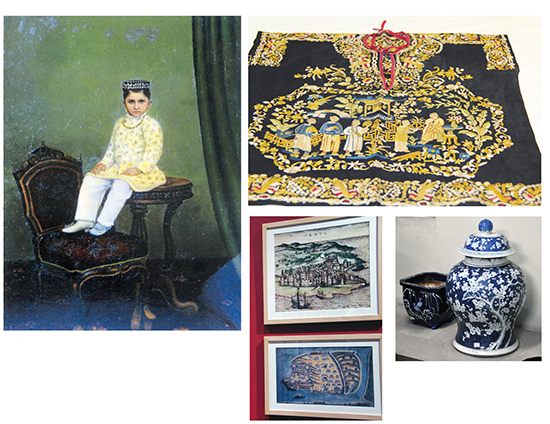
Clockwise from top left: Late 19th century navjote portrait, probably Canton (Collection: Hameed Haroon);
embroidered jhabla dipicting Chinese figures (Collection: Victoria and Albert Museum); porcelain at Alpaiwalla Museum;
depiction of early settlements in Diu (courtesy: A Zoroastrian Tapestry)and Hormus (courtesy: Studies in Parsi History)
On their frequent sojourns to China Parsis dealt with the Hongs, the business houses, and traded in tea and opium "at a time when it was perfectly legal,” she clarifies. (Subsequently, when the Chinese banned the import of opium, traders smuggled in the drug till the opium wars forced the Chinese to relent on the ban — editors) Depending on the wealth they made, they returned with shiploads of porcelain, textiles, furniture, jewelry and decided to upgrade themselves along the lines of the British lifestyle and culture. In the forefront of charity, they played a key role in establishing educational institutions, hospitals and helping their coreligionists who came in waves from Iran.
Whilst there will be a small section in the exhibition devoted to Yazd to hark back to the Irani Zarathushtis and their lifestyle before they made India their home, Godrej was more enthusiastic about the fourth level which will feature portraits. Four of Pestonjee Bomanjee’s paintings will be specially borrowed from the Chhatrapati Shivaji Maharaj Vastu Sangrahalaya (CSMVS, former Prince of Wales Museum), other works, some original and some facsimile, by Jehangirji Lalkaka, and Manchersha and Sohrab Pithawalla will come from private collections. The Dome Gallery will accommodate the works of 20th century artists like Piloo Pochkhanawala, Jehangir Sabavala, Nelly Sethna, Shiavax Chavda, Homi Patel, Gieve Patel and Mehli Gobhai and this section will be titled "No Parsi is an island,” to reinforce that "we are a part of the thread of life,” and believe in being cosmopolitan.
Godrej mentions that she got involved with this exhibition because of two people: publisher Maneck Davar (who is on the Congress organizing committee) and Mistree who being her co-author for the pictorial tome A Zoroastrian Tapestry: Art, Religion and Culture convinced her to "do this for the community” as also assist with the exhibition "The Everlasting Flame: Zoroastrianism in History and Imagination” that was running for two months from October-December 2013 at the School of Oriental and African Studies in London.
More important than the exhibitions will be Godrej’s role "in the complete restoration of the Alpaiwalla Museum, the only museum in the world devoted to Zoroastrianism… My hats off to Nivedita Mehta who despite her health problems has devoted her whole career to this; she has stuck it out as curator for 25 years,” appreciates Godrej who after a Bachelor’s degree in education, did her Masters in English and French and followed it up with a Masters in Ancient Indian Culture and a diploma in Aesthetics. The Punchayet trustees as the "custodians of this art” should take a greater interest in its restoration instead of viewing it as "bhaangoo tootoo saamaan (broken, decrepit stuff),” she feels.
Whilst there will be a small section in the exhibition devoted to Yazd to hark back to the Irani Zarathushtis and their lifestyle before they made India their home, Godrej was more enthusiastic about the fourth level which will feature portraits. Four of Pestonjee Bomanjee’s paintings will be specially borrowed from the Chhatrapati Shivaji Maharaj Vastu Sangrahalaya (CSMVS, former Prince of Wales Museum), other works, some original and some facsimile, by Jehangirji Lalkaka, and Manchersha and Sohrab Pithawalla will come from private collections. The Dome Gallery will accommodate the works of 20th century artists like Piloo Pochkhanawala, Jehangir Sabavala, Nelly Sethna, Shiavax Chavda, Homi Patel, Gieve Patel and Mehli Gobhai and this section will be titled "No Parsi is an island,” to reinforce that "we are a part of the thread of life,” and believe in being cosmopolitan.
Godrej mentions that she got involved with this exhibition because of two people: publisher Maneck Davar (who is on the Congress organizing committee) and Mistree who being her co-author for the pictorial tome A Zoroastrian Tapestry: Art, Religion and Culture convinced her to "do this for the community” as also assist with the exhibition "The Everlasting Flame: Zoroastrianism in History and Imagination” that was running for two months from October-December 2013 at the School of Oriental and African Studies in London.
More important than the exhibitions will be Godrej’s role "in the complete restoration of the Alpaiwalla Museum, the only museum in the world devoted to Zoroastrianism… My hats off to Nivedita Mehta who despite her health problems has devoted her whole career to this; she has stuck it out as curator for 25 years,” appreciates Godrej who after a Bachelor’s degree in education, did her Masters in English and French and followed it up with a Masters in Ancient Indian Culture and a diploma in Aesthetics. The Punchayet trustees as the "custodians of this art” should take a greater interest in its restoration instead of viewing it as "bhaangoo tootoo saamaan (broken, decrepit stuff),” she feels.
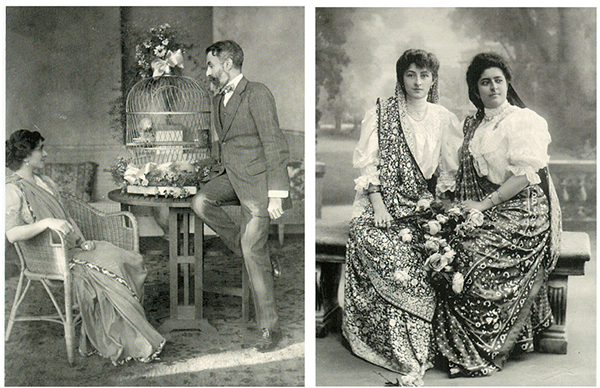
(Left) Lady Navajbai and Ratan J. Tata; (right) Sooni Ratan D. Tata (left) and
Lady Meherbai Dorab Tata (Tata Central Archives, Poona)
To renovate this building at Khareghat Colony into a modern structure, work will progress in phases and has started by improving the sanitary conditions with decent toilets and the installation of a water purifier. There are also plans to build a ramp in a subsequent phase of the one-and-a-half to two-crore-rupee project. Assistance has been assured by INTACH, the Prince of Wales Museum, Bhau Daji Lad Museum, Zarathushtis in Singapore and Hong Kong, but the business houses too will have to be approached. "We have to make efforts to run programs regularly as is done at the K. R. Cama Oriental Institute,” opines Godrej. To run a museum efficiently, besides a curator, "we would need a good program officer, two deputies from the next generation who could be trained, a librarian, a fund raiser, staff and security,” states Godrej.
Whilst the original Cyrus Cylinder from the British Museum that is currently on tour will arrive at the CSMVS on December 20, 2013, infusing fresh life among the exhibits at the Alpaiwalla will be the 30-foot-long glass panel depicting the western stairway of Darius’ palace and a replica of the sanctum sanctorum, that are awaited from London. Both these exhibits had been financed by Poonawalla with the understanding that after the SOAS exhibition they will be permanently housed at the Alpaiwalla Museum. Having specially "carved out space to accommodate these pieces,” Godrej says that only two sides of the kebla will be needed for the installation here. Whilst Poonawalla would have liked these pieces to be brought by air rather than ship in time for the January 1 inauguration of the renovated premises, Godrej says she convinced him that the money saved could be put to better use for the Museum. A model of the dakhma too, like the one at Doongerwadi and Bhau Daji Lad Museum, deserves to be kept here.
What are her views on maintaining the Doongerwadi property? Whilst the president of the National Society of the Friends of the Trees, former vice president of the Bombay Natural History Society (BNHS) and executive board member of the Ashoka Trust for Research in Ecology was not keen to see it as "a manicured garden,” she specifies that the land should be free of encroachment, and were any termites or disease to strike a tree, "horticulturists should be vigilant and take the help of city botanists.” The breeding of vultures in an aviary at Doongerwadi is a proposition she "can’t support” seeing the costs involved, the layout of the land which is not like the Rocky Mountains territory and aware that the BNHS program has not yielded any major success. Considering that the vultures in the entire Central Asian region have been affected she believes that it was only due to the Himalayas that it took longer for the virus to reach the vultures here.
What lies ahead for the Parsi community she is unable to fathom but she feels as Zoroastrians "we have to accept change, in our personal life and in the community.” According to her estimate, barring 10% in the community who have extremely liberal views and another 10% with extremely orthodox views, the remaining 80% who fall in the general spectrum should "think for yourselves… You don’t have to think for others... You don’t have to destroy one to build another. You need a huge amount of commitment and sacrifice. Are you willing to do that? Are you willing to die for it? I don’t have answers to that. I can only ask questions as a member of the community.” A firm believer in "peace at any price,” Godrej is sanguine that with patience and forbearance a compromise can be reached in any situation. "It is not always your way or the highway.” In her opinion, the Zoroastrian religion has no place for a devil, "only a fallen angel.”
Whilst the original Cyrus Cylinder from the British Museum that is currently on tour will arrive at the CSMVS on December 20, 2013, infusing fresh life among the exhibits at the Alpaiwalla will be the 30-foot-long glass panel depicting the western stairway of Darius’ palace and a replica of the sanctum sanctorum, that are awaited from London. Both these exhibits had been financed by Poonawalla with the understanding that after the SOAS exhibition they will be permanently housed at the Alpaiwalla Museum. Having specially "carved out space to accommodate these pieces,” Godrej says that only two sides of the kebla will be needed for the installation here. Whilst Poonawalla would have liked these pieces to be brought by air rather than ship in time for the January 1 inauguration of the renovated premises, Godrej says she convinced him that the money saved could be put to better use for the Museum. A model of the dakhma too, like the one at Doongerwadi and Bhau Daji Lad Museum, deserves to be kept here.
What are her views on maintaining the Doongerwadi property? Whilst the president of the National Society of the Friends of the Trees, former vice president of the Bombay Natural History Society (BNHS) and executive board member of the Ashoka Trust for Research in Ecology was not keen to see it as "a manicured garden,” she specifies that the land should be free of encroachment, and were any termites or disease to strike a tree, "horticulturists should be vigilant and take the help of city botanists.” The breeding of vultures in an aviary at Doongerwadi is a proposition she "can’t support” seeing the costs involved, the layout of the land which is not like the Rocky Mountains territory and aware that the BNHS program has not yielded any major success. Considering that the vultures in the entire Central Asian region have been affected she believes that it was only due to the Himalayas that it took longer for the virus to reach the vultures here.
What lies ahead for the Parsi community she is unable to fathom but she feels as Zoroastrians "we have to accept change, in our personal life and in the community.” According to her estimate, barring 10% in the community who have extremely liberal views and another 10% with extremely orthodox views, the remaining 80% who fall in the general spectrum should "think for yourselves… You don’t have to think for others... You don’t have to destroy one to build another. You need a huge amount of commitment and sacrifice. Are you willing to do that? Are you willing to die for it? I don’t have answers to that. I can only ask questions as a member of the community.” A firm believer in "peace at any price,” Godrej is sanguine that with patience and forbearance a compromise can be reached in any situation. "It is not always your way or the highway.” In her opinion, the Zoroastrian religion has no place for a devil, "only a fallen angel.”
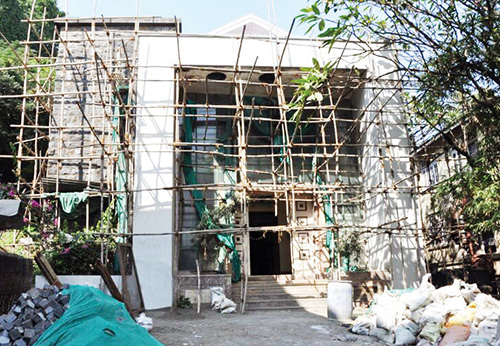
Alpaiwalla Museum under renovation Photo: Rashid Bamanbehram
Referring to her equation with Mistree who is known to be a traditionalist, Godrej mentions how they "agree to agree” on issues related to work, and "agree to disagree” on those that concern their beliefs. She recalls Prof Mary Boyce advising her, "Do as your conscience tells you.”
"I don’t know why people think I am a traditionalist,” says Godrej, but prayers to her "are an anchor in my life; like my husband is… I have tried to instill that in my children (daughter Raika and son Navroze) and I hope one day they will appreciate it.” Realizing the need to maintain "balance and harmony in our life as also tolerance and humility,” the environmentalist’s priority is to lead "a good, balanced life” in the interests of health and happiness "for if you don’t have good health, then with all the money in the world it would be difficult to be happy.”
Her immediate priority being the exhibition, Godrej reveals, "I have stuck my neck out… beyond my call of duty. How much I worry about it. I think I will have a good night’s rest only after everything is returned to everyone’s collection.” The reputation of the community being built on trust, she wonders, "What is happening? Why are we deliberately eroding that? You can’t buy trust; you have to earn it.”
◆ ◆ ◆
From the archive