
10WZC
“Born-again Zoroastrians”
As a group we are losing our traditional values, including the ability to laugh at ourselves
The Parsis in India — and the Parsis scattered around various parts of the globe —are followers of what was, for 400 years, a state religion in eastern Persia. What keeps this small body together today is a faith that does not demand too much from its adherents: somewhat reminiscent of that chief of protocol who accompanied the Queen of the Belgians on her visit to Warsaw in the early post-World War years, when Poland was still dominated by the Soviets. The Belgian Queen was a deeply religious person, and the chief of protocol was assigned to accompany her to mass on Sunday.
"Are you a Catholic?” the Queen asked him.
"Believing, but not practicing, Your Majesty,” the protocol chief truthfully replied.
"Of course,” the Queen said, "then in that case you must be a Communist.”
"Practicing, but not believing, Your Majesty,” was the frank reply.
We Parsis are a bit like that Polish functionary of the late 1940s. Some of us are believing and practicing Zoroastrians. Many of us are believing, but not practicing ones: belief in the faith then is the loose thread that binds us all together. In the course of our travels, both in India and abroad, my wife and I have not met a single Parsi in any part of the world who is not proud to be counted as one — even though he may not recite his daily prayers (as a good Parsi should), or even wear the sudreh and kusti with which he was initiated into the faith.
Like former US President George Bush who was often reckoned a "born-again Christian,” we Parsis are "born-again Zoroastrians.” And like all "born-again” individuals, we have our eccentricities. We are egotistical and fiercely individualistic — and alas, quarrelsome!
"Are you a Catholic?” the Queen asked him.
"Believing, but not practicing, Your Majesty,” the protocol chief truthfully replied.
"Of course,” the Queen said, "then in that case you must be a Communist.”
"Practicing, but not believing, Your Majesty,” was the frank reply.
We Parsis are a bit like that Polish functionary of the late 1940s. Some of us are believing and practicing Zoroastrians. Many of us are believing, but not practicing ones: belief in the faith then is the loose thread that binds us all together. In the course of our travels, both in India and abroad, my wife and I have not met a single Parsi in any part of the world who is not proud to be counted as one — even though he may not recite his daily prayers (as a good Parsi should), or even wear the sudreh and kusti with which he was initiated into the faith.
Like former US President George Bush who was often reckoned a "born-again Christian,” we Parsis are "born-again Zoroastrians.” And like all "born-again” individuals, we have our eccentricities. We are egotistical and fiercely individualistic — and alas, quarrelsome!
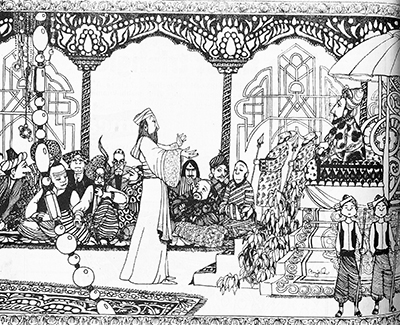
Dastur Meherjirana in the court of King Akbar
(Illustration by Manjula Padmanabhan)
I recall an incident my late father had told me about. In the 1930s — a year after I was born — he had gone from Rangoon to visit places in East Africa to open branches of the New India Assurance Company Limited. There were only two Parsis living in Dar-es-Salaam at the time. When my father took a stroll along the main thoroughfare he met one of them — a shopkeeper wearing a Parsi prayer cap, dressed in a baddian (short shirt) with the sudreh showing. My father, a convivial person, hailed this gentleman and the two chatted for some time. When my father left his shop and went up the same street, he came across a retail merchant, also a Parsi. My father hailed him with the traditional greeting, "Kèm chhèv sahib (How are you Sir)?” but received no response. The man turned his face away and refused to greet my father simply because he had first spoken to the other Parsi shopkeeper! "Tamé éné tá péhlé kèm gaya (why did you go to that other fellow first)?” This slightly pugnacious spirit persists, and exhibits itself in many odd ways in different places around the earth where we are now sprinkled.
Recently, however, I have noted with regret (and concern) that as a group we are losing our traditional time honored "values,” including the ability to laugh at ourselves.
Whenever Parsi Zoroastrians meet at seminars or conferences nowadays they appear to indulge more in dissension than in intellectual discourse, or in the quest for learning more about our great religion. A pity. We are showing signs of not being worthy of our forefathers who were made of sterner stuff. We keep harping on mindless conflicts as to how we should dispose of our dead; and as to whether children born of mixed marriages should, if they wish — and only if they wish — be initiated into the religion.
Of matters on which there is so much heat these days and little light, I offer for reflection, and acceptance, The Essence of Zoroastrianism. It is from a small booklet (now out of print) written by the late Astad D. Gorwala, ICS (the articles originally appeared in Parsiana). Gorwala was one of the unsung heroes of modern India and a great Zoroastrian.
The imaginative — but true-to-life essay — is about an old man sitting in his easychair on the verandah of an old house, looking into the darkness. The youngsters in the house come up to him and tell him that they do not know what their religion is. Would he therefore explain?
And explain he does. His mind comes to rest on one dastur of the past. In the 16th century, the great Emperor Akbar, who himself could not read or write but who had that rare facility of imbibing and understanding what others said (this untutored Mogul monarch is credited with having commissioned the first Persian translation of the Ramayana), summoned men learned in the great religions. One of them was the high priest of the Parsis, Dastur Meherjirana.
Gorwala draws upon contemporary and subsequent accounts as to what transpired at that historic meeting between Meherjirana and Emperor Akbar. To the great Akbar, Meherjirana highlights the Zoroastrian religion — so simplistic yet so moral:
"We believe in one divine power whom we most often call Ahura Mazda, the Lord of Wisdom. In the world, there are both good and evil, and the conflict between them makes itself apparent in almost all human transactions and affairs… To be disheartened, to give up, to abandon the fight for the good, we consider a sin, something to repent of and not to repeat. We serve the good best by serving our fellow human beings, people of our own faith and people of other faiths. We consider cruelty a vice, and consideration for others, and charity, a great virtue.
"Truth-telling, forswearing the lie, is to us an essential element in the fight for good and against evil. From which it follows that a Zarthoshti’s word is sacred, not to be broken, however difficult the circumstances… A Zarthoshti cannot have recourse to duplicity, double-dealing, cheating, fraud of any nature, or deceit. He must be honest, straightforward, frank, prepared to speak out and act against wrongdoing, whoever the doer. Justice and courage we count among the first weapons in the fight against evil. Industry, hard work are to us good, idleness, intemperance, and greed, are vices for which payment will have to be made at the final accounting: because after death comes judgment, when a man’s deeds speak for themselves, and lead him either to salvation — or not!...
"The method of disposing of the corpse is no part of my religion. Once the spirit has fled, what is the body, even of the greatest? A piece of steadily deteriorating flesh. Its disposal does not affect the further progress of the spirit that has left it. We have followed an old custom of our ancestors in our former land, and that is all.”
One of the Emperor’s courtiers interposes with a loaded question: "Do you accept converts?” To which the great priest replies: "We have not upto now sir — bound as we are to a promise we made to the ruler of the territory who allowed us to stay and gave us land. We promised we would not take into our faith his people.”
The Dastur does not say that conversion is against the faith. [In what is known as the Parsi Panchayat Case (1909) a Bench of two Judges of the Bombay High Court had agreed, on the evidence led before them, that the Zoroastrian religion enjoined conversion of the children of non-Zoroastrian parents although no instance was proved of such conversion in India, and the sentiment of the community was — against conversion: a ‘Parsi’ in the most rigid sense was one born into the community of Indian Zoroastrians and born of an Indian Zoroastrian father. This rather ambivalent judicial opinion remains today the Parsi law on conversions.]
Dastur Meherjirana proceeds: "Stern (the religion) certainly is in that as you do, so shall you be requited. But far is it from being joyless. Gaiety and laughter are part of being good, and fighting for the good, there are no fears inbuilt in it. The Zarthoshti faces the world cheerfully, knowing his duty, and knowing if he does it, he need be afraid of nothing and of nobody. We worship God, Great King, and fear no man. No spirit, no devil distresses us; we face it boldly if it appears, and soon, unable to trouble us, it departs.”
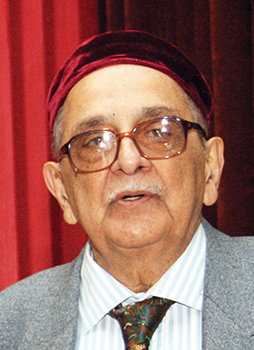
A senior advocate to the Supreme Court of India, Fali Nariman is the president of the Bar Association of India since 1991. He was additional solicitor general of India from 1972 to 1975 and served as nominated member of the Rajya Sabha from 1999 to 2005.
He was conferred the Gruber Prize for Justice and India’s second highest civilian award, the Padma Vibhushan and was selected by NDTV to be among the 25 living Indian legends.
He was conferred the Gruber Prize for Justice and India’s second highest civilian award, the Padma Vibhushan and was selected by NDTV to be among the 25 living Indian legends.
◆ ◆ ◆
From the archive