
Law
“The right freely to profess...”
The Constitution of India ensures children of Parsi/Irani mothers married to non-Parsis the right of entry into fire temples
Parsiana has approached me for a legal opinion on the current problem facing Parsi Zoroastrian women married to non-Parsis under the Special Marriage Act 1972 (under which neither spouse is required to renounce his or her own religion): the problem is that the children of such mixed marriages, even when they have had their navjote ceremony performed by ordained priests, are not admitted into our agiaries and atash behrams.
Let me explain the legal position as I understand it: uninfluenced by the well-known views of highly-placed "conservative” members of our community or by the equally well-known opinions of highly-placed "liberals.” Whatever one’s own predilections, in matters like this, the only safe rule to follow is that: "howsoever high you be, the law is above you.”
The law — as to conversion and as to the admission of Parsi Zoroastrians into fire temples — is governed by two landmark decisions:
of the Bombay High Court (1908) in Petit vs Jeejeebhoy (popularly known as the Soonoo Tata case), and
of the Privy Council (1925) — in an appeal from Burma — in Saklat vs Bella (Bella’s case).
The question before the courts in both these cases was not just whether the Zoroastrian religion permitted conversion of non-Parsis. The courts expressly recorded findings that it did — along with a further finding that although such conversion was permissible, Zoroastrians, since their advent into India 1,200 years ago, have never attempted to convert anyone into their religion. The important question raised before the Bombay High Court and before the Privy Council was whether settlors of trusts of fire temples (agiaries and atash behrams) in Bombay, and the agiary (in Rangoon), had ever contemplated and intended that "converts” should also be admitted to these places of worship; likewise, whether grantors of the lands where the Towers of Silence were located in Bombay, and where the Parsi burial ground was situated in Rangoon, had ever envisaged, at the dates of such grants, the admission into their sacred precincts of non-Parsis.
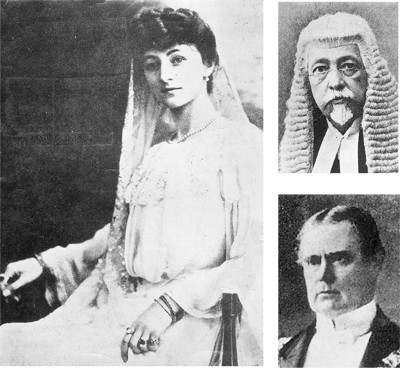
Alongside: Suzanne (Soonoo) Tata. Far right: Justices Dinshaw Davar (top) and Frank Beaman (below)
The Bombay High Court as well as the Privy Council held that the Parsi community in India (which then included Burma) had grown up to be such a distinct body (almost a "caste”), and admissions from outside had been so very rare, that at the time when the trusts were created and grants of lands were made it must have been intended (to quote the words of Lord Phillimore in the Privy Council) "for the benefit of professing members of the Parsi community, i.e. racial Parsis or people deemed after a long lapse of ages to be racial Parsis.”
The Bombay case concerned an avowed Christian convert to Zoroastrianism. In 1903 R. D. Tata married (in Paris) a Christian lady both of whose parents were Christians. On returning to Bombay she was given a Parsi name "Soonoo,” and then admitted into the Zoroastrian religion by the performance of a navjote ceremony by ordained priests. R. D. Tata claimed (and this is what was adjudicated upon) that by the conversion of the Christian lady to Zoroastrianism, and by virtue of the performance of the navjote ceremony, his wife had become a "Parsi professing the Zoroastrian faith,” and as such was entitled to participate in the benefits of the charitable and religious institutions of the Parsis. A special Bench of two judges of the Bombay High Court rejected the claim — after a very lengthy hearing, in the course of which a large number of witnesses and documents were examined. In his judgment, Justice Dinshaw D. Davar said that the word "Parsi” had a racial not a religious significance; "Zoroastrian denotes religion, Parsi denotes community, there is no Parsi religion in existence.” His companion Judge, Justice Frank C. O. Beaman, agreed — saying that the word "Parsi” had a "caste” meaning, not a religious meaning. Soonu Tata may have become a Zoroastrian, but she did not qualify as a "Parsi.”
Bella’s Case had a different factual background. It was not a case about conversion into Zoroastrianism of a person, neither of whose parents were Parsis. Bella was the daughter of a Parsi mother and a Goan father. Bella was initiated into the Zoroastrian religion by a navjote ceremony performed by ordained priests in Rangoon. And she claimed that she was therefore entitled to attend and partake of the ceremonials at the fire temple there. This gave offence to a number of members of the Parsi community in Rangoon, and a suit was brought by three of such members (as a representative suit) against Bella and her Parsi guardians stating that the agiary was held on trust for free and unrestricted use only of the Parsi inhabitants in Rangoon professing the Zoroastrian faith.
The fact that Bella had been validly initiated into the Zoroastrian religion was expressly denied by the plaintiffs. The issue was thus squarely raised, and was decided — in favor of Bella. The single judge in the trial Court at Rangoon (Justice Young) held that Bella (the daughter of a Goan father and a Parsi mother) could be and was in fact initiated into the Zoroastrian religion (by the performance of the navjote ceremony); and this specific finding was upheld by the court of appeal (the then Chief Court of Burma). On further appeal, the Privy Council, after perusing the entire record (which included a mass of evidence of over 600 pages taken on commission in Bombay), upheld the finding of the judges in the courts below, and added that no further rituals or ceremonials, such as burushnum, were necessary to effectuate Bella’s initiation into the religion. The Privy Council said that it was settled law that as regards the ‘racial’ claim to be regarded as a "Parsi,” maternity was of no importance and therefore the fact that Bella’s mother was a Parsi was unimportant "except as leading up to her conversion or initiation” (into the Zoroastrian religion). The Privy Council affirmed that Bella (daughter of a Parsi mother and a non-Parsi father) had become a Zoroastrian by the performance of the navjote ceremony. But the Privy Council then declared that Bella could not claim as of right, to enter into the Parsi agiary in Rangoon: this was only because the founders of the fire temple had intended that worship in the agiary should be "confined to persons who possess the double qualification of Zoroastrians and racial Parsis.” In another significant passage Lord Phillimore (delivering the opinion of the Privy Council) said that "the trustees of the temple could, if they wish, treat Bella as a trespasser,” but added that "it does not follow that they are bound so to treat her.” This was because, as a matter of law, trustees of religious trusts were not bound to exclude persons who had no legal title to share in the benefits of that trust.
What flows from all this is the following: As authoritatively stated by the Privy Council, the child of a Parsi mother and a non-Parsi father is entitled as of right to be recognized in law as a Zoroastrian if (and only if) such child has been initiated into the religion by a navjote ceremony performed by an ordained priest and he/she has the right to be so initiated if he/she wishes to profess and practice the Zoroastrian religion.
As to whether such child would then be admitted to an agiary or atash behram would depend on the terms of the trust deeds by which such places of worship had been established. If such trust deeds provide (as they invariably do) for admission into the fire temples of Parsis professing the Zoroastrian religion, then the child (of a Parsi mother and non-Parsi father) would not be entitled to admission as a matter of right: but the trustees could lawfully permit such child if already initiated into the religion by the navjote ceremony, to enter the place of worship. In doing so, the trustees would not be committing a breach of trust because trustees of religious trusts (as held in Bella’s case) are not bound to exclude persons who may have no legal title to or in the trust premises. At this point, therefore, the suggested remedy lies not in litigation but in persuasion.
If however the trustees are not persuaded and refuse to admit such a child (of a Parsi mother and non-Parsi father) then a suit for a declaration (and injunction) would lie in a competent civil court:
for declaring the right of such a child to be recognized as a Zoroastrian by religion according to the law laid down in Bella’s case; and
for a further declaration of the right of such a child to claim admission into the agiaries and atash behrams on the basis of a constitutional right now conferred by Article 25(1) of the Constitution of India 1950;
and for consequential relief viz a permanent injunction restraining the defendant trustees from denying such a child entry into the fire temple for purposes of worship;
Article 25(1) (of our Constitution) provides that "all persons” (not merely citizens but all persons) have "the right freely to profess, practice and propagate (their) religion.” "Race” or "caste” has no place in Article 25: the constitutional right (a right higher than a customary or a statutory right) is to freely profess and practice one’s religion: viz like one’s other co-religionists. Therefore once the child of a mixed marriage (of a Parsi mother and non-Parsi father) is initiated into the religion through the performance of the navjote ceremony by an ordained priest, he/she is entitled as a matter of law (post-1950) to practice the religion by worshipping in the fire temple (even if he or she be not a Parsi by race or caste);
Some rights (fundamental rights) conferred in Part III of the Constitution are enforceable only against the State (like Articles 14, 19 and 21) but rights conferred by other Articles in the Fundamental Rights Chapter are enforceable even against private persons indulging in a constitutionally prohibited practice. This has been so held by the Supreme Court of India in a decision reported in AIR 1982 S.C. 1473 para 12 (followed in AIR 1983 S.C. 328: paragraph 3): a case under Article 23 of the Constitution (Prohibition of traffic in human beings and forced labor): an Article also in the Fundamental Rights Chapter. The question on which there is as yet no authoritative decision of the Supreme Court is whether Article 25(1) falls within the category of rights that are available also against individuals or trustees. In my opinion this is the better view;
The constitutional right under Article 25(1) is a stand-alone right, and the provisions of Article 25(2) ("Nothing in this Article shall… prevent the State from making any law regulating any economic, financial, political or other secular activity which may be associated with religious practice or providing for social reforms etc…”) does not indicate that this right is addressed only to the State: on the contrary the opening words in clause (2) of Article 25 ("Nothing in this Article….”) presuppose that the provisions of Article 25(1) are meant to be observed by all, including individuals and trusts. The word "freely” in the phrase "the right freely to profess, practice and propagate religion” in Article 25 lends support to this interpretation because "freely” means "without let or hindrance.” It therefore includes the right to enter and worship at a fire temple without let or hindrance: the only condition necessary for the recognition and enforcement of such right being that the person so entering is a Zoroastrian by religion — even if he or she is not a "Parsi” by race or caste.
This then (as I see it) is the current state of the law, and the remedy to enforce it. One final word: the fact that a remedy available in law has not been asserted for over 50 years is not a good or lawful reason for denying its existence.

Noted jurist Fali S. Nariman, former additional solicitor general of India, is a senior advocate of the Supreme Court. The government conferred on him the Padma Vibhushan in 2007 shortly after he completed a six-year term as member of the Rajya Sabha.
◆ ◆ ◆
One reader wrote
I am a research scholar and am interested to know what the current status of the community is on this issue.Please could you let me know of the latest developments. Many thanks!!!
From the archive