
10WZC
Core commitment
Why have so many of us regressed from an enlightened religious vision to a primitive form of tribalism?
Human beings are provided with the faculty of the good mind which is capable of comprehending Asha (the quintessential right). When we are in any particular situation, we have the ability to recognize the extent to which Asha has been actualized or violated. And the innate inclination to promote Asha directs us to actualize the right. The good mind is known in the Gathas as Vohu-Mana, and the form of right doing is known as Spenta Armaity. This is the way of life.
Human beings, having free will, may act in accordance with Asha or in violation of it, by seeking not the objective right, but rather some personal advantage, in which case we have done wrong. An unconfused person would feel the guilt of wrongdoing in his or her conscience unless it is smothered by commitment to oneself rather than Asha. This is evil. Thus, one is required to realize what is the right thing to do. Having formulated it one declares it to those around, since we do live in a social world. And then with confidence and care we perform the action. This is very often summarized in the prayers as: good thoughts, good words, and good deeds.
Human beings, having free will, may act in accordance with Asha or in violation of it, by seeking not the objective right, but rather some personal advantage, in which case we have done wrong. An unconfused person would feel the guilt of wrongdoing in his or her conscience unless it is smothered by commitment to oneself rather than Asha. This is evil. Thus, one is required to realize what is the right thing to do. Having formulated it one declares it to those around, since we do live in a social world. And then with confidence and care we perform the action. This is very often summarized in the prayers as: good thoughts, good words, and good deeds.
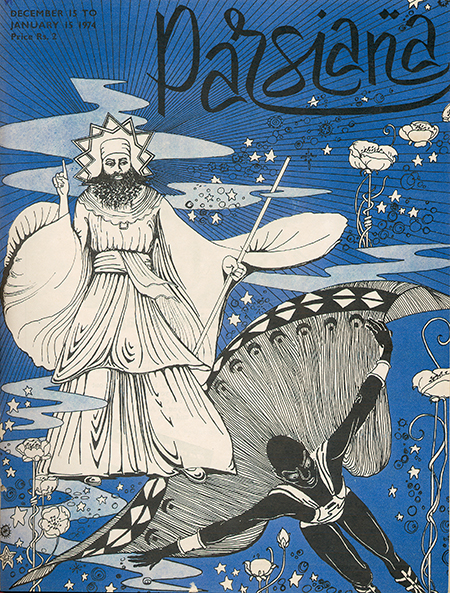
Illustration by Manjula Padmanabhan
This is the religious message we find in the verses of the Gathas. It is probably the earliest enlightenment religious vision in the history of humanity. It is free of miraculous happenings. And it is not in any way imposed. Zarathushtra asks "people from near and from far” to listen to his message with a "clear mind.” And calls upon each one to decide whether to accept it or not. Zoroastrians in the initiation ceremony recite the prayer in which they declare their acceptance. This is the Mazdayasni faith, since Asha, Vohu-Mana and Spenta Armaity are creations of Ahura Mazda, the wise Lord.
It is exactly what a reflective religion, i.e. an enlightenment faith, should have: a commitment to religion which has a rationally acceptable view of the world and a way of life. If I may put in a Kantian mode of expression I would say that: a religion without a vision of the world is blind, and a religion without a way of life is empty.
This is what anyone who considers himself or herself a Zoroastrian holds, unless he or she is ignorant. However, religious traditions have other dimensions, particularly ritual and congregation. The critical issue in theology is in clearly determining where the core of the religious commitment lies. And there is no doubt that if one takes the word of Zarathushtra seriously the core commitment is the vision and life disclosed in the Gathas.
The congregation is ordinarily the gathering of those who share the belief in the faith. But in very ancient times (pre-Zarathushtra) religion was tribal and the congregation was identified with the tribe. When an act of faith was considered the personal act of each human being, as Zarathushtra explicitly declared, a major transformation in religiosity came about, and reflective religion was born.
To me this recognition is an inspiring thought, and I cannot see why any Zoroastrian would disagree with it. Why is it, as has happened, that so many of us have regressed from this enlightened vision, a great moment in the process of civilization, to a primitive form of tribalism?
I was born in the Parsi community and have lived as a Parsi throughout my life. This is an ethnic, not a religious designation. It identifies the communal language, behavior, food, dress, etc, but not my religious faith, even though statistically most Parsis are Zoroastrians. I became a Zoroastrian on the day of my initiation, when I explicitly declared my acceptance. It was my will, not the ethnic accident of my birth, although my parents taught me the essence of the faith.
This distinction calls for no great intellectual effort. Parsis are an ethnic group and Zoroastrians are a religious group. And anyone, who, on understanding the teachings of Zarathushtra and declaring acceptance of them, is a Zoroastrian. Such a person may engage in the rituals of the religion, but if not born in the Parsi community cannot claim to be a Parsi. But for persons who have accepted the faith, no one in the world can deny them the designation of a Mazdayasni Zoroastrian.

Kaikhosrov Irani is emeritus professor of philosophy at City College, New York whose scholarly contributions there have been recognized with the establishment of the K. D. Irani Chair in Philosophy. A visiting professor at the University of Michigan and the University of Sydney, he was twice appointed Government Fellowship Lecturer at the K. R. Cama Oriental Institute. He was adjudged "Outstanding World Zarathushti” at the Seventh World Zoroastrian Congress in 2000.
◆ ◆ ◆
From the archive