
Books
Balding balconies
"Balconies were for chit-chat. If you rang the bell and walked in, it was serious business,” revealed Naresh Fernandes editor of Time Out Mumbai as he launched Beyond Bombay Balconies by Ayesha Taleyarkhan at the Taj Mahal Palace on September 28, 2013. Addressing an audience of architects, historians and friends of Taleyarkhan, Fernandes reminisced about the Bandra neighborhood of his childhood: "Going across unannounced meant something was amiss… Balconies keep the crowd out and keep the inmates in. They also help to let in the people in the street through the trellis and keep out irritants and adversaries.”
Sitting on the dais with Taleyarkhan was theater personality and advertising professional Alyque Padamsee. "A picture speaks a thousand words, an artist’s mind portrays a hundred emotions,” he said of the few slides projected from the glossy coffee table book. "Ayesha captured balconies at the right time” as they are fast disappearing, commented the veteran ad-man recalling standing at his balcony on Colaba Causeway. He narrated how the photographer has shot widely in SoBo (SOuth BOmbay) — a term he coined on his return from New York’s SoHo (SOuth of HOuston Street in Lower Manhattan).
Sitting on the dais with Taleyarkhan was theater personality and advertising professional Alyque Padamsee. "A picture speaks a thousand words, an artist’s mind portrays a hundred emotions,” he said of the few slides projected from the glossy coffee table book. "Ayesha captured balconies at the right time” as they are fast disappearing, commented the veteran ad-man recalling standing at his balcony on Colaba Causeway. He narrated how the photographer has shot widely in SoBo (SOuth BOmbay) — a term he coined on his return from New York’s SoHo (SOuth of HOuston Street in Lower Manhattan).

Ayesha Taleyarkhan
"Thank you for celebrating this happy occasion with me,” Taleyarkhan commenced her brief talk. "I am happy for the two books, the first of which was in 2002 (Bombay: Balconies and Verandahs). Printing, equipment, cities, all change, so do textures and details,” she elaborated. She asserted how balconies reflect centuries of history and the people who live there and how she has captured this again. The lens-lady particularly referred to the balconies of the very building the launch was being held in — the Taj Mahal Palace.
The photographer then thanked Rohinton Mehta, technical editor of Smart Photography and friend Ajit Manjrekar who helped with the processing and color correction of the images, JAK Printers who printed the book and specifically Khushru Patel, partner in the press, for the "excellent printing and binding.” She also lauded "the awesome architects here,” several of whom commented on the slides chosen. The photograph-capturer concluded, "Books are marketed all the time but here there are no book readings and this is not just a launch so (we) want to involve the audience.”
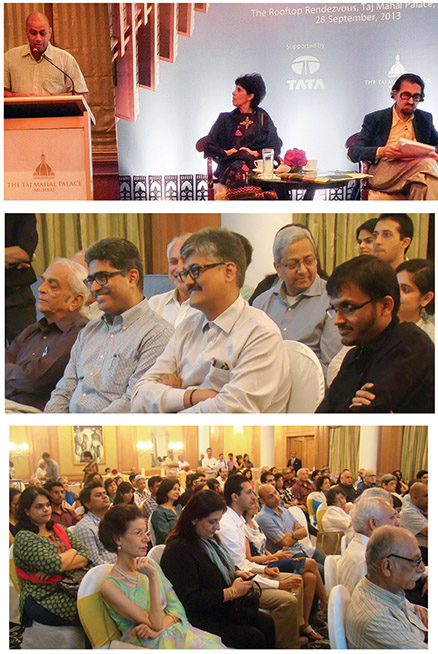
Naresh Fernandes launches book as Taleyarkhan and Alyque Padamsee look on;
section of the audience;
Anand Pandit, Vikas Dilawari, Rajiv Mishra and Suprio Bhattacharji in first row
In the subsequent interaction, Dr Rajiv Mishra, principal Sir J. J. School of Art and Architecture elaborated on how balconies are a celebration of space and that it’s important to admire the intricate designs that accompany the architecture of buildings. He also mentioned that balconies enhance the spaces in a building and often help facilitate contact and conversation with the people walking on the streets. Balconies filter air, heat, cold, sunlight, rain and dampness. Mishra also pointed out that balconies in skyscrapers eliminated the personal touch as facial features were impossible to see. "In fact balconies remind you there are people, which you don’t know after a few floors,” he jested.
Padamsee introduced Vikas Dilawari, the conservation architect who won this year’s 9th Asia Pacific UNESCO awards, stating he was responsible for "connecting the past with the future” and spoke on how he had restored several heritage structures, including the Bombay Municipal Corporation (BMC). Padamsee regretted Dilawari was unable to restructure BMC itself! The architect, in turn, reminded the gathering of the Gothic revival and importance of balconies for art deco in Bombay. Calcutta went for the neo classical while Bombay opted for Gothic as "we had good stone and craftsmen. Most Gothic corridors were built (facing) the west as the breeze came from there… If no restoration is done, then the past melts away,” reminded Dilawari.
The professionals labored the fact that balconies were designed to cater to our climatic conditions as they afforded cross ventilation, defined a building, were a lifestyle expression as also had perforations from which one filtered the world. Balconies, corridors and verandahs were a space for engagement — inside-out and vice versa.
Anand Pandit with 50 years’ experience in the field cautioned, "We have a huge chance to follow our own language and we are madly following western thought. We are getting killed by our new generation. We are losing the space where cricket was played, chit-chat happened, drip-dry chawls existed…” as more and more students become enchanted with western architectural concepts. He reiterated that there is a tactile quality to these spaces — whether balustrade or trellis — where one engages with the milkman and children on the streets, how institutional values are inculcated through engagement.
Marine Drive has the second longest stretch of art deco buildings after Florida, Ratan Batliboi, architect and urban designer pointed out. His firm got the contract for the first phase for redesigning Marine Drive. Whilst working on this renovation project he shared that the government officials suggested standardizing the art deco buildings by painting them saffron, white and green as part of the beautification plan.
Taleyarkhan shared her compulsion towards balconies, these versatile spaces which can be used as-you-like-it. She is also drawn to the mini garden attempts by some inhabitants à la the Tokyo experiment. A mayor of the Japanese megalopolis mourned the concrete jungle. He encouraged window boxes, turning the city green in two years. Will Bombay’s balconies go beyond?
Vanishing views
Beyond Bombay Balconies by Ayesha Taleyarkhan. Self-published in 2013. Pp: 170 Price: Rs 2,995. Website: www.ayeshataleyarkhan.com
Ayesha Taleyarkhan re-visited the lanes and by-lanes of the ever-growing city of Bombay, to produce the second volume Beyond Bombay Balconies 11 years after Bombay: Balconies and Verandahs (see "A Balcony View” Parsiana, September 2002 ). "So much had changed in the in-between years, so much had stayed the same,” the lens-lady writes in the introduction termed Mainstay about Bombay’s new, unrecognizable avatar. From over 5,000 photographs shot, she has reframed the second edition of the book with stringent selection, resulting in several photos getting replaced. This is a larger book, with most photos luxuriously apportioned a page each. The coffee table book archives the changes from 2002 to 2012, the "westernization,” the greed of builders, the space crunch the metropolis faces, the celebrations, the colors.

Each of the five sections of the hard-bound glossy book has the text written by architects and journalists. The Foreword, "Monitor,” penned by conservation architect Abha Narain Lamba, highlights how the balcony is the "interface between the public and private realm… where the nucleus of family activity within the urban oasis interfaced with the world beyond. From reading the morning newspaper, to chatting with neighbors across the street and haggling with street vendors to an afternoon snooze, the balcony witnessed its diurnal (daytime) cycle of activities,” the heritage conservationist details.
Monitoring the muse of the megalopolis
"The verandah, besides serving an architectural and climatic function, is also a crucial social space because it defines and creates a buffer zone,” comments architect Rahul Mehrotra, in "Muse.” Mehrotra has been one of the founder members of the Kala Ghoda area rejuvenation movement and the restoration of the Oval Maidan. "In the traditional or vernacular style, balconies were closer to being verandahs as they were all encompassed under the roof,” the restorer states.
"The verandah, besides serving an architectural and climatic function, is also a crucial social space because it defines and creates a buffer zone,” comments architect Rahul Mehrotra, in "Muse.” Mehrotra has been one of the founder members of the Kala Ghoda area rejuvenation movement and the restoration of the Oval Maidan. "In the traditional or vernacular style, balconies were closer to being verandahs as they were all encompassed under the roof,” the restorer states.
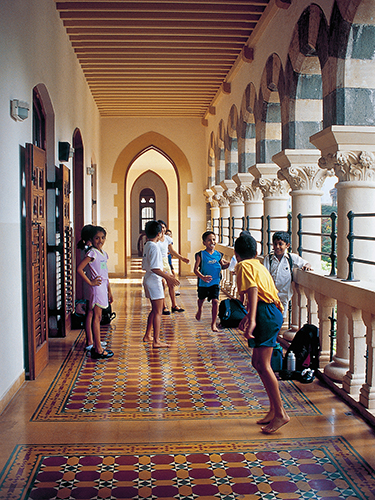
A renovated verandah in a school
"Housing areas such as the Parsi baugs and buildings around Apollo Bunder are examples of urban apartment blocks quite specific to Bombay... In fact you entered the apartment through the verandah,” he specifies. This acted as a social buffer apart from being a pleasant and neutral space. He also talked of the utilitarian concept of having a paying guest in this area. The architect differentiated between neo-classical [Ballard Estate, (Royal) Institute of Science and the old Cawasji Jehangir Hall]; neo-Gothic (Bombay University, Elphinstone College and the Secretariat); Traditional or Vernacular (Kotachi Wadi, Mathar Pakdi and the villages of Bandra); and Art Deco of the 1930s, 40s and 50s (buildings of Oval Maidan and Marine Drive).
"We have changed not just the landscape but the color of the sea and sky… color runs riot, design goes berserk, laundry flies like a banner and railings animate. It’s a numbing of the senses and a dumbing of aesthetics… It is here that the high-rise skyline of Bombay abounds. It is here that the serious issues like decay, apathy, negligence and space crunch” are realized, senior journalist Madhulika Verma details in "Metaphor.” It is here that we mourn the absence of balconies as they become hazardous wind traps when we head for the skies. The sub-sections "Wear and Tear” and "Drip and Dry” depict this candidly with photographs of laundry-balconies where it all hangs out.
The balcony romance
Whether Juliet or Rapunzel, "films, plays, stories, poems have all needed this precious space (balconies) to transform the mundane to the evocative and the romantic,” points out Meenakshi Agrawal. The freelance writer also talks of the energy of the city — cheering festive processions of Govinda, Ganesh Chaturthi or sports events as seen from balconies. Each section of this book begins with photographs of building material as does Agrawal’s "Meley.”Wrought iron railings were preferred as balcony embellishments as they allowed the breeze to come in at lower levels. Architect Brinda Somaya elucidates how balconies got enclosed for the ever expanding need for space in box-like apartments. The affluent need more privacy and the balcony becomes the TV room or a child’s bedroom. The essential idea in "Metamorphosis,” though is that "balconies were so ornamental that they acted as an embellishment for the buildings itself.” Further, "The balcony serves as a viewing gallery. Nothing endorses this better than the chawl culture. It is the active space where people dry (and grind) their spices, oil their hair, gossip and see the world pass by.”
Whether Juliet or Rapunzel, "films, plays, stories, poems have all needed this precious space (balconies) to transform the mundane to the evocative and the romantic,” points out Meenakshi Agrawal. The freelance writer also talks of the energy of the city — cheering festive processions of Govinda, Ganesh Chaturthi or sports events as seen from balconies. Each section of this book begins with photographs of building material as does Agrawal’s "Meley.”Wrought iron railings were preferred as balcony embellishments as they allowed the breeze to come in at lower levels. Architect Brinda Somaya elucidates how balconies got enclosed for the ever expanding need for space in box-like apartments. The affluent need more privacy and the balcony becomes the TV room or a child’s bedroom. The essential idea in "Metamorphosis,” though is that "balconies were so ornamental that they acted as an embellishment for the buildings itself.” Further, "The balcony serves as a viewing gallery. Nothing endorses this better than the chawl culture. It is the active space where people dry (and grind) their spices, oil their hair, gossip and see the world pass by.”
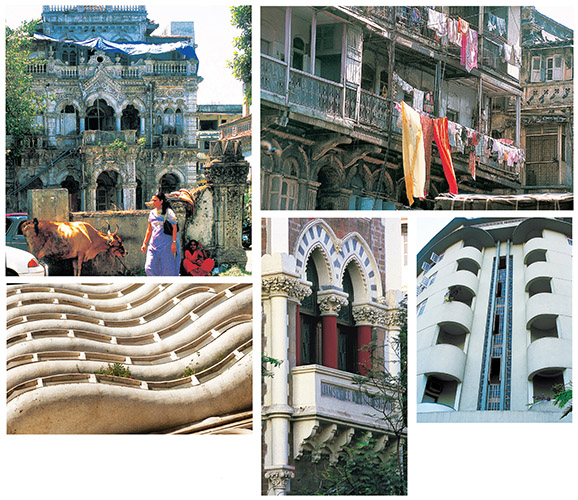
Balconies in various styles offering several uses
"Nothing can excite a writer more than writing about a city that has given her wings,” Bombay-born Mini Chandran-Kurian states. In "Megalopolis” she adds, "And here, from the balconies, Bombay does beckon, her magnetism magnified, her glitter untarnished, her power undiminished, her spirit undefeated. That’s what this grande dame is all about. Her landmarks, her elements, her people her essence.” How 20 million people crowd 170 square miles, the disparity in space occupation, the slum and palatial homes co-existing, the followers of one religion living harmoniously with those of another. All this is amplified through Taleyarkhan’s eye traversing lanes, compounds, chawls, hutments and bungalows. The "Megalopolis” highlights views of temples, maidans, skyscrapers, the ubiquitous sea in the city and bazaars as seen from balconies across the colorful southern tip of the city.
"While some balconies float in the clouds, the vernacular and the neo-Gothic styles of balconies entice you with their shapes and classical lines and their old-world charm,” writes Taleyarkhan. The artist photographer seems to concentrate on south Bombay, Mahim and Bandra. The further northern suburbs reach out to the skies with little space open to balconies.
◆ ◆ ◆
From the archive