
50TH ANNIVERSARY
A sense of discomfort
Unless we tackle problems head on the future scenario for the community is grim
On the happy occasion of Parsiana reaching its 50th milestone, it gives me no pleasure to write about issues and problems confronting our community. However, it is essential that these problems be brought into the public domain time and again, which if not reversed will overwhelm us over the next few decades, definitely before the end of the 21st century.
Parsis of the present generation face a convergence of crises unmatched since the times our ancestors set foot on Indian soil. Our family system is in crisis as also our economic health system, our population augmentation system, our leadership system and above all, our human values system.
Is this evidence of terminal decay within the community? Are we at the end of history?
Parsis of the present generation face a convergence of crises unmatched since the times our ancestors set foot on Indian soil. Our family system is in crisis as also our economic health system, our population augmentation system, our leadership system and above all, our human values system.
Is this evidence of terminal decay within the community? Are we at the end of history?
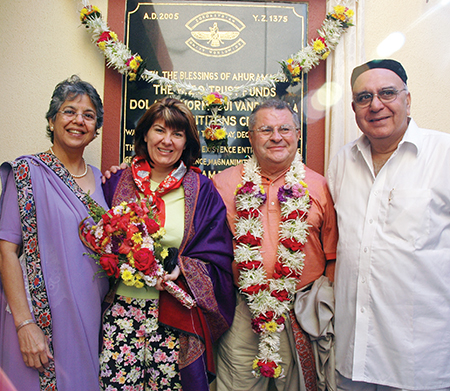
L to R: Bachi Tamboly, Rena and Behram Baxter who funded a
WZO Senior Citizens’ Center and Dinshaw Tamboly
Consider the following facts:
Demography
The Parsi Irani Zoroastrian community as we know it today is sliding into oblivion, undergoing demographic devastation of the worst possible kind.
The Census of India was completed in 2011 but the communitywise figures have yet to be released. However from the census figures of 2001 we do know that the Parsi community that boasts of the highest literacy rate in India is staring at extinction. In a population of 1.2 billion in India, there are only about 69,601 Parsis. While the 2001 census recorded a 21% decadal growth of the country’s population, the number of Parsis have been consistently declining by about 12% each decade.
The Census authorities have been at pains to highlight the dismal agewise distribution of the Parsi community. In the age group of 0 to 6 years, on an all India basis the population percentage is 15.9, whilst amongst Parsis it was only 4.7%.
As far as India is concerned, less than 5% of the population is over 60 years, but in our Parsi community we have 31% who are over 60 years of age, probably the highest ratio anywhere in the world.
It is a universally known fact that for any community to sustain itself in terms of numbers, it must have a fertility rate of at least 2.1 children per family. It is also a known fact that in any community where the fertility rate has been 1.9 children per family the decline has, so far, never been reversed. With the fertility rate of the Parsi community perceived to be in the region of 0.8 children per family can there be any doubt that the community is headed towards extinction?
Those charged with community responsibility believe they can arrest the decline in community numbers by offering financial compensation of a few thousand rupees every month and in return expect youth to marry early and within the community. To my mind, in this day and age, where the community profiles reflect relatively equal ratios of late marriages (thereby fertility decline), no marriages and interfaith marriages, to try and arrest our plummeting population is simply clichéd wishful thinking, an exercise in futility.
Planet Earth has a population upwards of seven billion, a world in which if we determine Parsi Irani Zoroastrians to be approx 100,000, it means that for every one Parsi Irani Zoroastrian there are 70,000 individuals of other faiths. With the lopsided ratio of 1:70,000 can anyone realistically expect our youth to marry only within our community? (In terms of percentage Parsi Irani Zoroastrians account for 0.0014% of the world population.)
This growing segment of our community — those who marry outside the community and their offspring — have been failed by the existing community management networks who having a conservative outlook continue to practise selective exclusion and address only the concerns of those who strictly follow the outdated ritualistic prescriptions regarding marriage and family. The ostracization has not had any effect or made any difference as people continue to adapt and adjust to realities of the times they live in.
The gloom and doom scenario does not end with our dismal numbers.
The Parsi Irani Zoroastrian community as we know it today is sliding into oblivion, undergoing demographic devastation of the worst possible kind.
The Census of India was completed in 2011 but the communitywise figures have yet to be released. However from the census figures of 2001 we do know that the Parsi community that boasts of the highest literacy rate in India is staring at extinction. In a population of 1.2 billion in India, there are only about 69,601 Parsis. While the 2001 census recorded a 21% decadal growth of the country’s population, the number of Parsis have been consistently declining by about 12% each decade.
The Census authorities have been at pains to highlight the dismal agewise distribution of the Parsi community. In the age group of 0 to 6 years, on an all India basis the population percentage is 15.9, whilst amongst Parsis it was only 4.7%.
As far as India is concerned, less than 5% of the population is over 60 years, but in our Parsi community we have 31% who are over 60 years of age, probably the highest ratio anywhere in the world.
It is a universally known fact that for any community to sustain itself in terms of numbers, it must have a fertility rate of at least 2.1 children per family. It is also a known fact that in any community where the fertility rate has been 1.9 children per family the decline has, so far, never been reversed. With the fertility rate of the Parsi community perceived to be in the region of 0.8 children per family can there be any doubt that the community is headed towards extinction?
Those charged with community responsibility believe they can arrest the decline in community numbers by offering financial compensation of a few thousand rupees every month and in return expect youth to marry early and within the community. To my mind, in this day and age, where the community profiles reflect relatively equal ratios of late marriages (thereby fertility decline), no marriages and interfaith marriages, to try and arrest our plummeting population is simply clichéd wishful thinking, an exercise in futility.
Planet Earth has a population upwards of seven billion, a world in which if we determine Parsi Irani Zoroastrians to be approx 100,000, it means that for every one Parsi Irani Zoroastrian there are 70,000 individuals of other faiths. With the lopsided ratio of 1:70,000 can anyone realistically expect our youth to marry only within our community? (In terms of percentage Parsi Irani Zoroastrians account for 0.0014% of the world population.)
This growing segment of our community — those who marry outside the community and their offspring — have been failed by the existing community management networks who having a conservative outlook continue to practise selective exclusion and address only the concerns of those who strictly follow the outdated ritualistic prescriptions regarding marriage and family. The ostracization has not had any effect or made any difference as people continue to adapt and adjust to realities of the times they live in.
The gloom and doom scenario does not end with our dismal numbers.
Economic status
A report conducted in 2009 by the Tata Institute of Social Sciences on Socio-Economic and Educational Status of the Parsi Community in India has laid bare certain facts about our community such as: despite the perceived general economic affluence of the community, there are reasons to believe that Parsis are a heterogeneous community in terms of their socio-economic status.
There is a small fraction of the community which exists even below the poverty line (BPL) as per the official definition of poverty.
The economic situation of families availing of aid from trusts and charity funds has not improved over three generations but has either remained constant or has been aggravated.
The skewed age composition of the Parsis has resulted in an escalating dependency ratio, i.e. high proportion of Parsis who are not economically active.
It is quite clear that our ageing population is a factor that has contributed not only towards our falling numbers but also towards an increase in the number of families facing economic hardships.
A report conducted in 2009 by the Tata Institute of Social Sciences on Socio-Economic and Educational Status of the Parsi Community in India has laid bare certain facts about our community such as: despite the perceived general economic affluence of the community, there are reasons to believe that Parsis are a heterogeneous community in terms of their socio-economic status.
There is a small fraction of the community which exists even below the poverty line (BPL) as per the official definition of poverty.
The economic situation of families availing of aid from trusts and charity funds has not improved over three generations but has either remained constant or has been aggravated.
The skewed age composition of the Parsis has resulted in an escalating dependency ratio, i.e. high proportion of Parsis who are not economically active.
It is quite clear that our ageing population is a factor that has contributed not only towards our falling numbers but also towards an increase in the number of families facing economic hardships.
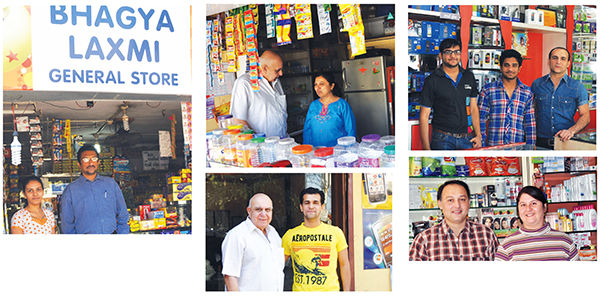
Pictures of beneficiaries for whom support is extended towards self-employment by WZO Trust Funds
Our trusts and charity funds
Apart from the increase in economic hardships created on account of our ageing population, a matter of great concern is that in spite of there being a plethora of trusts/charity funds within our community, the levels of poverty continue to rise.
Our trusts/charity funds have provided yeoman service to those who are really needy, but have at the same time unwittingly contributed to making the community reliant upon charity to the extent that many, including able-bodied, now demand charity as a matter of right.
As early as in 1931, the Sir Ratan Tata Charities had invited S. F. Markham, a distinguished graduate of Wadham College, Oxford, associated with many renowned institutions such as the Carnegie Corporation and others, to undertake a study and to report on "The Problems Affecting the Parsee Community.”
In his report, one of the points mentioned by Markham bears repeating: "How many years of so-called ‘philanthropy’ has it taken to produce this class of ‘professional beggars?’ Those ‘charitable’ persons who by their lack of common sense have helped to sap the spirit of self-reliance in the community cannot be regarded in any sense of the word as benefactors.”
It has been 82 years since Markham gave his report, but barring a few, most of our trusts/charity funds continue to dish out funds as doles rather than using them to encourage and develop a spirit of entrepreneurship and self reliance amongst our people.
The problem in this instance is that an over abundance of charity has sapped the spirit of self reliance. By dishing out largesse even to the able-bodied undoubtedly, our trusts/charity funds, have done great harm to the rank and file of our community, weakened it to the extent of extinguishing the fire in their bellies, and thereby made them incapable of surviving in a competitive environment. By giving to those what they could be gaining from their own initiatives, our trusts/charity funds have been practising the kind of method that destroys the initiative of people and makes them dependant.
For all our efforts to eliminate poverty, what we have succeeded in doing has only been in creating a permanent secondary class of Parsis, where our poor continue to become poorer.
Apart from the increase in economic hardships created on account of our ageing population, a matter of great concern is that in spite of there being a plethora of trusts/charity funds within our community, the levels of poverty continue to rise.
Our trusts/charity funds have provided yeoman service to those who are really needy, but have at the same time unwittingly contributed to making the community reliant upon charity to the extent that many, including able-bodied, now demand charity as a matter of right.
As early as in 1931, the Sir Ratan Tata Charities had invited S. F. Markham, a distinguished graduate of Wadham College, Oxford, associated with many renowned institutions such as the Carnegie Corporation and others, to undertake a study and to report on "The Problems Affecting the Parsee Community.”
In his report, one of the points mentioned by Markham bears repeating: "How many years of so-called ‘philanthropy’ has it taken to produce this class of ‘professional beggars?’ Those ‘charitable’ persons who by their lack of common sense have helped to sap the spirit of self-reliance in the community cannot be regarded in any sense of the word as benefactors.”
It has been 82 years since Markham gave his report, but barring a few, most of our trusts/charity funds continue to dish out funds as doles rather than using them to encourage and develop a spirit of entrepreneurship and self reliance amongst our people.
The problem in this instance is that an over abundance of charity has sapped the spirit of self reliance. By dishing out largesse even to the able-bodied undoubtedly, our trusts/charity funds, have done great harm to the rank and file of our community, weakened it to the extent of extinguishing the fire in their bellies, and thereby made them incapable of surviving in a competitive environment. By giving to those what they could be gaining from their own initiatives, our trusts/charity funds have been practising the kind of method that destroys the initiative of people and makes them dependant.
For all our efforts to eliminate poverty, what we have succeeded in doing has only been in creating a permanent secondary class of Parsis, where our poor continue to become poorer.
Youth
Our youth are the only silver lining in a dismal scenario; they are our pride and joy. But what have the elders done or are doing to cultivate, motivate and encourage our youth to hold their own in a world that moves on and progresses with every passing moment? Living in an environment which is very competitive, what we are unfortunately doing is making our youth complacent.
Many of our youth witness their parents and their friends’ parents focussing all their energies on seeking financial support from various trusts/charity funds for the smallest of requirements. What impact does this have on the psyche of young impressionable minds?
Youth of the current genre having witnessed the frequent eruptions of controversies within the community on the most insignificant of issues, have mentally alienated themselves from taking interest in community affairs. They rightly believe that elders are concerned only with fomenting and participating in controversies.
Community elders by their lackadaisical attitude and dependence on charity funds have fashioned a generation of white collared youth satisfied with nine to five employment. How many real time entrepreneurs do we have amongst our youth, and if there, where are they? How many of our youth have shown interest in appearing for Common Entrance Tests that would enable them to join elite services such as Indian Administrative Services, Indian Police Services, Indian Foreign Services etc?
The failure is not of the youth but of the elders who have done precious little to mold them to take on the challenges they have to contend with.
If our youth are to blossom in life, parents, elders and community leaders must encourage, nurture, counsel, motivate and support them to develop a sound future for themselves, to change their mindsets into becoming competitive enough to match their contemporaries in different professions and services in which they have interest.
Our youth are the only silver lining in a dismal scenario; they are our pride and joy. But what have the elders done or are doing to cultivate, motivate and encourage our youth to hold their own in a world that moves on and progresses with every passing moment? Living in an environment which is very competitive, what we are unfortunately doing is making our youth complacent.
Many of our youth witness their parents and their friends’ parents focussing all their energies on seeking financial support from various trusts/charity funds for the smallest of requirements. What impact does this have on the psyche of young impressionable minds?
Youth of the current genre having witnessed the frequent eruptions of controversies within the community on the most insignificant of issues, have mentally alienated themselves from taking interest in community affairs. They rightly believe that elders are concerned only with fomenting and participating in controversies.
Community elders by their lackadaisical attitude and dependence on charity funds have fashioned a generation of white collared youth satisfied with nine to five employment. How many real time entrepreneurs do we have amongst our youth, and if there, where are they? How many of our youth have shown interest in appearing for Common Entrance Tests that would enable them to join elite services such as Indian Administrative Services, Indian Police Services, Indian Foreign Services etc?
The failure is not of the youth but of the elders who have done precious little to mold them to take on the challenges they have to contend with.
If our youth are to blossom in life, parents, elders and community leaders must encourage, nurture, counsel, motivate and support them to develop a sound future for themselves, to change their mindsets into becoming competitive enough to match their contemporaries in different professions and services in which they have interest.
Community leadership
Community leadership is probably at its nadir. Those occupying positions of responsibility though aware of the crisis situation, propel their actions based on political partisanship, and/or practise divisive religious centric leanings that have proved to be a deterrent for collective application of minds to courageously and wisely create solutions to the vexed issues that confront the community.
Community leadership is probably at its nadir. Those occupying positions of responsibility though aware of the crisis situation, propel their actions based on political partisanship, and/or practise divisive religious centric leanings that have proved to be a deterrent for collective application of minds to courageously and wisely create solutions to the vexed issues that confront the community.
Religion and clergy
The clergy that should play the role of being a unifying force have unfortunately become the cause of creating a divide within the community. Our clergy has been unable to speak in one voice. Confidence and respect of the laity for the priestly class has been substantially eroded on account of their obscurantist views and announcement of decrees best suited to medieval times.
For far too long have the clergy and self anointed religious scholars conditioned the community into believing/accepting the irrational, ridiculous and fallacious beliefs that extol the presumptive superiority and purity of the Parsis being a select race to which no harm can befall.
It is time for the clergy to realize and accept realities of the 21st century and become temperate once again if they do not wish to further fragment the community.
The clergy that should play the role of being a unifying force have unfortunately become the cause of creating a divide within the community. Our clergy has been unable to speak in one voice. Confidence and respect of the laity for the priestly class has been substantially eroded on account of their obscurantist views and announcement of decrees best suited to medieval times.
For far too long have the clergy and self anointed religious scholars conditioned the community into believing/accepting the irrational, ridiculous and fallacious beliefs that extol the presumptive superiority and purity of the Parsis being a select race to which no harm can befall.
It is time for the clergy to realize and accept realities of the 21st century and become temperate once again if they do not wish to further fragment the community.
Conclusions
The future or rather the lack of it is not difficult to foresee. For a person such as I who feels with his heart and thinks with his head, I must confess that I feel most uncomfortable about the future. To survive, the community will have to come to terms with and address the various issues that engulf us. It will be a great tragedy for humanity in general if the Parsi community simply fades away into oblivion.
Some in the Parsi community believe and preach the gospel that the Almighty will send a savior at the appropriate time and with divine intervention and sanction we will multiply and live in a world that will be complete and perfect. Much as we would all be delighted to welcome a divine redeemer can we afford to simply sit back and await the arrival of the exalted being?
Going by the present trend, the only scenario that will unfold before the end of the current century is that Parsis as a race would have perished whereas Zoroastrianism as a religion will continue to be practised by a few, and Parsiana will in all probability celebrate its centenary under its new name Zoroastrianana!
The future or rather the lack of it is not difficult to foresee. For a person such as I who feels with his heart and thinks with his head, I must confess that I feel most uncomfortable about the future. To survive, the community will have to come to terms with and address the various issues that engulf us. It will be a great tragedy for humanity in general if the Parsi community simply fades away into oblivion.
Some in the Parsi community believe and preach the gospel that the Almighty will send a savior at the appropriate time and with divine intervention and sanction we will multiply and live in a world that will be complete and perfect. Much as we would all be delighted to welcome a divine redeemer can we afford to simply sit back and await the arrival of the exalted being?
Going by the present trend, the only scenario that will unfold before the end of the current century is that Parsis as a race would have perished whereas Zoroastrianism as a religion will continue to be practised by a few, and Parsiana will in all probability celebrate its centenary under its new name Zoroastrianana!
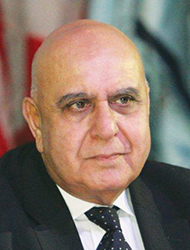 Actively associated in community activities since 1983, Dinshaw Tamboly is one of the founding trustees of the three World Zoroastrian Organisation Trusts in India and spearheads their welfare activities. He is a trustee of many other medical and religious trusts and had served as trustee of the Bombay Parsi Punchayet. He retired in March 2012 as corporate counsellor to various leading Indian corporations when he advised them in developing and promoting exports to the sophisticated markets on the continents of North America and Europe.
◆ ◆ ◆
From the archive