
50TH ANNIVERSARY
Disruption by dispersal
Whilst merging with the new host culture, migrants could lose their ancient values
Zarathushtra was the first messenger and teacher who showed the path of monotheism for the redemption of the world thousands of years ago. When people had become accustomed to false beliefs and thoughts and did inappropriate things to please their imaginary gods, Zarathushtra invited them to benefit from wisdom, to freely choose the right path for themselves and provide joy and comfort for themselves and others by truth and endeavor.
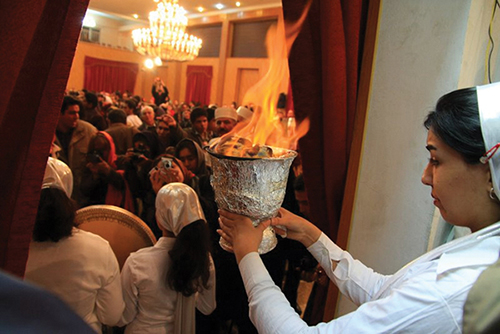
Iranians celebrate Sadeh in the home
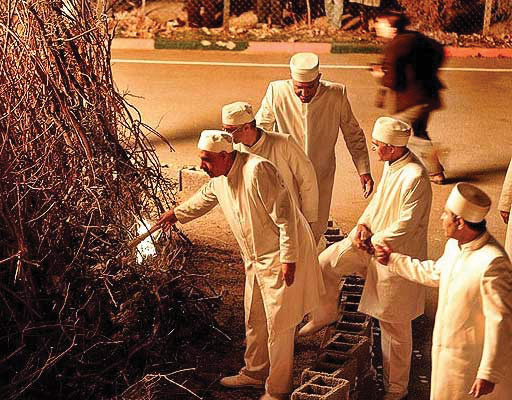
Iranians celebrate Sadeh by lighting a bonfire
Zarathushtra believed human progress depended on an individual’s ability and knowledge, and not the power to fight which was characteristic of warring factions. Therefore he recommended acquisition of knowledge and wisdom as the best way to lead a joyous and peaceful life. He advised people to avoid superstitious beliefs and distance themselves from priests and fortune-tellers who sought to appease their false gods with animal sacrifice or permitted intoxicating alcoholic drinks on merry occasions.
With Zarathushtra’s insight, the people of Iran were released from "Deev Yasna” or the worship of imaginary gods and came to be known as "Mazdayasna” which means those who have chosen the God of Wisdom and the Right Path. For millennia, they brought dignity to Iran and superseded the other nations with their productive knowledge, valuable culture and civilization, until in the Sasanian era they were defeated by the Arabs. This unpleasant event, which caused the devastation of cities as well as oppression and cruelty to a lot of people, marred the image of Iranian culture and civilization. After 200 years of Arab rule in Iran, the followers of Zarathushtra branched into three separate groups, each pursuing a different lifestyle.
The first group constituted those who in order to keep their Iranian nationality and remain in the country were forced to accept the religion of the Arabs and stay away from the Mazdayasni faith. Forming the majority of the Iranian people today, they are deemed first class citizens in this country and have benefited from all the blessings and privileges.
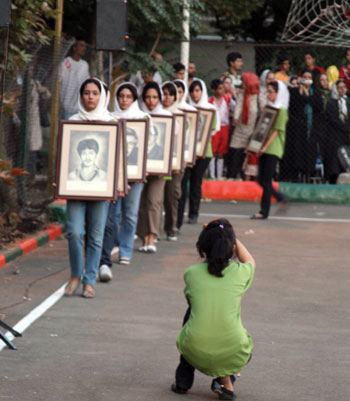
At the Jam-e-Jaanbakhtegan annual sports event in memory of Zoroastrian martyrs
The second group forsook their Iranian nationality and chose to follow the Mazdayasni religion in another land. They migrated from Iran with great difficulty, taking the sacred fire as their ritual symbol and settling in India. In the beginning they experienced hardship and poverty, but with a lot of patience, effort and perseverance, and after a thousand years of living among different races and religions in India, they have turned into prominent, educated and leading figures in various fields of science, economics and industrial development. Over this period of time they have retained their faith in the Mazdayasni religion although due to the influence of various sects and religions in India some of the other people’s beliefs have merged with their own.
In spite of forgetting the Parsi dialect, they refer to themselves as Zoroastrian and Parsi. The Iranian national and cultural characteristics are somewhat forgotten. Now the Parsis of India do not hold ceremonies and traditional rites like NowRuz, Sadeh, Mehregan, the gahanbars and nor do they celebrate the national epics like the Zoroastrians of Iran in plentiful glory. They have stopped using the Iranian chronometry and discontinued with the clothing, food and dialect of their ancestors.
The third group protected and maintained both their Iranian nationality and their Mazdayasni religious identity. They continued to live in their birthplace. Due to the extreme prejudice of some governments, a large number was killed and those who survived were forced to seek refuge in the cities beside the central desert of Iran. Despite the shortage of water in the desert cities they managed to do farming and animal husbandry. As members of a minority religious group they had a difficult life with very few privileges of a citizen, yet they labored to preserve the good reputation of the Mazdayasni society. In some eras, as per the government’s edict, they had to wear a special outfit to distinguish them from others. The height of their houses had to be less than that of the majority and in order to live in their home town, they had to pay a religious tax (tribute). Many Zoroastrian families had to abandon their ancestral religion as subsisting on meager earnings from farming and animal husbandry jobs they were unable to pay this tax. With the help of Manekji Hataria who helped in abolishing this tribute in Iran and from the gifts of the Parsi families in India, the condition of the Iranian Mazdayasnis improved.
Since then Zoroastrians in Iran have experienced a more peaceful life and have access to better jobs as well. For establishing a school, hospital and charity centers in the city where they resided, they became known as a benevolent society. Now they live in desert cities as well as other cities of Iran and every year in order to hold their ceremonies and traditional rites they return to their hometown and the traditional holy places located in Yazd province. Another privilege they now enjoy is high level of education, with 98% of the Iranian Mazdayasnis being educated and most of them also having university education.
Concerns about migration
There are some behavior patterns that have proven to be deterrent factors in the growth of the Zoroastrian society. The four features typical to the Mazdayasni society are marriage at an older age, unwillingness to have children in the prime of life, restricting the number of children in each family and refusal to proselytize and accept other people in the Mazdayasni religion. All these features have contributed to a fall in our numbers. Due to the same reason, the world statistics of the followers of the Zoroastrian religion have not been registered with the United Nations because so far the population of its followers has not reached the minimum requisite level.
The migration and dispersion of the Mazdayasni population is also one of the unpredictable events which have caused some cultural and social difficulties. Everybody has the right to settle in another country for a better life, higher education and career prospects and many Parsis from India have now migrated to America, Canada, Europe and even Arabic countries. What will become of the many institutions like cultural centers, fire temples, hospitals and guest houses built in India by their ancestors?
Zoroastrian youth residing in Iran have also migrated to America in recent years. With their daily and weekly workload, they don’t have enough time to maintain their ancient culture. Although in a few states some cultural centers have been established by benefactors and they sometimes hold ceremonies and Iranian traditional rites, it is mainly the first generation that observes the traditions. It is disturbing that the next generation of Zoroastrians born in Europe, America and other countries who will naturally grow up with children from other nations may show no signs of following their ancient valuable culture, which will soon be forgotten.
There are some behavior patterns that have proven to be deterrent factors in the growth of the Zoroastrian society. The four features typical to the Mazdayasni society are marriage at an older age, unwillingness to have children in the prime of life, restricting the number of children in each family and refusal to proselytize and accept other people in the Mazdayasni religion. All these features have contributed to a fall in our numbers. Due to the same reason, the world statistics of the followers of the Zoroastrian religion have not been registered with the United Nations because so far the population of its followers has not reached the minimum requisite level.
The migration and dispersion of the Mazdayasni population is also one of the unpredictable events which have caused some cultural and social difficulties. Everybody has the right to settle in another country for a better life, higher education and career prospects and many Parsis from India have now migrated to America, Canada, Europe and even Arabic countries. What will become of the many institutions like cultural centers, fire temples, hospitals and guest houses built in India by their ancestors?
Zoroastrian youth residing in Iran have also migrated to America in recent years. With their daily and weekly workload, they don’t have enough time to maintain their ancient culture. Although in a few states some cultural centers have been established by benefactors and they sometimes hold ceremonies and Iranian traditional rites, it is mainly the first generation that observes the traditions. It is disturbing that the next generation of Zoroastrians born in Europe, America and other countries who will naturally grow up with children from other nations may show no signs of following their ancient valuable culture, which will soon be forgotten.
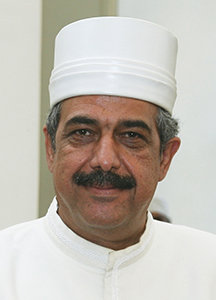 Mobed Koorosh Niknam has served one term as the elected Member of Iranian Majlis, representing the Zoroastrian community. He has studied Ancient Iranian Culture and worked towards propagating its rich values. He also manages the religious activities of the Paris based European Center for Zaratoshtis.
◆ ◆ ◆
One reader wrote
IS Mobed Niknam the same individual who was elected to represent his district in the city of Yazd, thereby representing Muslims, as well as all other residents?
From the archive