
Religion
A spiritual net
The consecrated fires helped bind the community and make Parsis prosper
Our Zoroastrian religion is a religion of nature. As such, we revere and worship the natural elements rather than man-made icons of worship.
Accordingly, fire is one of the natural elements, and it has been given the prime importance in our religion since times immemorial. Fire has been recognized as the representative of the Creator, Dadar Ahura Mazda, in this material world, and in our scriptures it has been described as ‘the son of Ahura Mazda.’ Fire has been considered a living object. Even in the depth of darkness, a living spark of fire has the ability to draw our attention. Fire is also considered as the life-force of the universe. When a person dies, it is said that the fire has gone out of the body. Therefore, since ancient times, fire has been ordained in our religion as the main form of worship, resulting in the practice of consecration and installation of the same in places of worship which we know by the name of fire temples.
The element of fire (Avesta ataxs), as a luminous creation in direct and close contact with human beings, in one form or the other, plays an important part in the religious life of man, and in almost all the religions of the world. In the Zoroastrian religion, fire is specifically venerated as the shining emblem of Ahura Mazda. The Zoroastrian religion has accepted the natural element of fire on this earth as a visible medium through whom Ahura Mazda and nature is worshipped. In Yasna 36.1, it is expressly mentioned: ‘Through the activities of this fire, first do we approach Thee, O Mazda Ahura! Thee, O Most Holy Spirit.’ Moreover,
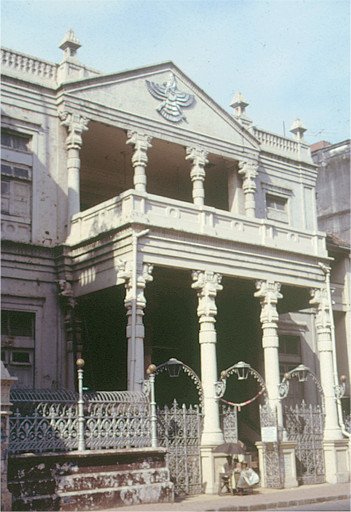
Anjuman Atash Bahram: "a unique place of worship”
as the son, and therefore the representative of Ahura Mazda, the presence of fire in all Zoroastrian ceremonies is inevitable. This veneration of fire has then culminated in the practice of making a qibla of it in a sanctum sanctorum, and a building for housing the same known as atash kadehs or fire temples. In Iranian history, we notice that even in pre-Zoroastrian times, the sacred fires were consecrated and installed in properly constituted and sanctified places, which were used as places of worship in ancient Iran. The three oldest and historic holy fires of Iran, as mentioned in the Atash Nyaish, are Atash Farnbagh (installed by Shah Jamshed), Adar Gushnasp (installed by Shah Kaikhusro) and Adar Burzin Meher (installed by Shah Gustasp).
Moreover, throughout Iranian history of the Zoroastrian empires, we find that the illustrious kings and heroes of ancient Iran had established holy fires for religious purposes, and also for commemorating historical events of national importance. The ancient holy fires, therefore, were regarded as religious as well as national institutions. During the Sassanian times, several such holy fires were consecrated and installed, and in present times, the ruins of such ancient fire temples of the Achaemenian and Sassanian times have been discovered on various ancient sites in Iran. There are references by later Arabic writers that every Sassanian king had to perform a pilgrimage to the holy fire of Adar Gushnasp on his accession to the throne.
After the downfall of the Parsi Zoroastrian empire in Iran, a group of Parsis migrated to India, and after settling down, the first thing they did was to consecrate and install the holy Iranshah fire at Sanjan. Subsequently, as the Parsis spread out and settled in whatever parts of India, they strove to consecrate a fire temple in those areas. As such, a fair amount of fire temples are to be found in the whole of India (including some parts of present day Pakistan). It is to be noted that these fire temples are not just the physical institutions for worship, but also serve as spiritual power-houses for the community. Our system of consecrating a new fire temple is such that alats (religious implements) of the existing fire temples are to be taken in use. For the consecration of the holy Iranshah fire, our forefather-priests had gone to Iran and brought the alats from the existing fire temple there. Thus, in a way, all our existing fire temples are considered to be spiritually connected to the oldest holy fires of ancient Iran. Our present generation should understand that our early forefathers in India, by consecrating the holy Iranshah fire and other sacred fires, have cast a spiritual net around the community, which in turn has helped to bind it together and survive for so long in an unknown land, and later on to prosper and excel in all its glory. For a community like ours with a migratory background, such holy institutions like our fire temples serve as the rallying factor around which the community revolves. For that reason, we strive to preserve diligently, the khorreh of these fire temples and also of our community through the observance of tariqats.
It could be observed therefore that the existence of fire temples is crucial for the survival of our religion and community. As long as our members understand this, and have faith in it, the community would survive the vicissitudes of time, as it has been able to do so till now. As is said in the Gathas, the fire of Ahura Mazda gives strength and courage to the devotees, and helps form a strong chain of union against those who connive to destroy the faith.
Zarthoshti Anjumanna Atash Bahram, the youngest of eight such atash bahrams in India, is headed by the author. It was consecrated in the year 1897 AC by the writer’s great-grandfather, Dr Jamasp Minocher Jamasp Asa and the seat of dasturi is hereditary in the family. The imposing structure built at that time to house the fire remains the same, albeit requiring considerable repairs from time to time, as it is now 109 years old.
Managing an atash bahram is a totally different proposition from managing an agiary or any other place of worship. The functioning of an atash bahram is not to be equated with that of an agiary. Attending to this grade of fire requires a high level of proficiency. The boe ceremonies (particularly in the Shahenshahi atash bahrams) are fairly elaborate, and different from those performed in an agiary. As such, the priests required for the same ought to be not only of the highest priestly qualifications, but also possessing strong physical and mental faculties, because of the tough nature of work required. Not only that, but such boewallas are required to perform higher liturgical ceremonies like yazashne, vendidad, nirangdin, etc. As such, each atash bahram ideally requires a set of five to six qualified priests. An atash bahram may generally be headed by a dastur, who has an insight and the ability to understand and guide through this intricate nature of work. The dastur is then assisted in the work of management of the said atash bahram by a committee of eminent Parsis as trustees.
The income of the fire temple is generated through regular donations as also from the interest earned on investments of corpus donations that the atash bahram has received.
Despite the fact that the donations do come in at regular intervals, there is more or less a shortfall of income as compared to expenditure — more so when major repairs to the edifice are undertaken (for example during the time of centenary) when an appeal for donations was circulated.
The major items of expenditure are salary to staff and boewallas as also for bawal kathi (firewood) and electricity. The bawal kathi which is an essential ingredient to keep the fire aglow is obtained from H. Sidhwa and Sons, a Parsi entrepreneur.
At present Zarthoshti Anjumanna Atash Bahram has a corpus fund of approximately one crore rupees.
All the four atash bahrams in Bombay are incidentally situated within a radius of about one mile in the Dhobitalao – Fanaswadi – Thakurdwar areas of south Bombay. There was obviously a sizable Parsi population in the vicinity of these areas at the time when these atash bahrams were consecrated (between 1783 AC and 1897 AC). In the course of time, because of various factors and also with the trend of the general population of Bombay, the Parsi population has at present heavily shifted to places like Dadar in central Bombay and further away in the suburbs and distant suburbs (like Vasai, Thana, etc). As such, the regular number of daily devotees visiting the atash bahram has naturally decreased to a certain extent. We have however to understand that since atash bahrams are considered to be unique places of worship among our community members, because of the highest grades of fires installed therein, the devotees always make it a point to visit them at least once a week and on all important occasions and festivals and are therefore considered to be well-patronized.
The primary concern of the dastur (high priest), trustees and the committee members is to ensure a sufficient number of qualified boewallas who carry out their duties of tending the holy fire, and also performance of higher liturgical ceremonies.
During muktad 110 tables on an average are put up and approximately 550-600 behdas (vases) of different families are established.
The performance of other routine ceremonies ordered by the laity like those of baj rozgar, jashan, etc are of secondary nature in the working of an atash bahram. As such, there is no single panthaky system like that in an agiary where a panthaky is generally in charge of that particular agiary having all the responsibilities of getting boe ceremonies and other rites performed. Since an atash bahram is a central religious institution, people are desirous of having the ceremonies of their families performed therein. Accordingly, there is a practice in all atash bahrams that any mobed, with the permission of the dastur, could carry out the performance of different ceremonies on behalf of his clientele. Thus a system of multiple panthakies working in the atash bahram has developed over the years, each having varied number of clientele with him. Accordingly, the number of practicing mobeds would also be as per the requirement of such panthakies. Some mobeds may be working on a regular basis, some may attend only when required, and some more would come only during the muktad days, and so on.
So is the case with chasniwallas. Hence, the number of mobeds and chasniwallas depend upon the quantum of work generated through a number of panthakies. But one thing is definite that each and every one of these panthakies, mobeds and chasniwallas must work under the overall supervision of the concerned dastur.
Grades of fire
According to our religion, we have three grades of consecrated fires. The first grade is known as the atash bahram, in which 16 different types of fires are consecrated and unified through elaborate ceremonies and enthroned in a sanctum sanctorum. The boe ceremonies and attending to this grade of fire require utmost diligence and perseverance and observance of high purificatory measures called tariqats. The priests attending to the atash bahram fire should be of the highly qualified yaozdathregar category.
The second grade of fire is known as the atash adaran. And the fire temple in which it is enthroned in a sanctum sanctorum is popularly known as the agiary. Four different types of fires are consecrated and unified to form this grade of fire. Performing boe ceremonies in all five gahs of the day in an adaran is absolutely essential.
The third grade of fire is known as the dadgah. This grade of fire may or may not be installed in a sanctum sanctorum. Performance of boe ceremonies in all the five gah is not compulsory. Moreover, all types of household fires and any other type of fire besides the first two grades, are categorized as the dadgah fire.
At present we have eight atash bahrams, all in India. Out of these, four are in Bombay, two in Surat, one in Navsari and one in Udvada (which is known as the Iranshah). When our ancestors landed at Sanjan in Gujarat around 1,300 years ago, they then consecrated the highest grade of fire in Sanjan, and in the absence of any physical king at that time, they called this fire ‘Iranshah’ (King of Iran) in the spiritual sense. This Iranshah fire then had to be shifted to different places in times of difficulty through our period of history in India and has ultimately settled in Udvada since 1742 AC.
Out of these eight atash bahrams, a total of three atash bahrams (two in Bombay and one in Surat) belong to the Qadmi sect of our community, and the rest belong to the Shahenshahi sect.
◆ ◆ ◆
From the archive