
Events & Personalities
Cursetji’s centenary
On May 23, 2013 over 70 family members converged on Poona from Bombay, Baroda, Ankleshwar, Ahmedabad, Gurgaon, Balasore and Madras to celebrate the 100th birthday of Nargis Cursetji according to the Parsi calendar, mah Dae, roz Adar. Surrounded by her children, grandchildren, great-grandchildren, nieces, nephews and friends, the centenarian had a jashan in the house that morning, followed by the varas ugarvanu (birthday) ceremony with a meal of malido, dhan dar and patio with sev-dahi for dessert, reveals an account written by her granddaughter Benaifer Bodhanwala of Balasore, Orissa and sent by email to Parsiana by her son Rustom.
That evening the celebrant arrived at the Komra-ni Agiary dressed in cream and gold, cut a chocolate cake (her favorite flavor) and watched a power point presentation on her life. Music, dancing and laughter accompanied the sharing of memories of good times and sad, of struggles and sacrifice, of the experiences that molded them, by her children Dinaz, Rustom, Rohinton and Bakhtavar. The youngest, Vera, who was in America for the birth of her first grandchild, addressed the gathering via a long distance call, evoking nostalgia. The dinner that followed — murghi no pullav dar, kid gosht, sali murhi, cake and ice-cream was catered by Darius Dorabjee.
That evening the celebrant arrived at the Komra-ni Agiary dressed in cream and gold, cut a chocolate cake (her favorite flavor) and watched a power point presentation on her life. Music, dancing and laughter accompanied the sharing of memories of good times and sad, of struggles and sacrifice, of the experiences that molded them, by her children Dinaz, Rustom, Rohinton and Bakhtavar. The youngest, Vera, who was in America for the birth of her first grandchild, addressed the gathering via a long distance call, evoking nostalgia. The dinner that followed — murghi no pullav dar, kid gosht, sali murhi, cake and ice-cream was catered by Darius Dorabjee.
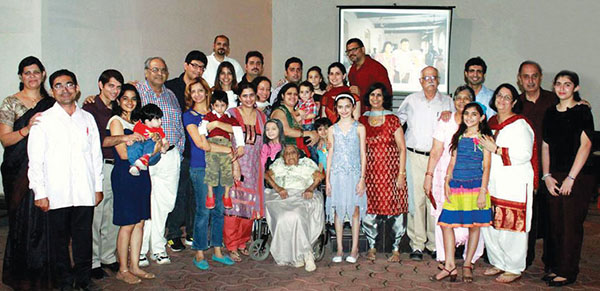
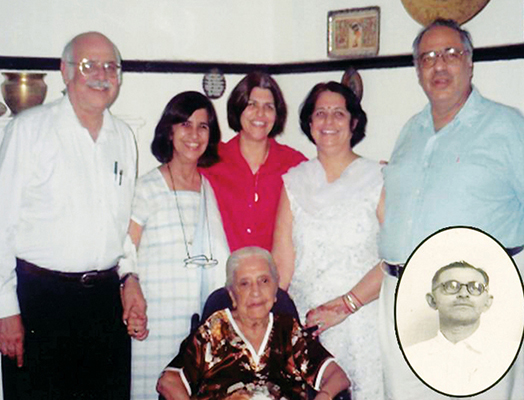
Nargis Cursetji on her 100th birthday with entire family (top) and children; (inset) late husband Minocher
Born in Ahmedabad into the well-known Cavina family on June 17, 1913, Nargis graduated with a BA from the Bombay University with maths, economics and Persian language as her subjects in an age when education for girls was a rarity. She married Minocher Cursetji in July 1942 and moved to Guntur, Andhra Pradesh where the Cursetjis were among a handful of resident Parsi families. A decade later the family relocated to Sindri in Bihar where the parents brought up their brood of five, instilling in them the precepts and practices of a Zoroastrian way of life. It helped that their father, Minocher, was a navar and maratab. Nargis would be up at daybreak to boil milk for their tea. She stitched clothes, told stories, taught mathematics, brought gifts on her visits and cooked well, giving her family treats like ghee-gor ni rotli as evening snacks.
A teacher by profession, Nargis considered no sacrifice too great when it came to the education of her family. Little wonder that her children grew up to be achievers in their own fields of activity. She diligently wrote notes even for her grandchildren and is still fondly remembered by her former students. She rose to be headmistress of the school in Sindri, which had 700 students, before retiring in 1973. She expressed scorn at the notion of achieving 100 percent results, and was always there to hold their hands and hearten the weaker students. Good at sports, she won prizes in tennis, badminton, table tennis, carom and bridge. In later years she remained glued to the television watching grand slam tournaments, backing her favorite players Martina Navratilova, Jimmy Connors, Stefan Edberg, Gabriella Sabatini, Steffi Graf and Pete Sampras. She could play the harmonium and the dilruba and led the school assembly with the national anthem.
Passionately involved in the political scenario, she was saddened at the formation of the state of Andhra Pradesh with the reorganization of states in 1956 (it was carved out of Bombay state, the Telugu speaking areas of Andhra state and parts of the erstwhile Nizam’s kingdom of Hyderabad, with the Kannada speaking areas going to Karnataka) as it triggered off a chain of linguistic based states and shifted the focus from nationalism to regionalism. "She clung to the radio and sobbed at the funeral of Pandit Jawaharlal Nehru,” the country’s first prime minister, the write-up mentions.
At present, recovering from a hip fracture, the centenarian looks forward to achieving yet another milestone, the write-up concludes.
◆ ◆ ◆
From the archive